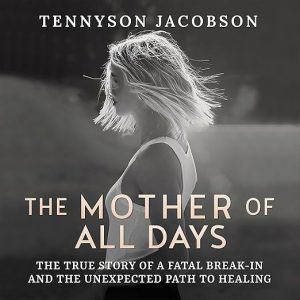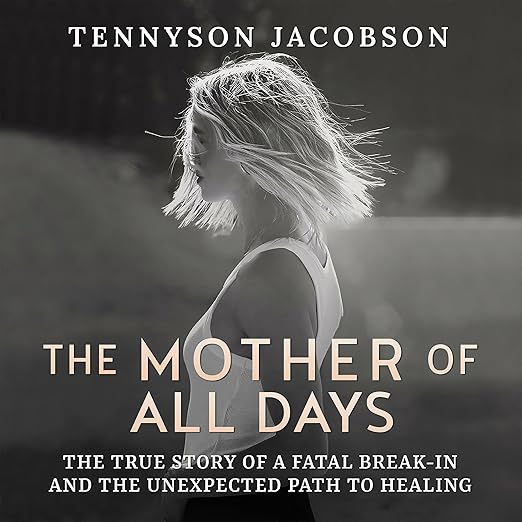
Memoirs about violence usually spend their length on the violence. The intrusion, the fight, the police, the headlines, and then a closing chapter of hard-won perspective to send everybody home. Tennyson Jacobson has written the inverse of that book, and this audiobook is worth your attention specifically because of the inversion. A violent home intruder forces her and Kyle Jacobson into a fight for their lives in the dead of night, the story reaches the news, and then the news moves on, which is roughly where the memoir actually begins. Close to nine hours follow the part nobody photographs: the emotional and psychological damage, the PTSD, and the years of work required to be a person again.
A Single Sustained Voice Across Hours of Recollection
Jacobson's structure puts the reader in an unusual position. The attack is not a mystery being withheld, and she does not build toward it as a set piece; it is the fact everything else has to be measured against. What follows is closer to an inventory than a plot. She examines her beliefs, rebuilds a self-esteem she had not realized was fragile, and finds wounds that predate the break-in and were merely uncovered by it. That last move is the book's real argument, and it is the one that gives it a life beyond its own news story. Sarah Lenihan's August 2025 response describes the effect as less like reading and more like sitting with a close friend telling her story, and singles out the emotional presence of the author rather than the drama of the events. That is an accurate reading of what the book prioritizes.
Tennyson Jacobson reads her own book, which changes the transaction. An author-read memoir about a home invasion means the voice describing the intruder belongs to the person who was in the room, with no professional layer standing between the account and the listener. That is the source of its intimacy and also the reason it can be difficult to hear: a hired reader can modulate a passage about panic, while the person who lived it is negotiating with her own material in real time. The job here is endurance rather than range, since the book runs on a single sustained voice across hours of recollection with no cast and no shifts of register. Sample a passage from the recovery sections rather than the opening, where the delivery has to carry reflection instead of incident.
An Ending That Never Feels Purchased
Recovery narratives usually fail in one of two directions. They either stay in the trauma, becoming an ordeal to get through, or they leap to the lesson and turn a life into a slogan. Stacey Pezold's June 2025 response, another five-star verdict, puts its finger on why this one avoids both: Jacobson does not simply recount the break-in, but invites the reader into the silent aftermath and the emotional reckoning that follows, going past the surface of what happened. The book is candid about the slowness of that work and about the number of times it does not go well, which is what keeps the hopeful ending from feeling purchased.
The headline phrase quoted in the description, the one the coverage used to sell the story, tells you exactly what this book is pushing against. Being turned into a nightmare for public consumption is its own injury, and Jacobson keeps returning to the distance between what was reported and what was actually happening in the house afterward. Kyle Jacobson stays in the frame throughout, which is rarer than it should be: this is a story about two people managing one event, and the marriage does real work in it rather than serving as background support.
A Copy Stained With Tears and Dog-Eared
No advisory appears anywhere on this record, and one is warranted. The subject is a violent nocturnal home invasion, and the material includes the assault itself, its psychological consequences and an extended treatment of PTSD. Nothing on the listing warns a buyer of that, which matters more in audio than in print, because a listener cannot skim ahead to see what is coming and cannot easily judge how graphic a passage will get before it arrives. Anyone with their own history of home invasion, assault or panic disorder should approach the opening chapters deliberately rather than casually.
The reception was assembled by readers of the printed edition, not by listeners. Five written responses sit on this record, filed between June and December 2025, and the audio arrived in February 2026, so every one of them was written before this file existed. The evidence is right there in their language: S. Fawcett's December 2025 account describes turning the pages and finds the words more intense in print, and a separate June 2025 response reports a copy stained with tears and dog-eared for a return visit, plus four more ordered as gifts. Those are real, unusually engaged readers, and the 5.0 average across 108 ratings is a genuine signal about the book. Just be clear that it is a signal about the writing rather than the recording. Worth flagging too that the listing files this partly under sports and outdoors, tagged for adventurers and explorers, which is nobody's idea of where a memoir about a home invasion belongs.
The Ordinary Indignities of Healing, No Jargon
The listener this was built for is someone doing the same work, or living beside someone who is. Readers of trauma recovery memoir, anyone in therapy for PTSD, partners trying to understand what happens to a person months after the emergency ends. It will also reach people who came for the incident and stay for the aftermath, provided they accept early that the incident is not the destination. The candor about self-esteem, belief and the ordinary indignities of healing is the specific value on offer, and it is delivered without therapeutic jargon.
Note that this is not a true-crime listen. Nobody investigates anything, the intruder is not a character to be solved, and the case does not structure the narrative. Listeners who want procedural detail, courtroom material or a chase will be waiting through hours of interior work for something that never arrives. It is also, by design, a book that asks for patience with slow progress and repeated setbacks. Grief and recovery move at their own speed here, and anyone who wants the crime will be waiting a very long time.
Common Questions
Does the audiobook describe the attack itself in detail?
The break-in opens the book and is recounted directly, but it occupies a small share of the running time. The description is explicit that the true subject is the quiet aftermath rather than the event, so expect the assault early and the consequences for the rest.
Is the audiobook safe for a listener with a similar history?
Approach it deliberately. Nothing on the listing carries a content advisory, and the material covers a violent nocturnal intrusion plus sustained treatment of PTSD. If that overlaps with your own experience, consider sampling the recovery chapters first rather than starting at the beginning.