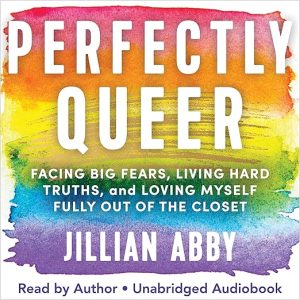
Perfectly Queer works, and the reason it works is simpler than memoir writing advice usually admits: Jillian Abby is unsparing about her own confusion. This audiobook, which chronicles her journey to recognizing and accepting herself as a lesbian at nearly forty, is not a story of instant clarity. It's a story of someone who genuinely loved her husband and her life while simultaneously being unable to name something fundamental about herself. The complexity of that reality, holding both truths at once, is what makes Perfectly Queer worth seven hours of anyone's attention rather than a more straightforward coming-out narrative.
Jill's life before her self-recognition reads as genuinely complete rather than as an obvious error waiting to be corrected in retrospect. Twenty years with her college sweetheart. Two children. A bar that ranked among the best local businesses in Tampa Bay. A suburban home with a white picket fence that Abby names with complete self-awareness as a cliche and then explains why it wasn't, not to her, not at the time. That grounding in the actual texture of her former life is what separates this memoir from the genre's tendency toward backward-constructed inevitability, where authors unconsciously rewrite the past to make the revelation feel predestined.
As Hilarious as It Is Heartfelt
The book's emotional center is the question it keeps returning to: what does it mean to be a person who loves someone genuinely while also being, in some fundamental way, unavailable to them? Abby doesn't let herself off easily here. She acknowledges that her marriage had real value, that her husband was not a mistake she made, and that her coming out required destroying a life that contained genuine love and stability. The cost of her self-recognition is real in the memoir, not sanitized into a narrative of liberation that erases what was lost. One reviewer described her 'introspection throughout her whole journey' as 'what made the book so intriguing,' and that's the accurate assessment. The honesty is never comfortable, which is exactly what memoirs of this type require to be trustworthy.
The humor runs throughout, and it's the right kind: self-deprecating rather than defensive, observational rather than deflecting. Abby describes her own obliviousness with a precision that is simultaneously funny and kind to herself. She's not performing insight in retrospect; she's reconstructing genuine confusion in a way that allows readers to follow her toward clarity rather than simply receiving the conclusion. Reviewers consistently mentioned the balance of honesty and wit as the memoir's defining quality, with one calling it 'as hilarious as it is heartfelt.'
Self-Narration Escalates From Preferable to Essential
Abby self-narrates, and this is one of the memoir cases where self-narration is not just preferable but essential. The story is too particular, too dependent on vocal register and timing, to survive translation to another voice. Her delivery during the sequences where she's reconstructing genuine confusion, before she had language for what she was experiencing, requires exactly the tone of someone who now knows what they didn't know then but is choosing not to impose that knowledge on the memory. That's a subtle calibration that a trained narrator working from a script cannot replicate from the outside. The audio performance is not polished in the professional narrator sense, but it's honest in a way that professional polish would compromise.
A book club selection for the reviewer who noted that 'most of our group is not queer but this book helps us understand,' Perfectly Queer has the specific quality of memoir that works across demographic lines: it's particular enough to be specific and universal enough to be applicable. The questions Abby raises about identity, about the competing obligations to self and to family, about whether prioritizing one's own happiness is selfish, are recognizable to readers whose circumstances differ substantially from hers.
The Subtitle Signals a Memoir of Late Blooming
The audiobook's perspective is necessarily limited to Jill's subjective experience. The husband, the children, and other key figures in her story appear as she perceives them rather than as fully rendered independent characters. This is appropriate for memoir as a form, but readers who find single-perspective accounts of relationships frustrating should calibrate their expectations. Abby is fair to the people in her story, but the account is hers rather than theirs.
The book's thematic focus on the specific experience of late-in-life coming out means its emotional territory is concentrated. Readers who expect broad LGBTQ+ memoir coverage, or who come looking for experience that closely mirrors different circumstances of queer self-discovery, will find Abby's particular path both detailed and somewhat narrow in scope. This is not a criticism; it's the nature of memoir to be specific. But the book's subtitle, 'A Memoir of Late Blooming,' accurately signals that the subject matter is particular rather than representative.
The audiobook's treatment of the children is also worth noting. Abby's two kids are present in the memoir as real people whose lives were substantially changed by their mother's coming out, and she handles their presence with care. She doesn't use them as accessories to her own story, nor does she sanitize the disruption that her recognition caused in their family structure. The way she navigates the tension between her own need for self-knowledge and her responsibilities as a parent is one of the memoir's most genuinely difficult sections, and it's handled without self-exculpation.
Essential for Anyone Navigating a Similar Journey
Essential for anyone navigating a similar late-in-life coming-out experience, or supporting someone who is. Also valuable for readers interested in what memoir can do when the author is genuinely willing to examine their own confusion rather than retroactively clarifying it. Works well as a book club selection for mixed audiences, as noted by the reviewer whose group found it illuminating across different life experiences. Less relevant for readers looking for broader LGBTQ+ memoir or coming-of-age narratives from an earlier period of life.
- Voice: Abby self-narrates with the authentic tone of someone reconstructing genuine confusion rather than performing resolution; the slight informality is an asset rather than a limitation.
- Big ideas: Late-in-life identity recognition, the competing obligations of self-knowledge and family stability, the specific texture of suburban lives reimagined
- Atmosphere: Honest and funny in equal measure, with an emotional directness that doesn't tip into sentimentality
- Worth it?: A well-written, honestly narrated memoir that works across demographic lines because its central questions about identity and self-knowledge are more universal than its specific circumstances.
A Few Questions About Perfectly Queer
Does Jillian Abby narrate the Perfectly Queer audiobook herself?
Yes. Abby self-narrates, and it's essential to the audiobook's impact. The story's emotional texture depends on her particular voice and timing, which a professional narrator working from a script could not replicate.
How does the audiobook handle the impact of Abby's coming out on her family and former husband?
Abby addresses the cost honestly without sensationalizing it. Her former husband and children appear as she perceives them rather than as fully independent voices, which is appropriate for memoir as a form. She does not minimize the disruption or reframe it as purely liberating.