Before You Press Play
- Narration: C.L. Berns is the credited reader, and the steadiest fact on a record whose byline and genre fields argue with its own description.
- Themes: Two strangled tourists inside a theme park, an undercover private investigator, corporate reputation management, Florida heat
- Mood: Brisk, sweaty, procedural
- Verdict: The novel described here sounds solid. Confirm who actually wrote it before committing twelve hours.
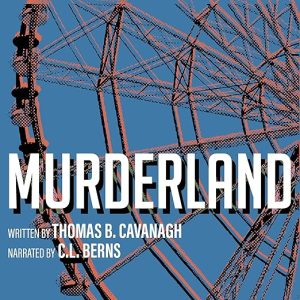
Two tourists are found strangled inside a theme park called Empire Realm, three weeks apart, while management prepares a twentieth anniversary celebration. That is the audiobook this record describes, eleven hours and forty-nine minutes of it, read by C.L. Berns. It is a crime novel and the description says so without hedging: a cop turned private investigator named Kevin Lonnegan goes undercover as a park employee through a brutal Florida summer, because a killer has chosen the happiest place on earth for a hunting ground. The byline above that description reads Caroline Fraser, the genre fields read biographies and memoirs, history and mystery, and the tag reads True Crime. Something on this page does not belong with the rest of it.
Start with the evidence, since the conclusion rests entirely on it. The description is fiction carrying invented proper nouns, Empire Realm and Kevin Lonnegan among them, and the blurb attached to it calls its author a great new talent in crime fiction, credited to Lee Irby. The publisher field holds two houses joined by a comma. The genre fields file one product simultaneously as biography, history and mystery, with a True Crime tag stacked on top, which is a combination no single book satisfies. And a written response credits a writer named Cavanaugh with drawing you into the characters' world, on a page bylined to somebody else entirely.
Two records appear to have been welded into one, and only a buyer can work out which half is on sale. The likeliest reading is that the description, the responses and the runtime belong together while the byline does not, because several independent elements agree with each other and a single field disagrees with all of them. That remains inference rather than certainty, and the practical instruction is identical either way: confirm the author before you order. If the True Crime tag brought you here expecting a nonfiction narrative, the description printed on the same page is already telling you something different.
Berns Has to Sound Like Two People at Once
Taken as the novel it describes, the premise does real work. A theme park is a closed society with uniforms, shift rosters, backstage corridors and a public face it cannot afford to drop, which makes it an unusually effective setting for an undercover investigation. An August 2022 five-star reaches the same conclusion, praising the vivid surroundings of the park and backstories expertly intertwined into the exciting present. The description supplies the motive for a cover-up as well: the deaths arrive as a public relations disaster with an anniversary already on the calendar, which gives every person in authority a reason to want the investigation quiet.
C.L. Berns reads it, and that credit is the most stable thing on this page. Eleven hours and forty-nine minutes is a full-length thriller, so the reader has to sustain a private investigator, a park hierarchy and a Florida heat the description treats as an antagonist in its own right. Undercover stories put particular pressure on a narrator, because one character has to sound like two people without either version tipping into caricature. Berns is what this record supplies on the performance side, and a sample will tell you quickly whether the Florida register lands or curdles.
A Response Filed Two Decades Before Its Product Exists
Provenance is a problem in the column as well. One response is dated August 4, 2005, which sits twenty years ahead of the June 2025 release on this page, and it reads as a note from somebody living near the Orlando parks who found the whole scenario funny. A response filed two decades before its product exists cannot be a verdict on the file you would be buying. Set alongside the byline trouble, it means the star figure above is aggregating opinions that were not all formed about the same object, and possibly not even about the same book.
The most useful criticism comes from a three-star filed in March 2026, and it is blunt about the structure: without the ending, that reader says, this would have been a one-star, and the ending is good enough that the preceding chapters seem hard to believe. That is a pacing complaint spread across nearly twelve hours, and it deserves weight from anyone deciding whether to commit several evenings. The badge lends the worry mild support. A 4.1 sits above 110 ratings while the five visible responses average 4.2, so the unread majority is running just below the sample you can actually inspect.
Pointing Them Straight at a Novel
Theme-park mysteries are a specific taste, and this one knows the taste it serves. If you enjoy a closed-setting investigation with a workplace hierarchy to navigate, and you are content for the detective to be a worn-down professional treating the job as a step up from workers compensation files and messy divorces, the setup delivers what it promises. Florida crime readers will recognize the register within a chapter. Readers who need an investigator with an unblemished record should look elsewhere, since the description sells Lonnegan partly on the seediness of his usual caseload.
True-crime listeners are the group who should be most careful, because the tag on this record is pointing them straight at a novel. Nothing about the described book looks like a bad purchase; it simply is not the genre the shelf advertises, and twelve hours is a long stretch in which to discover that. Confirm the author line, read the description against the category, and treat the responses as a mixed pool rather than a verdict. Assuming the description is the honest part of this page, you are being offered a full-length theme-park thriller with a compromised investigator and an anniversary nobody wants disrupted.
Frequently Asked Questions
Is the Murderland audiobook fiction or true crime?
The description is unambiguously fiction: an invented theme park, an invented private investigator, and a cover quote praising its author as a talent in crime fiction. The record nonetheless carries a True Crime tag and files itself partly under biographies and history. Trust the description over the shelf labels, and verify before ordering.
What is the runtime of the Murderland audiobook, and who narrates?
Just under twelve hours, read by C.L. Berns. That sits in standard full-length thriller territory, roughly three long evenings. The narrator credit is one of the few fields here that nothing else on the page contradicts, which on this particular record counts for rather more than usual.