Before You Press Play
- Voice: Bernadette Dunn narrates with controlled emotional precision, avoiding easy sentimentality while letting Robinson's genuinely extraordinary circumstances carry their own dramatic weight.
- Big ideas: Women's ambition and historical erasure, the economics of American newspaper syndication, the personal cost of self-invention
- Atmosphere: Cinematic and urgent, with the texture of rigorous archival research beneath the narrative momentum
- Worth it?: A biography of serious ambition that recovers an unjustly forgotten voice; Dunn's narration is well-matched to material that earns its emotional stakes.
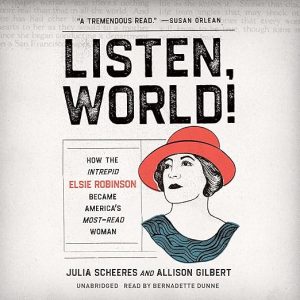
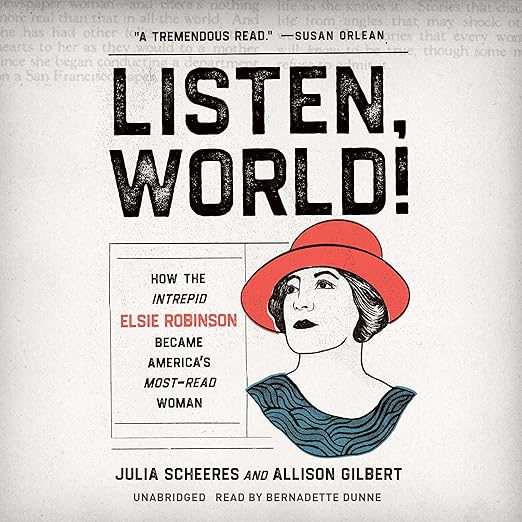
Biography at its best recovers a life from the specific amnesia that women's accomplishments often suffer in the historical record. Listen, World! by Allison Gilbert and Julia Scheeres is exactly that kind of biography, and this audiobook narrated by Bernadette Dunn treats the material with the cinematic seriousness it earns. I came to Elsie Robinson without prior knowledge, which turned out to be the correct approach: discovering her from scratch, rather than arriving with expectations, lets the full improbability of her story hit at full force.
By 1917, Elsie Robinson was thirty-five years old, freshly and scandalously divorced, with no income and a chronically ill son who needed care she couldn't afford. What she had was a conviction that she was meant to write, and the particular stubbornness that converts conviction into action in the face of implausible odds. She swung a pickax in a gold mine. When the mine shut down, she moved to the Bay Area and walked into the Oakland Tribune with samples of her work and what the biography describes as pure moxie. She was hired immediately. Within years, her nationally syndicated column was reaching fifty million readers, a number she sustained for over three decades.
A Reviewer Knocked Over by the Research Itself
Gilbert and Scheeres do something that separates good biography from great biography: they refuse to let Elsie Robinson become simply a vehicle for the message that resilient women succeed. Robinson is rendered as a full person with specific quirks, specific failures, specific moments of doubt and self-revision. The 'cinematic detail' promised in the synopsis is genuinely delivered. Reviewers have confirmed that the research depth is exceptional: one reader noted being 'knocked over by the remarkable and thorough research that uncovered the history' behind Robinson's rise and the period that shaped her. This level of archival commitment keeps the biography from becoming hagiography, which is the occupational hazard of recovering a forgotten figure.
The broader cultural argument embedded in Robinson's story is handled with appropriate subtlety. Gilbert and Scheeres are clearly aware that a woman with Robinson's reach and readership would be a household name if she had been a man, and that her disappearance from cultural memory is itself a kind of history. But they make this argument by letting the evidence accumulate rather than by stepping out of the narrative to editorialize, which is the more persuasive and more respectful approach to a subject who was never short of opinions about how to state a case.
Dunn Trusts the Facts to Carry Their Weight
Bernadette Dunn's narration matches the biography's register with considerable skill. She handles both the intimate, near-confessional material of Robinson's private struggles and the broader historical sweep of the syndication era with the same clarity and emotional calibration. Dunn does not reach for obvious emotional underlining in the scenes of hardship; she trusts Robinson's actual circumstances to carry their own weight, which is the right call for material this inherently dramatic. At seven hours and thirty-four minutes, the biography is paced tightly enough to sustain momentum without sacrificing the depth of scene that makes character biography compelling.
The co-authorship of Gilbert and Scheeres produces a voice that manages to feel singular, which is not always the case with dual-authored biographies. One might expect narrative seams between sections researched and drafted by different writers, but the prose reads as unified, with a consistent attention to the sensory specificity of setting that makes Elsie's world feel inhabited rather than reconstructed. Book club communities that have taken up this biography seem to understand its richest dimension: it provokes genuine conversation about what kinds of ambition get remembered and what kinds get filed away.
Independence That Stayed Precarious, Never Secure
Listeners should prepare for a biography that doesn't deliver a conventional arc of triumph over adversity and then settled happiness. Robinson's life remained turbulent after her journalistic success; the biography is honest about the personal costs of her choices and the extent to which the independence she achieved was always precarious rather than secure. This is the more accurate and more interesting story, but those hoping for a clean inspirational narrative may need to adjust expectations. The book is honest rather than triumphalist about what self-invention actually costs.
The period detail is dense in places, particularly the sections covering the business structures of newspaper syndication in the early twentieth century. Listeners with an interest in media history or the economics of American journalism in the 1920s and 1930s will find this scaffolding enriching. Those primarily interested in Robinson's personal story might find the industry context occasionally absorbing more time than they expected. Understanding how syndication worked is, however, inseparable from understanding how extraordinary Robinson's reach actually was within the systems of her time.
Recovery Biography for Readers of Stacy Schiff
Biography readers who appreciate rigorous research and genuinely cinematic scene-building will find this one of the more rewarding audiobooks in the genre. It suits listeners who loved the recovery biographies of the past decade, titles like Stacy Schiff's Cleopatra or Catherine McNeil's work on overlooked women of letters, and who are accustomed to biographies that take their subjects as seriously as the subjects took themselves. Listeners looking for an introductory, broadly accessible biography of a famous person will find Robinson's relative obscurity either the central appeal or a barrier, depending on their relationship to discovery. Book clubs that enjoy narrative nonfiction with cultural argument embedded in individual story will find the discussion material particularly rich.
A final note for listeners who discover their own connection to Robinson's particular story: the biography ends with a strong argument for why Robinson's disappearance from cultural memory is both preventable and worth actively reversing. Gilbert and Scheeres make the case not as polemic but as implication, letting the scale of what was forgotten speak for itself. That's the right choice for a biography of a woman who always preferred to let her own words do the heavy lifting.