The Short Version
- Narration: Christian Rodska carries six hours in which nothing is dramatized, so the question worth putting to a preview is whether the reading supplies momentum the prose deliberately withholds.
- Themes: an unlikely wartime partnership, monarchy under bombardment, complementary temperaments, leadership shared between two people
- Mood: Considered and intimate
- Verdict: A persuasive short argument about a relationship, and the wrong book entirely for anyone who came for the transcripts.
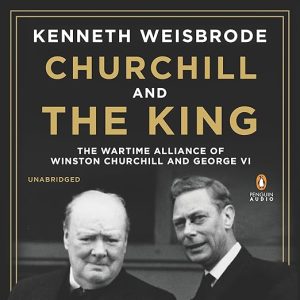
Penguin Audio's copy makes a priority claim for this audiobook, calling Kenneth Weisbrode's study of the bond between King George VI and Winston Churchill the first of its kind, and noting in the same breath that books about the two men individually could fill a library. Five hours and fifty-six minutes, published in October 2013. The runtime is the honest signal on this record: what you are buying is a short argued essay about a relationship rather than a dual biography, and every strength and every weakness follows from that difference.
Psychology Instead of a Transcript, by Design
Weekly meetings are the spine of the book. A shy monarch and a prime minister with a wrecked political past sat down together every week through the worst of the war, and Weisbrode's argument is that the pairing worked precisely because the weaknesses were complementary: the king's reticence offset by Churchill's appetite for casting himself as the nation's savior, and Churchill's damaged credibility restored by the king's public embrace and private counsel. A response headlined Good but wanted more, three stars from February 2014, names the cost of that argument exactly, calling the book more speculation than the writer wanted and suspecting a paucity of surviving material behind it.
Weisbrode's method compounds the problem. Where the record is thin the book reasons about psychology instead of quoting a transcript, and anyone who wants the conversations themselves will feel the absence in nearly every chapter. Whether that counts as a flaw depends on what you think the book is for. As an argument about how two temperaments held an institution together under bombardment, it is persuasive and unusually well shaped. As a source of new material about either man, it has very little to hand over, and it never quite admits as much.
Rodska Must Keep Two Famous Cadences Apart
Small, intimate moments are what a five-star from November 2013 singles out, crediting Weisbrode with writing the pivotal wartime events and also the quiet exchanges that make both men human, and using the familiar name Bertie for the king throughout. That is the book's real pleasure. A war leader and a monarch are difficult figures to render ordinary, and the passages in which they are simply two frightened people in a room together are the ones that stay with a listener long after the strategic material has faded.
Christian Rodska has the file, and the assignment is more delicate than a straight history read. Two men have to stay distinguishable inside reported speech, because a book built on private conversation lives or dies on whether a listener always knows which of them is talking, and both were public voices with famous cadences that a reader can gesture at or ignore entirely. Six hours leaves little room to recover if that choice goes wrong. Sample a passage of exchange between the two rather than the introduction, and hear which way the reading leans before you buy.
Six hours is short for the period and exactly right for the thesis. Weisbrode is not retelling the war; the war is the pressure under which the relationship gets examined, and the compression keeps attention on the two men rather than on campaigns and cabinet reshuffles. Anyone who has read widely about Churchill will find the familiar material handled at speed and the unfamiliar angle given proper room, which is the correct allocation for a book making one argument rather than surveying a decade.
Two Hundred Pages Is What Six Hours Sounds Like
Page counts turn up in the strangest places. A separate five-star describes this as a short little book of about two hundred pages before praising the psychological insight inside it, which is a print measurement sitting on an audio record and, unusually, a useful one: two hundred pages is what six hours sounds like, and it sets the scale before you commit. The same column carries a four-star from May 2023 recommending the book to readers just entering the Churchill atmosphere, which is the most accurate placement anybody has offered for it. This is an entry point rather than a supplement.
Claims on the jacket deserve a second look as well. First of its kind is a strong assertion, and the record offers nothing that would support or test it, which is the ordinary condition of publisher copy rather than a scandal. More useful to a buyer is the phrase largely overlooked, which a listener should read as a signal about the volume of surviving material rather than about historical importance. The relationship was never secret. It simply was not the thing anybody chose to build a whole book around, and the reason becomes audible once the sources run thin.
A Bargain at Six Hours, or a Repetition
Readers coming to Churchill for the first time are the natural audience, and so is anybody who watched the films about George VI and wondered what those war years looked like from inside the palace. It suits listeners who prefer short argued history to long narrative history, and it suits a short-session habit particularly well, since six hours divides neatly and no chapter depends on holding a battle order in your head from one sitting to the next.
Specialists should look elsewhere, because a book that reasons where the archive is silent will frustrate anyone who came for the archive. Readers who want the war itself should look elsewhere too, since the campaigns are context here and never the subject. Completists who already own a shelf of Churchill will find the ground familiar and the angle genuinely new, which makes this either a bargain at six hours or a repetition, depending entirely on how much of that shelf they have actually finished.
Good to Know
How long is the audiobook, and does the length suit the subject?
Just under six hours, or roughly two hundred pages of print. The brevity is the right call. Weisbrode argues a single point about a relationship rather than narrating a war, and a longer treatment would have required material the historical record does not appear to hold.
Is this a biography of Churchill or of George VI?
Neither, strictly speaking. It is a study of what happened between them, with the wartime years as the pressure that reveals it. The copy notes that books about each man individually could fill a library, and this one deliberately declines to add another volume to that pile.
Do you need to know the period before starting?
No. The book assumes very little and moves quickly through the familiar events, which is why it works as a first purchase on the subject. Anyone already well read on the war will recognize most of the background and should come for the argument rather than the narrative.
What is the main weakness of this audiobook?
Thin sourcing exactly where it matters most. A book about private weekly meetings wants records of private weekly meetings, and where those are missing the argument becomes inference about temperament. It is well-reasoned inference, but inference all the same, and a listener should know that before starting.