The Short Version
- Read by: Leon Nixon reads Thomas Sowell's correspondence with a clear and unhurried delivery that suits the reflective, epistolary nature of the material without imposing any theatrical quality the letters don't invite.
- At its heart: Intellectual integrity over decades, the formation of a public thinker, correspondence as autobiography
- Vibe: Reflective and measured, with the occasional crackle of intellectual friction
- Short version: A revealing portrait of Sowell's mind in process, best suited to listeners already familiar with his published arguments who want to see the thinking behind them.
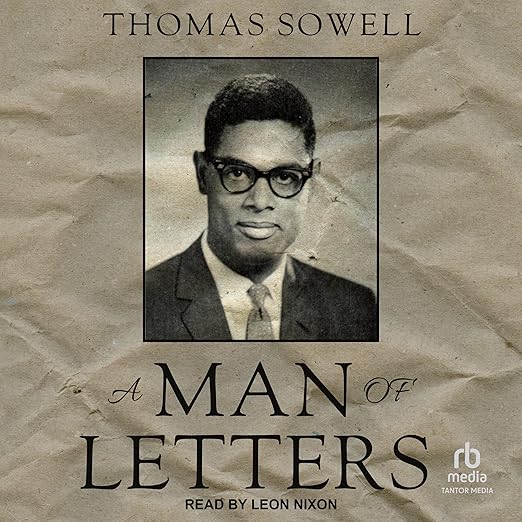
Thomas Sowell's A Man of Letters is an unusual kind of autobiography. Rather than a linear narrative of life events, the book traces Sowell's career and intellectual development through his actual correspondence, from his earliest letters as a graduate student at the University of Chicago in 1960 through a final reflective letter to his longtime friend and fellow economist Walter Williams in 2005. This audiobook gives you 45 years of a formidable mind at work in something other than its Sunday clothes, as one reviewer put it, and that phrase captures exactly what makes the format valuable.
Leon Nixon narrates, and his reading is suited to the material. Sowell's letters are not theatrical; they are precise, often terse, and occasionally sharp. Nixon reads them with appropriate directness, neither inflating the emotional temperature nor smoothing over the moments where Sowell's impatience or moral severity comes through clearly. The correspondents are a remarkable list: Milton Friedman, Clarence Thomas, David Riesman, Arthur Ashe, William Proxmire, Vernon Jordan, Charles Murray, Shelby Steele, and Condoleezza Rice, among others, and the range of intellectual and political territory covered across those relationships gives the audiobook its scope.
Friedman at the Start, Williams at the Close
The epistolary format is both the book's greatest strength and its only real limitation. As a strength, it provides something Sowell's formal works rarely offer: access to the texture of his thinking as it developed, including mistakes, course corrections, and private impatience with ideas he was simultaneously arguing against in public. One reviewer noted that this determination toward mental clarity and intellectual integrity shines from every page, and that's accurate. The letters reveal a consistency of intellectual standards that runs through Sowell's engagement with almost everyone he corresponded with, regardless of whether they agreed with him.
The limitation is structural rather than qualitative. Because the book covers more than four decades and ranges across economics, race, policy, and personal relationships, certain threads emerge and then recede without the sustained development you'd find in a biography or a single-subject essay collection. The letters with Milton Friedman, which begin when Sowell was still a graduate student, are among the most interesting in the book because they show a student navigating the early formation of his economic philosophy. The exchange with Walter Williams that closes the book has a different, more valedictory quality that gives the collection a genuine sense of conclusion.
Nixon's Pacing Rewards Evidence Over Sentiment
The nine-hour runtime accommodates the collection's breadth without feeling padded. Nixon's pacing is deliberate, which matters here because the letters reward being heard at a speed that allows you to process the argument before the next one begins. Sowell's correspondence is not casual; even letters to friends have the quality of someone who takes words seriously and expects the same from his correspondents. Hearing that quality in audio makes the intellectual seriousness more palpable than reading the same text on a page, where the eye can skim what the ear is compelled to process.
The letters involving controversial public figures, particularly those touching on race and social policy, are handled by Sowell with a characteristic insistence on evidence over sentiment. His exchanges with figures across the political spectrum, including correspondents who disagree sharply with his positions, show a mind that welcomes argument when it's conducted seriously and has little patience for argument that isn't. That quality is not always comfortable, but it is consistently illuminating, and Nixon's narration keeps the reader anchored in Sowell's perspective without editorializing.
Pascal's Dictum as an Organizing Principle
The letters from the 1960s and 1970s are particularly valuable for understanding how Sowell's positions developed in real time against specific intellectual and political pressures. His correspondence with David Riesman and Arthur Ashe touches on dimensions of the civil rights era that don't appear in his published books in quite the same register, and these exchanges give the audiobook a historical specificity that rewards close listening. Watch also for the evolution of his relationship with Walter Williams over four decades, from professional peers to close friends; that arc gives the collection its emotional spine even as the intellectual range stays wide.
One reviewer noted that Pascal's dictum, that the first moral duty is to think clearly, runs through Sowell's correspondence as a kind of organizing principle. That framing is accurate, and listeners who keep it in mind will find the letters more coherent as a body than they might appear when encountered individually.
The Spontaneous Surface of a Mind Still Arguing
This audiobook rewards listeners who already have some familiarity with Thomas Sowell's published work. Without that context, the correspondence can feel like dispatches from an intellectual argument whose terms haven't been fully established. With that context, it functions as something genuinely rare: access to the private side of a major thinker's engagement with the ideas he is most associated with.
Listeners interested in the history of economic thought, the politics of race and social policy in the late twentieth century, and the texture of intellectual friendship over long periods of time will find the collection rewarding. Those looking for a narrative biography of Sowell will need to look elsewhere; A Man of Letters is not that, and it is more interesting for not being it. The epistolary format gives you something a biography cannot: the spontaneous surface of a mind that is used to performing its work in public but here is simply corresponding, arguing, responding, and occasionally admitting uncertainty about where the argument should go before the published version has to commit to an answer. That texture is rare, and it makes A Man of Letters a genuinely distinct entry in the Sowell catalog.