Quick Take
- Narration: Christine Rendel reads Lodge’s dense historical research with careful clarity, well-suited to academic-adjacent prose over 12 hours.
- Themes: Victorian women and labor, real versus fictional detection, feminism and moral ambiguity
- Mood: Richly researched, occasionally dense, consistently intriguing
- Verdict: Lodge’s recovery of the forgotten real women who investigated Victorian Britain, alongside their far more glamorous fictional counterparts, is exactly the kind of historical work that changes how you see a whole genre.
I came to this one through a detour. I had been listening to a run of Victorian crime fiction, Wilkie Collins, some early Sherlock Holmes, a bit of Mary Elizabeth Braddon, and found myself thinking about the women in those stories: the victims, the witnesses, the occasional amateur sleuth. The mystery genre has long assumed a male default for the detective figure. Sara Lodge’s book is the systematic argument for why that assumption has always been wrong.
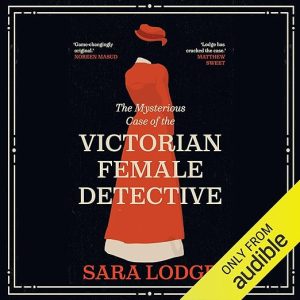
The Mysterious Case of the Victorian Female Detective is a work of historical recovery and cultural analysis, published by Audible Studios and narrated by Christine Rendel. Lodge, a literary scholar, is doing two things simultaneously: excavating the real women who worked as detectives in Victorian Britain, for private agencies and sometimes for the police, and examining the sensational fictional versions that enthralled the Victorian public. The comparison between these two populations is where the book’s real argument lives.
Our Take on The Mysterious Case of the Victorian Female Detective
Lodge’s research is genuinely excavatory. The real Victorian female detectives she recovers are not famous figures waiting to be popularized but largely forgotten working women who performed morally complex tasks. They were sometimes paid to betray other women: to gather evidence in divorce cases, to surveil wives suspected of infidelity, to act as agents of a legal system that did not protect them. Lodge is clear about this moral ambiguity. The real female detective was not a feminist icon. She was often a laborer making complicated choices in a system designed against her.
The fictional female detective was something else entirely. In Victorian melodrama and popular fiction, she was cross-dressing, fist-swinging, outwitting criminals and love rats with bravado. She was a fantasy projection: the woman who got the better of men, unencumbered by the actual constraints her real counterparts navigated. Lodge traces how this fantasy operated and what cultural anxieties it managed, which is where the book’s literary scholarship is strongest.
Why Listen to The Mysterious Case of the Victorian Female Detective
For readers with a background in Victorian literature or detective fiction history, Lodge’s synthesis offers new coordinates. She covers both sides of the Atlantic, real and fictional women in Britain and the US, which gives the argument geographic scope that a more nationally focused study would miss. One reviewer with clear scholarly engagement calls it a triumph of historical investigation and literary analysis, a description that is somewhat elevated but not inaccurate. This is careful, original work on a subject that mainstream publishing has mostly ignored.
Christine Rendel’s narration suits the material. Lodge’s prose is scholarly but not inaccessible, and Rendel reads with the clarity and measured pacing that historical nonfiction requires. She is not a performer who adds interpretive color, which is the right call for academic-adjacent material that already carries its own weight.
What to Watch For in The Mysterious Case of the Victorian Female Detective
Two reviewers mention the same structural problem: Lodge makes points repeatedly, and the book is longer than its argument strictly requires. One simply notes it is too wordy and unnecessarily extended. That is a real issue in a twelve-hour listen. The research is rich enough that expansion makes sense, but a tighter editorial hand would have served the argument better. Listeners who prefer their historical nonfiction at a brisk pace may find certain sections testing their patience.
The balance between real women and fictional women also shifts across the book, and not always predictably. Some chapters are primarily literary analysis, others primarily historical biography. Listeners who come specifically for one of those strands will encounter the other throughout, which is Lodge’s point about their interconnection but can feel uneven in practice.
Who Should Listen to The Mysterious Case of the Victorian Female Detective
This is essential listening for anyone with a genuine interest in Victorian fiction and the history of detection, particularly readers who have wondered why Sherlock Holmes gets all the scholarly attention while the women who actually did this work remain invisible. It is also valuable for feminist history listeners who want a subject with both real and symbolic stakes. General audiobook listeners who want a narrative-driven history will find the scholarly framing occasionally demanding. Students of Victorian literature or cultural history will find it a legitimate and well-argued contribution to the field.
Frequently Asked Questions
Is this book more literary analysis or historical biography?
Both, in roughly equal measure. Lodge examines real women who worked as Victorian detectives alongside the fictional female detectives who appeared in melodrama and popular fiction. The two strands are compared throughout rather than treated separately.
Does Lodge address famous fictional female detectives like Miss Marple?
Miss Marple is a twentieth-century creation and slightly outside Lodge’s Victorian frame. The book focuses on the Victorian period and its specific fictional traditions, including melodrama and sensation fiction, rather than the classic detective fiction that came later.
Is Christine Rendel’s narration a good fit for this kind of scholarly history?
Yes. She reads with clarity and measured pacing appropriate for academic-adjacent material, without adding interpretive performance that would feel out of place.
Is the book too long for what it covers?
Two reviewers specifically mention that points are repeated and the book is longer than necessary. At 12 hours it is a substantial commitment, and listeners who prefer concise argument-driven nonfiction should factor that in.