The Short Version
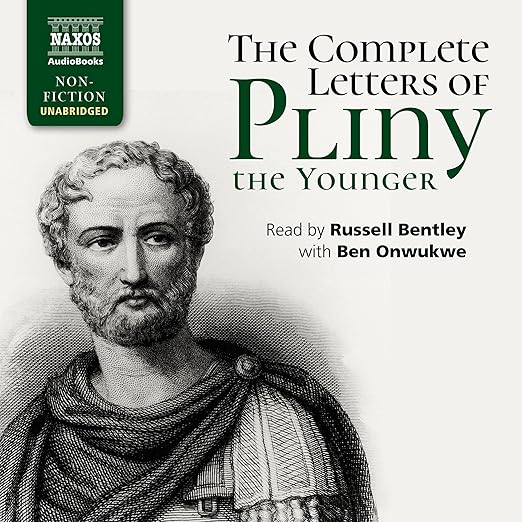
- Voice: Russell Bentley reads with measured intelligence, resisting theatrical framing to let Pliny's own voice carry the correspondence across fourteen hours.
- Big ideas: Roman imperial life, epistolary self-construction, eyewitness history
- Atmosphere: Cultivated and reflective, with the intimacy of private correspondence made public
- Worth it?: A rewarding audiobook for patient listeners who want direct access to one of antiquity's finest and most varied correspondents.
The craft of the letter as a literary form is easy to underestimate from a distance. We tend to assume that ancient correspondence survives because of its historical utility rather than its literary quality, and then we spend time with Pliny the Younger and discover we were wrong. The Complete Letters of Pliny the Younger, this audiobook spanning all ten books of extant correspondence from roughly AD 97 to 112, is a sustained encounter with a mind that wrote for posterity and knew it. The letters feel constructed. They have shape, intention, and a narrator in Pliny himself who is never entirely absent from his own observations.
I came to this one late in the evening, intending to sample a single letter or two before sleep. An hour passed. The letters have that quality: individually brief, collectively they build something that resembles a portrait of an entire world. By the time I reached the Vesuvius account, familiar to most classicists as one of the most famous eyewitness testimonies in ancient literature, I had been listening long enough that the broader texture of Pliny's social and intellectual life gave those famous letters additional weight that reading them in isolation would not provide.
Bentley Resists the Urge to Perform History
Russell Bentley's narration is measured and intelligent, which is exactly what this material requires. The temptation with ancient correspondence would be to perform it, to give each letter a theatrical frame that signals we are hearing something historic and important. Bentley resists that and is right to do so. He reads these letters as what they were: the considered prose of an educated man addressing specific recipients on specific occasions. The result is narration that respects the letters' own register, which is conversational and polished simultaneously, a combination harder to capture than it sounds. One reviewer described the translation as first-rate, and Bentley's reading serves that quality consistently across fourteen hours without either dulling the material through uniformity or disrupting its intimacy through theatrical intrusion. The sustained delivery across such varied content is a genuine accomplishment.
Fundamentally Spoken Forms Returned to Their Register
The case for the audiobook version of Pliny's letters is stronger than it might initially appear. Letters are fundamentally spoken forms, composed for a reader who was imagined receiving them directly. Hearing them read aloud by a skilled narrator returns them to something closer to their original register. The advice Pliny offers, the social observations he makes, the careful navigation of imperial politics that runs through the correspondence with Trajan in Book Ten, all of it moves differently when spoken than when read on a page. A reviewer noted that reading the letters gave them a first-hand account in contrast to secondary history, and that quality is heightened by the listening experience.
The organizational structure across ten books also rewards attentive listening to the full range of topics. Pliny moves from literary critique to domestic anecdote to legal matters to natural history without losing his own voice across those transitions, which makes the collection feel less like an archive and more like an extended conversation with a coherent and genuinely interesting person. The variety is part of what makes the full fourteen hours feel less like a test of endurance and more like a sustained relationship with a first-century Roman mind.
Pliny's Public Voice and His Letters to Trajan
At fourteen hours, this is a substantial listen, and it is worth being honest about what the experience asks. The letters are not arranged by theme but across ten books that mix personal and official correspondence in ways that do not always build momentum in the way narrative prose would. Some letters are substantial and rich; others are brief to the point of enigmatic. Listeners looking for continuous narrative drive will need to adjust their expectations. This is a collection best approached with patient, curious attention rather than an appetite for escalating plot or a single compelling throughline.
The accompanying PDF mentioned in the product notes provides supplementary reference material, and listeners who want notes on the addressees and historical circumstances will find it useful alongside the audio. Some knowledge of the Antonine emperors and the social structures of imperial Rome enriches the experience considerably, though it is not strictly required to follow Pliny's individual observations.
One dimension of Pliny's letters that the audiobook format highlights particularly well is the range of register across the ten books. The personal letters to friends, with their mixture of literary commentary and domestic observation, sit alongside the formal correspondence with Trajan about provincial administration in Bithynia, and hearing those two registers in the same narration clarifies how different Pliny's public and private voices were while remaining recognizably the same person. That kind of tonal range across a single collected work is unusual in ancient literature, and Bentley's reading preserves the distinction without underlining it artificially. The contrast illuminates something about first-century Roman professional life that secondary accounts rarely capture so directly.
One dimension of Pliny's letters that the audiobook format highlights particularly well is the range of register across the ten books. The personal letters to friends, with their mixture of literary commentary and domestic observation, sit alongside the formal correspondence with Trajan about provincial administration in Bithynia, and hearing those two registers in the same narration clarifies how different Pliny's public and private voices were while remaining recognizably the same person. That kind of tonal range across a single collected work is unusual in ancient literature, and Bentley's reading preserves the distinction without underlining it artificially. The contrast illuminates something about first-century Roman professional life that secondary accounts rarely capture so directly.
One of the Most Precise Eyewitness Testimonies
This audiobook is for readers of classical literature and ancient history who want direct access to one of the richest primary sources of the early imperial period. It works particularly well for listeners who enjoy personal essay and epistolary literature, since Pliny's letters operate as both historical record and literary form simultaneously. Skip it if you need a single-subject focused history of the period rather than a discursive range of topics seen through one cultivated observer's eye. Anyone interested in the eruption of Vesuvius in AD 79 should encounter Pliny's first-hand account here: it remains one of the most precise eyewitness testimonies to survive from antiquity, and hearing it within the full context of Pliny's correspondence gives it a weight it cannot carry when read in isolation.
Does this audiobook include Pliny's famous letters about the eruption of Vesuvius?
Yes. Books Six and Seven contain the two letters addressed to Tacitus describing the eruption of Vesuvius in AD 79 and the death of Pliny the Elder, which are among the most celebrated eyewitness accounts from antiquity.
How does the audiobook handle the variety of topics across Pliny's ten books of correspondence?
Russell Bentley's consistent narration provides a throughline, but the collection is genuinely diverse. Listeners should approach it as a range of voices from one man's life rather than a focused historical account with a single narrative arc.
Does the Complete Letters audiobook come with supplementary notes?
An accompanying PDF is available with the purchase, providing additional reference material that helps contextualize the addressees and historical circumstances of each letter.