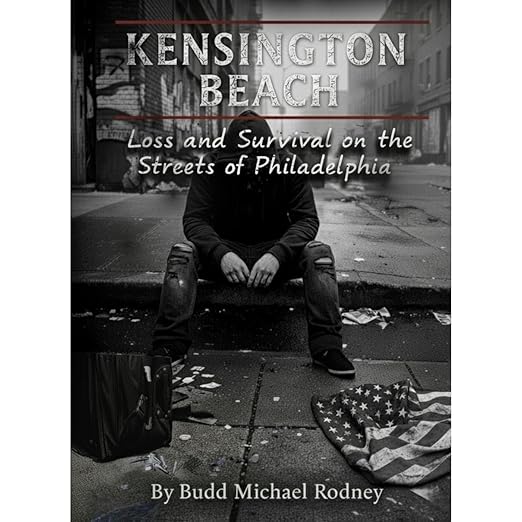
Kensington Beach lands with the force of a document rather than a memoir. Budd Rodney's account of his descent from correctional officer to homeless addict in the open-air drug market of Kensington, Philadelphia, is one of the most unflinching first-person records of the American opioid crisis I have encountered in any format, and the audiobook makes that immediacy felt from the opening minutes. This is not a comfortable listen. It is not meant to be.
A note upfront about the narration: the narrator is listed as Virtual Voice, meaning this is an AI-generated reading rather than a human performance. For a memoir this raw, that is a genuine limitation. The synthetic delivery cannot fully render the emotional register that Rodney's writing demands: the shame, the dark humor that survivors use as armor, the specific music of street-level Philadelphia vernacular. What the AI narration does provide is clarity and consistent pacing, which at least serves the documentary quality of the material. Listeners who find AI narration a barrier should seek a human-narrated edition if one becomes available.
A Hitter, Paid in Drugs and Cash
Rodney's writing is the real force here. His background in corrections gives him an unusual dual lens: he knows the institutional systems that failed him from the inside, and he knows the street systems that replaced them with the same granular clarity. The sections describing his role as a 'hitter,' a street-level injector paid in drugs and cash to help other addicts who could no longer find their own veins, are among the most jarring passages in recent addiction memoir. Rodney does not aestheticize this. He describes it with the matter-of-fact precision of someone who was too deep inside it to have any distance at the time.
The narrative arc ends with a choice that restructures everything that came before it: months of grueling surgeries to save his frostbitten feet, or bilateral amputation. That a man who lost everything, including parts of his body, chose to write this book rather than retreat into silence speaks to something the best addiction memoirs have always understood: bearing witness is part of the recovery. 'This is not a story for the faint of heart,' the synopsis says, and that is accurate, though I would add that it is also not a story of despair. The survival at its center is credible precisely because it costs so much.
Photographs the Audio Edition Cannot Include
The opioid crisis has generated a substantial body of memoir and journalism, from Beth Macy's Dopesick to Sam Quinones's Dreamland, but most of it is observed from the outside or told from early stages of addiction. Rodney's account goes further into the experience than almost anything else currently available: the community hierarchies of the Kensington drug market, the 'tranq' drug that the synopsis identifies as a flesh-eating xylazine-fentanyl combination, the live-feed YouTube cameras through which the outside world occasionally glimpsed the neighborhood's suffering. The specificity is what makes it valuable as cultural testimony.
Reviewers have noted the book's emotional intensity repeatedly. One describes feeling 'sadness, anger, and disgust' in rapid succession, which is an honest description of the emotional range the text moves through. Another notes the photographs that accompany the print edition as evidence of the memoir's honesty; those images are not available in the audio format, which is a meaningful loss for a book that anchors its credibility in documentation.
Virtual Voice Flattens the Register Shifts
The content is graphic. Rodney describes needle use, overdoses, street violence, and the physical deterioration caused by tranq with clinical specificity. Listeners who have personal or family experience with addiction should approach with care: this is not gentle or redemptive in the conventional memoir sense. The recovery, when it comes, is hard-won and complicated, not a clean pivot toward wellness. That honesty is the book's greatest asset and also its heaviest ask.
The Virtual Voice narration flattens some of the register shifts that would carry greater weight in a human performance. Moments of dark humor, of which Rodney has quite a few, land less cleanly in synthetic delivery. The book is compelling enough to hold attention regardless, but the narration is the clear limitation of this edition.
Dismantled by Something Stronger Than Knowledge
The book has been compared by reviewers to Beautiful Boy, Tweak, Hillbilly Elegy, and Dopesick, and those comparisons give a useful genre map. Kensington Beach occupies the furthest interior position among them: it does not look at the crisis from above or from outside, the way Dopesick largely does, or from the remove of a parent watching a child disappear. It is the ground-level account of someone who was inside the market, doing its work, surviving by the rules of a community that had developed its own intricate social order in the absence of the institutions that had failed everyone in it.
A final note on what makes Rodney's perspective unusual even within the crowded space of opioid crisis memoir: his background in corrections means he understood the systems he was violating. He did not end up in Kensington ignorant of how institutions process addiction; he arrived knowing exactly what the legal and medical system thought of people in his situation, having enforced those views professionally. That specific form of fall, from enforcer to subject, gives his account a layer of self-reckoning that straightforward addiction memoir cannot access. He was not betrayed by systems he trusted. He was dismantled by something stronger than his knowledge of the systems.
Unmediated Testimony Instead of Policy Analysis
For anyone trying to understand the human mechanics of the opioid crisis at ground level, this audiobook belongs at the top of the reading list alongside Beautiful Boy and Hillbilly Elegy. It is especially valuable for healthcare workers, social workers, and journalists covering addiction who want unmediated testimony rather than policy analysis. Not recommended for listeners in early recovery who may find the graphic content destabilizing, or for those seeking a straightforward redemption narrative. The survival here is real, but the road to it is documented in full.
Before You Press Play
- Narration: Virtual Voice AI narration provides clarity but cannot match the emotional intensity Rodney's raw testimony deserves; a human narrator would serve this memoir far better.
- Themes: Opioid crisis and addiction, institutional failure, survival and self-reckoning
- Mood: Unflinching and documentary, heavy throughout with moments of dark humor
- Verdict: A powerful first-person account of the Kensington opioid crisis that earns its place alongside the best addiction memoirs, despite the limitations of AI narration.
Frequently Asked Questions
Is this audiobook narrated by Budd Rodney himself or a professional narrator?
This edition uses Virtual Voice, an AI-generated narration rather than a human performer. Rodney does not narrate his own memoir in this version, which is a notable limitation given the personal intensity of the material.
How graphic is the content in this audiobook?
Very graphic. Rodney describes intravenous drug use, overdoses, flesh wounds caused by xylazine (tranq), street violence, and his work injecting other addicts in detail. This is not sanitized addiction memoir; it is close-range documentation of conditions at the bottom of the crisis.
Is Kensington Beach primarily a recovery story or an account of active addiction?
It is primarily an account of active addiction and street survival, with recovery arriving late and at great physical cost. The book does not follow the conventional addiction memoir arc of descent and redemption; it spends most of its pages inside the descent itself.
How does this audiobook compare to Dopesick or Hillbilly Elegy for listeners interested in the opioid crisis?
Where Dopesick is journalism and Hillbilly Elegy is cultural analysis from a particular political standpoint, Kensington Beach is pure first-person testimony from inside the crisis. It is more graphic and more immediate than either, and it covers the tranq fentanyl-xylazine combination that came later than the drugs covered in those earlier books.