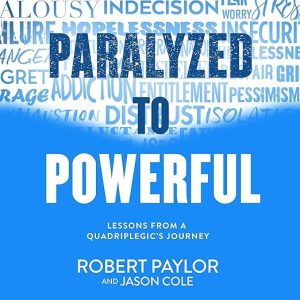
A collegiate rugby final is where this audiobook's author stopped being able to move, and the six hours that follow are about the years after. Robert Paylor was competing for a national championship when he suffered a catastrophic spinal cord injury and was left paralyzed from the neck down. Doctors told him he would never walk or move his hands again. The book opens on a question rather than that scene, though, and the question is aimed squarely at you: what paralyzes you? That framing is the whole design, and whether it works on a listener depends almost entirely on how much patience they have for being included in somebody else's catastrophe.
The Peaks and Valleys of Recovery
Somebody who has been through a spinal cord injury themselves left the strongest recommendation on this record, and the substance of it matters more than the enthusiasm. What that reader values is not the inspiration but the realism about the peaks and valleys of recovery, alongside hope and usable coping techniques. That is a precise compliment and a rare one on this shelf. Recovery memoirs almost always compress the middle, because the middle is repetitive and undramatic and nobody wants to hear about the slow months. A reader with lived experience saying the peaks and valleys are represented honestly is the single most informative thing on this page.
Paylor's structure explains why. The book is not organized as a chronology that arrives at a triumph. The argument, stated openly in the description, is that this is a guide to overcoming unseen challenges, built from personal experience, hard-earned lessons and practical tools, and that his paralysis simply happens to be the literal version of what everybody else carries around metaphorically. You may never face a spinal cord injury, the copy says, but we all face moments that threaten to define us. The memoir is the evidence base for a method, which is a more honest arrangement than a method dressed up as a memoir.
Paylor's Own Trade of Intimacy for Polish
The early material is where the writing earns its keep. One reader singles out the days immediately after the injury as the rawest and most vivid stretch of the book, and that tracks with how the description positions it: those chapters are the ones with nothing resolved in them yet, written by somebody who is now safely on the far side and refusing to make it comfortable. Six hours and one minute is also a well-chosen size. Long enough for the injury material to land at full weight, short enough that the framework sections do not sprawl into a course.
Reading his own book puts Paylor in an unusual position, and it changes the transaction in ways worth thinking about before you buy. A hired reader performs grief at a professional distance; the person it happened to cannot. What you get instead is somebody saying difficult things in his own cadence, with whatever unevenness that brings, and the trade is intimacy for polish. The risk on a self-narrated memoir is always the same: a writer reciting his own worst days can flatten out defensively at exactly the moments a listener most needs him present. Sample a passage about the injury and its aftermath rather than one of the framework sections, because the framework will sound fine in any voice.
No Sentence States His Current Condition
Read the reception column carefully before you weight it. One of the five written entries opens by disclosing a friendship with the author, describing classes together at UC Berkeley before the rugby injury and a return to campus in 2018, which is a generous and transparent thing to volunteer and also means that entry is not a stranger's assessment. A hundred and six ratings sit behind a perfect five-star average, and nothing readable on the page dissents from it. Neither fact is suspicious on its own. Together they mean the page cannot tell you how this lands on someone with no connection to the story.
Dual positioning is the real thing to watch. Another entry calls it an easy read about a very difficult time and says you will not want to put the book down, which is a compliment aimed at a memoir. The description promises something else alongside it, a set of tools for identifying mental and emotional barriers. Those two books coexist here, and depending on which one you came for, the other will read as either ballast or as the point. Listeners who want the story will sit through the frameworks. Listeners who want the frameworks will get a great deal of rugby and recovery first.
One more gap is worth naming, because the copy is conspicuously careful about it. The description tells you what the doctors predicted and that Paylor refused to accept it. It never says where that refusal ended up. No sentence on this listing states his current condition, which for a book whose title moves from paralyzed to powerful is a striking omission, and a buyer hoping for a specific medical outcome will have to buy the book to find out whether one is delivered.
Is the Silence a Hook or a Hole
Coaches, physical therapists and anyone in the first year of a hard recovery will find the most here, and so will families who are supporting someone through one. Recovery is both the subject and the method here, which is what makes that group the primary audience. Beyond it, this suits listeners who like their motivational material anchored to a specific verifiable event rather than floating free, and anyone who has found the resilience shelf too abstract to act on. Athletes will recognize the mentality the book both credits and interrogates.
Hold off if you are in an acute stage of grief or injury yourself, because the early chapters are unsparing and the record carries no content advisory of any kind. The same applies if inspirational framing puts your teeth on edge, since the instructional half is explicitly built to convert one man's recovery into instructions for your life. Skeptics of the mindset genre will find the usual machinery here, better anchored than most but not fundamentally different. The record itself never says how far the recovery went, and deciding whether that silence is a hook or a hole is the last question worth asking before you buy.
In Brief
- Performance: Paylor reads his own account, trading a professional's polish for the cadence of the person it happened to.
- What it covers: Catastrophic spinal cord injury, athletic identity, the unglamorous middle of recovery, mindset as a practice.
- Feel: Direct, unsparing early, instructional later.
- Our call: A recovery memoir with a real method attached, praised most credibly by listeners who have lived the same injury.
Before You Listen
Does the author narrating his own audiobook change how it lands?
Substantially. A memoir of catastrophic injury read by the person it happened to removes the layer of performance a hired reader provides, which buys immediacy and costs polish. The effect is strongest in the earliest chapters and least noticeable in the instructional material, where any competent voice would do the same work.
Is this audiobook a memoir or a self-improvement guide?
Deliberately both. The description states outright that this is more than a recovery story, offering usable tools for the invisible obstacles that hold people back, all of it drawn from lived experience. Expect narrative first and framework second, with the two interleaved rather than cleanly separated.
How graphic is the injury material for a sensitive listener?
The subject is a spinal cord injury that caused paralysis from the neck down, and nothing on the listing flags that for sensitive buyers. Anyone currently dealing with a serious injury, their own or a family member's, should approach the opening stretch knowing that nothing has been softened for comfort.