Quick Take
- Narration: Tom Briggs brings a clear, assured delivery to the material, suited to the Zentara UK brief biography format which prioritizes information over dramatic performance.
- Themes: Revolutionary nationalism, Cold War politics, the mythology of liberation
- Mood: Measured and biographical, structurally focused rather than hagiographic
- Verdict: A well-organized short biography that respects the contradictions in its subject, useful for listeners who want a focused portrait of one of the twentieth century’s most consequential figures.
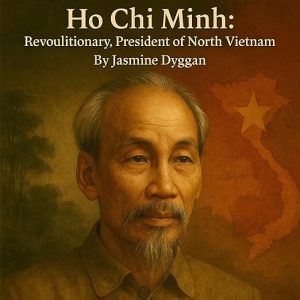
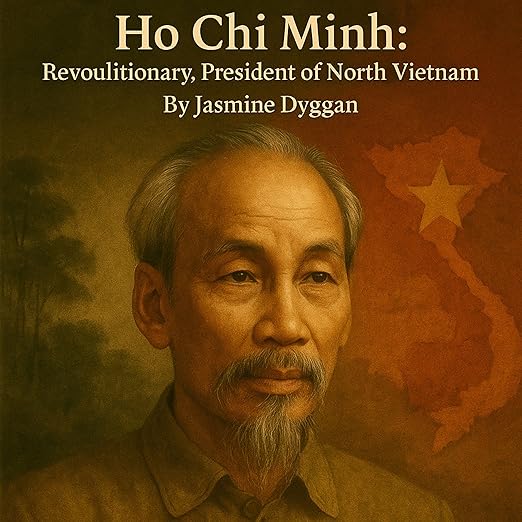
There are political figures whose biographies are almost impossible to write with any balance, because the scale of what they represent keeps pulling the writer toward either reverence or condemnation. Ho Chi Minh is one of those figures. For millions of Vietnamese, he is genuinely the father of the nation, a man whose simplicity of dress and manner embodied a moral vision that outlasted him. For others, particularly those who experienced the North Vietnamese state at close range or whose families were caught in the political campaigns of the 1950s, he is a figure whose methods were anything but gentle. Jasmine Dyggan’s short biography, at exactly three hours, navigates this with more care than you might expect from a brief entry in the Zentara UK Famous Lives series.
The book is organized around ten key aspects of Ho Chi Minh’s life and legacy, which gives it a useful structural clarity at the cost of some narrative flow. You move through his formative years abroad, where he worked in kitchens in London and Paris and absorbed the political ideas that would shape the rest of his life, to the founding of the Indochinese Communist Party, the Viet Minh resistance, the 1945 declaration of independence, and the long wars that followed. Each chapter is focused and purposeful, which suits the short format without making the whole feel fragmentary.
The Intellectual Dimension the Political Record Tends to Obscure
What the book does well that shorter treatments often miss is its attention to Ho Chi Minh as an intellectual figure. He was a writer, a poet, and a polyglot who corresponded in French, Chinese, and English. His 1945 declaration of independence was deliberately constructed to echo both the American Declaration and the principles of the French Revolution, a rhetorical choice that was also a political argument: that the values the West claimed to represent should apply equally to the colonized. Dyggan handles this dimension with genuine interest, and Tom Briggs’s narration gives the literary material appropriate weight without overplaying it.
The section on Ho’s years abroad is among the most interesting in the biography. Working in the kitchens of the Carlton Hotel in London, later moving through Paris’s Vietnamese expatriate community, and encountering Marxism not as an imported ideology but as a framework that seemed to explain colonialism directly, these years shaped a man who was simultaneously a Vietnamese nationalist, a communist, and a product of French culture. That combination is what makes his legacy so difficult to classify within any single political tradition.
The Contradictions the Biography Does Not Flinch From
The book’s willingness to name the contradictions in Ho Chi Minh’s record is its most honest quality. The suppression of non-communist resistance in the North, the human costs of land reform in the 1950s, the gap between the rhetoric of liberation and the realities of a one-party state, these are mentioned, if not examined at the depth a longer biography would allow. The author frames Ho as both idealist and pragmatist, and acknowledges that for some he represents liberation while for others he remains a figure of the Cold War’s more brutal machinery. This refusal to resolve the contradictions into a simple verdict is exactly the right approach for a subject this complex.
At three hours, you will not get the psychological depth of William Duiker’s landmark biography, which remains the scholarly standard in English. What you get is a competent, honest orientation to one of the most consequential political lives of the twentieth century, structured clearly enough to be useful as background before approaching longer works or before traveling to Vietnam. What makes the format work here, rather than simply frustrating the listener with brevity, is the ten-chapter structure. Because each chapter has a defined focus, from the years abroad to the Ho Chi Minh Trail to the literary legacy, you always know what question is being addressed and when it is being set aside. That structural clarity is harder to achieve in short biographies than it looks, and Dyggan manages it well.
The Zentara UK Format in Practice
The Zentara UK Famous Lives series is designed for listeners who want a focused, well-sourced short biography rather than a hagiography or a political polemic. The format works well for Ho Chi Minh because the subject’s life is structured enough chronologically, and the ten-chapter organization gives the narrative clear anchors without the sprawl that biographical subjects of this magnitude can sometimes produce. The 5.0 rating with 46 reviews suggests the format is delivering what its intended audience wants, which is more than a Wikipedia summary and considerably less than an academic monograph.
Who Should Listen, Who Should Skip
This audiobook is for listeners who want a portrait of Ho Chi Minh that is honest about his contradictions and useful as a biographical foundation. It is not for those seeking a sustained political argument either for or against his legacy. Listeners who have already read Duiker or Neil Sheehan’s work will find this introductory. Those approaching Ho Chi Minh with no prior context will find it a well-structured starting point that opens into the larger literature naturally.
Frequently Asked Questions
Does the biography take a sympathetic or critical view of Ho Chi Minh, and does it address the human rights record of his government?
The book is notably balanced. It acknowledges the admiration Ho commands in Vietnam alongside the contradictions in his record, including the costs of land reform and the suppression of political opposition. It frames him as simultaneously nationalist and communist, liberator and authoritarian, without resolving those tensions into a simple verdict.
Is this part of a series, and do the other Zentara UK Famous Lives titles need to be read alongside it?
It is part of the Behind the Name: A Zentara UK Famous Lives Book Series, but each title is self-contained. You do not need to read any other volume in the series to follow this biography.
How does this short biography compare to longer works on Ho Chi Minh, such as William Duiker’s?
Duiker’s biography is the scholarly standard and offers far greater depth, particularly on the political and military decisions of the Viet Minh and North Vietnamese periods. This audiobook functions as an orientation and introduction rather than a replacement for that level of treatment.
Does the audiobook cover the period after Ho Chi Minh’s death in 1969, including the fall of Saigon in 1975?
Yes, the biography addresses his legacy through the final victory in 1975 and into the present day, including the renaming of Saigon as Ho Chi Minh City and his continued status as a national symbol within contemporary Vietnam.