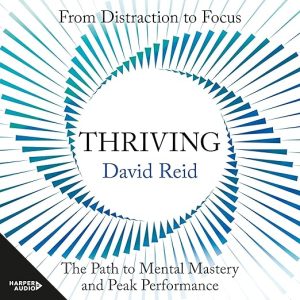
When the tag says Cricket and the description never once says cricket, you are looking at a filing decision made from outside the book. What the description does say is that David Reid arrived at performance coaching by way of forensic behavioral science, and that he now works with athletes, coaches, artists and business leaders. Cricket may well sit somewhere inside those nine hours and thirty-four minutes. This audiobook's own copy does not name a single sport, and a listener browsing that category would have no way of knowing what they had found.
If the opening question sounds familiar, that is the genre operating as designed: what separates the world's elite performers from everyone else. The answer offered is a clarity-based framework, described as in use by top performers around the globe, and the copy takes care to insist that this is not another quick-fix guide. It calls itself a roadmap blending ancient Eastern wisdom with current Western science. Whether that pairing is a genuine synthesis or a positioning statement is precisely what a buyer cannot determine from the description alone. One line does land, though: in a world where attention is the ultimate currency. That is the frame the entire book hangs from, and it is a sharper place to start than the elite-performer question the copy opens with.
Once you reach the list of key insights, the architecture appears, and it is far more concrete than the framing above it. Everything is Connected. Attention: The New Currency. No Mud, No Lotus. Finding Calm. Unlocking Creativity. Mental Rehearsal. Persevering With Passion. Belonging and Connection. Eight headings, each with a one-line gloss, running through focus, adversity, pressure, creative thinking under stress, motivation after setbacks and the relationships that support all of it. That is a curriculum, and it tells you considerably more than the marketing paragraph does. The glosses are specific as well: master focus in a distracted world, transform challenges into growth opportunities, access clarity when pressure mounts, prime your mind for peak performance. Whatever else this book is, it is organized.
Why Listen to Thriving
Two names appear on this record and both of them are David Reid. He wrote it and he reads it, which for a book selling a framework its author uses with clients is the arrangement that makes sense, since coaching is a spoken discipline to begin with. Nine hours and thirty-four minutes is a serious commitment for a practical title, long enough to work through eight areas properly and long enough that the delivery has to sustain itself. No other voice is credited, and no note describes the reading. Self-narration does remove one variable buyers usually have to guess at: whatever the delivery is like, it will not be somebody performing a system they have never used, and for material this dependent on conviction that counts for something.
Five hours into a book like this, either you are doing something or you are not, and that is where the description leaves a real gap. It promises practical exercises alongside real-world examples, and exercises are the hardest material to carry into audio, because they want a pause, a page and something to write with. Nothing on the record says whether the recording makes room for them. A book expecting participation asks something quite different of you than one expecting attention, and across nine hours and thirty-four minutes that difference compounds. The copy also promises inspiring insights alongside the exercises, and that half of the offer transfers to audio with no friction whatever. Beyond the eight headings, no chapter listing appears anywhere.
What to Watch For in Thriving
Every buyer wants to know what other listeners made of a thing, and this page has nothing whatever to offer. No rating, no vote counter, no written responses. The release date reads March 6, 2026, HarperAudio is the publisher, and that is the whole evidential basis. For a book whose central claim is that a framework works, the absence of anybody reporting whether it worked for them is a genuine gap in the evidence. A recent publication date may explain the quiet, or it may not, and the silence itself cannot tell those two possibilities apart.
Most of the description reads as though it were written for a printed jacket, and one detail gives it away: an invisible formatting character has survived inside the first of the key insights, the kind of artifact that comes from pasting text out of a layout program. The copy also carries British spellings throughout while the record's language field reads English, which places the publication without telling you much else. None of that touches the content. All of it means the only source of information about this recording is a page nobody proofread. HarperAudio sits on the publisher line, which is worth registering against copy this rough: the problems here are presentation, not provenance.
Who Should Listen to Thriving
One kind of listener is extremely well served here: somebody who already accepts the premise and wants a structured route through it. If those eight headings read like a list of your own difficulties, focus, calm under pressure, motivation after a setback, creative thinking while stressed, then this book is addressed directly to you, and the runtime suggests each area gets real attention. The copy names athletes, executives and anyone simply striving to be better, which is broad, though the framework language is specific enough to be tested once you start. The other group worth naming is people who coach other people. The copy addresses coaches as directly as athletes, and a framework presented in eight named pieces is far easier to borrow from than a book organized as a single argument.
Both the skeptics and the exercise-averse should hesitate. If terms like clarity-based framework and mental mastery put you off, nothing in the description will change that, because the register never varies. And if the practical exercises are the reason you are buying, ask yourself honestly whether you will stop a recording to do them. Skip it as well if you have read widely in this category, since blending Eastern wisdom with Western science is a crowded shelf and nothing here indicates what makes this version different. Until somebody writes the first response to this one, a description and a single credited voice are all you have, and the credit at least is the right one, since the person who built the framework is the person delivering it.
What does the Cricket tag have to do with this audiobook?
Nothing the description supports. The copy names athletes, coaches, artists and business leaders as its audience and never mentions cricket, or any other individual sport, at any point. Treat the tag as a classification decision taken outside the book, and assess the content against the eight key insights that are actually listed.
Should I wait for reviews before buying this audiobook?
If reader evidence matters to you, yes. Publication was March 6, 2026, and no rating, vote count or written response has appeared. That leaves the publisher's own description as the sole account of what the recording contains, which is thin ground for a nine and a half hour commitment.