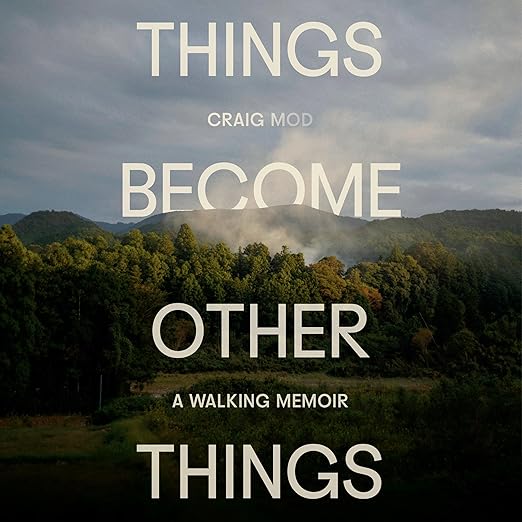
Before You Press Play
- Read by: Craig Mod reads his own work with unhurried intimacy; the deliberate cadence mirrors the walking rhythm of the journey itself, and the self-narration carries unmistakable personal authority.
- At its heart: Grief and memory, Japan's rural depopulation, the transformative work of long walks
- Vibe: Meditative, sharp-eyed, and unexpectedly tender
- Short version: Among the best walking memoirs of the past decade; the audiobook format deepens the contemplative texture of Mod's prose in ways the page cannot fully replicate.
Craig Mod's Things Become Other Things arrives in audiobook form with Mod himself at the microphone, and from the first minutes it is clear this is the only version that makes complete sense. The book documents a 300-mile walk along Japan's Kumano Kodo pilgrimage routes in 2021, during the pandemic border shutdown that kept most of the world out of the country, but to describe it purely as a travel account undersells what Mod is attempting. This audiobook runs five hours and thirty-seven minutes, narrated by the author, and includes a downloadable PDF of Mod's photographs. The walk becomes a structure for something harder: mourning a friend whose life ended too soon, accounting for his own unlikely trajectory from a post-industrial American town to a permanent life in Japan, and bearing witness to villages that are quietly emptying out generation by generation as their elderly populations age without replacements arriving.
William Gibson Calls It Epic and Exquisitely Detailed
William Gibson, who does not give commercial endorsements casually, called this "an epic, exquisitely detailed journey" and "uniquely unforgettable." That last phrase does real work. What Mod achieves on the Kii Peninsula is a specific kind of attention, the kind that opens up only when, as he puts it, "you're bored out of your skull and the miles left are long." His prose catches things that ordinary travel writing misses: aging fishermen described with the precision of someone who watched them for an hour, the particular quality of a kissaten cafe at seven in the morning where the proprietress has made the same coffee the same way for thirty years, the foul-mouthed kids who ask him "Just what the heck are you, anyway?" because a bicultural American in his forties walking solo through their peninsula is genuinely strange.
One reviewer captured the writing's quality in terms worth repeating: "The contrast in the writing is mesmerizing: evocative but playful; factual yet abstract; subtle yet poignant. Meandering prose." That balance is difficult to hold for an entire book and Mod holds it. The grief for his lost friend, whose story enters the walk in fragments offered in glimpses rather than delivered as a single extended section, never overwhelms the landscape writing, yet it changes the texture of everything he observes. The friend's absence is structural rather than decorative. You feel it in the moments when Mod notices something beautiful and has no one to tell.
Mod's Own Unhurried Pace Matches the Walk
The self-narration is the audiobook's primary argument for choosing audio over print. Mod is an essayist and photographer by training, and he reads with the same unhurried precision he brings to his writing. The long pauses between observations feel intentional rather than hesitant, and the rhythm of his delivery maps onto the rhythm of walking in ways that a professional narrator, however skilled, would struggle to replicate without the lived experience of the walk itself. Reviewers who encountered both the print and audio versions reported wanting to begin the book again immediately after finishing, the kind of response that signals texture worth revisiting rather than simply plot worth retelling.
The PDF of photographs included with the audiobook edition is genuinely worth downloading before you begin. Mod describes evidence of floods and tsunamis, the light of the peninsula's coastline at different hours, the particular quality of rural Japanese architecture in various states of habitation and abandonment, and seeing those images changes what the prose means. At just under six hours, the runtime is precisely right for the material. This is not a book that would benefit from being longer, and it is not one that feels truncated.
What Japan Looks Like When No One Is Watching
The book is structured associatively rather than chronologically. The walk provides the forward momentum, but Mod moves freely between the Kii Peninsula in 2021, his childhood in America, his experience as an adoptee arriving in Japan at nineteen, and his memories of the friend whose loss shadows the entire journey. This structure could feel undisciplined in lesser hands. Here it works because each association is earned. The connections are not forced, the transitions are legible, and the rhythm of the walk itself keeps the reader oriented even when the narrative drifts into memory. The Shinto and Buddhist context of the Kumano Kodo routes is woven in without becoming a lecture; Mod converses with priests, observes mountain shrines, and walks paths that pilgrims have walked for centuries, holding this history lightly enough that listeners who know nothing about Japanese religious tradition will not feel excluded.
The depopulation of the villages deserves particular notice as a theme. Mod does not romanticize decline and does not perform sadness about it. He records what he sees with precision: the proportion of houses where shutters have not been opened in months, the arithmetic of an aging population with no young people arriving. The nature that returns to claim abandoned settlements is specific and slightly threatening and very much alive. This is not a book about a beautiful Japan preserved for tourists. It is a book about what Japan looks like when almost no one is watching.
For Readers of Macfarlane, Dyer, or Solnit
Readers who have responded to writers like Robert Macfarlane, Geoff Dyer, or Rebecca Solnit, essayists who use physical movement as a structure for richer thinking, will find a natural home in this book. It requires patience with an associative, non-linear form; readers who prefer narrative drive and clear chapter-by-chapter progression may find the rhythm elusive at first, though it rewards persistence. Prior knowledge of Japan helps but is not required. The grief at the book's heart is handled with restraint, arriving quietly rather than dramatically, which means listeners looking for emotional catharsis of the conventional kind should calibrate their expectations. Download the photograph PDF before you begin listening.