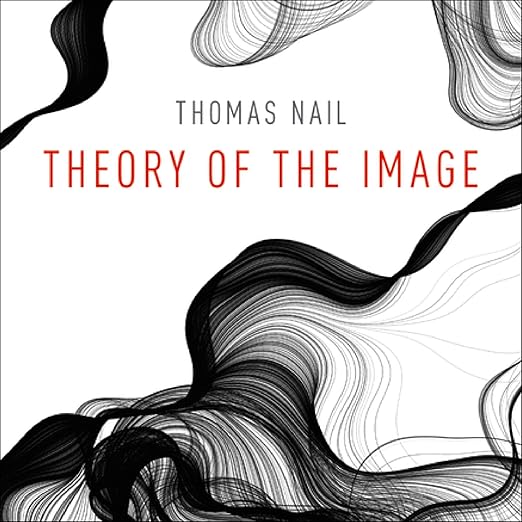
Nine ratings, not one written response, and sixteen hours of philosophy about why pictures will not hold still. This audiobook is not courting a general audience by accident. Thomas Nail's project is a history of Western art told entirely through motion, and the claim underneath it is that the image has almost never been understood as something fundamentally in movement. Oxford University Press published the book. University Press Audiobooks produced the recording, with Doug McDonald reading.
Nail's starting observation is easy to accept; the argument built on it is not. We live surrounded by images circulating at speeds no previous century could have produced, and Nail treats that acceleration as a genuine historical rupture rather than a matter of degree. If the image is now defined by its mobility, then aesthetics and art history both need rebuilding from the ground up. That is the wager, and he spends the full length making it.
Philosophy Wearing Art History's Coat
What follows is described on the page as the first kinetic history of the Western art tradition, running from prehistory to the present and closing on the contemporary digital image and its hybridity. The scope is enormous and the method is materialist, meaning the analysis stays with what images physically do rather than with what they represent. Anyone who has read Nail's earlier work on movement will recognize the machinery being extended into a new domain.
It should be said plainly that this is philosophy wearing art history's coat. The description names aesthetics, art history, cultural theory and media studies as the areas it opens new territory in, which is four disciplines and an admission that it belongs cleanly to none of them. Listeners who arrive expecting a tour of paintings will meet a theoretical apparatus first and specific artworks second.
Whether McDonald's Delivery Suits Text This Technical
The genuinely interesting move is refusing the usual periodization. Art histories tend to advance by style, by nation or by century. Organizing the same material by kinds of motion cuts across all three, which is the sort of reframing that either produces real insight or produces a very elaborate restatement. The description presents the framework as one Nail has been building elsewhere rather than improvising for this book, which makes the ambition at least an informed one.
Sixteen hours is a serious commitment and, for once, the right shape for the material. A dense theoretical argument spread across a full historical sweep needs room to lay out its terms before applying them, and abridgment would leave the framework standing on nothing. Listeners who work through academic monographs by ear rather than by eye will recognize this length as the price of an argument that actually builds.
The imprint's name declares its purpose: scholarly monographs that would otherwise never reach audio at all. That matters, because the alternative for most listeners is not a different recording of this book. It is no recording. A small house bringing an Oxford philosophy title into audio is doing work the large audio publishers have no commercial reason to do, and the catalog is better for it.
Silence in the review column works in two directions. Nine people have rated this and the average sits at 4.8, which is a strong number from a tiny, self-selected group, and every one of them declined to write anything down. That is normal for academic audio. It also means ratings alone cannot indicate whether McDonald's delivery suits a text this technical, and a demanding monograph punishes a reading that drifts.
Filed Under Art, Demanding Materialist Philosophy
The obvious problem is the one the title advertises. A book about images, delivered with none. Nail's readings of specific works, prehistoric marks, classical sculpture, painting, film, digital media, have to travel entirely through description, and the listing announces no accompanying visual material. Some of the analysis survives that intact, because the argument is about kinds of movement rather than about what a particular canvas looks like. Some of it plainly will not.
Genre placement is another thing to check before buying. This sits under Arts and Entertainment with an Art tag, which puts a continental-philosophy monograph beside popular art appreciation and artist biographies. Nothing in the classification warns a browsing listener that the vocabulary assumes familiarity with materialist philosophy, or that the first hours are spent constructing terms rather than looking at pictures.
No Flipping Back to Check a Definition
Prior reading is effectively assumed even though nothing says so. The description positions this as a further development of Nail's larger philosophy of movement, which means the framework arrives partly pre-built. A listener who has not met that framework will still follow the sentences, but the significance of the moves will be harder to weigh, and audio removes the option of flipping back three chapters to check a definition.
Difficulty compounds by ear in a way that is easy to underestimate. Theoretical prose depends on precise repetition of technical terms, and the eye tracks that repetition automatically while the ear does not. Anyone planning to use this academically should expect to run passages twice and should consider having the printed text nearby for the sections where the terminology stacks up.
The Sample Is the Only Test That Counts
Graduate students and researchers in aesthetics, media theory and art history are the obvious constituency, particularly anyone already working with Nail or with the wider turn toward movement in contemporary theory. For that reader the audio edition solves a real problem, since dense monographs are among the hardest books to find time to read and among the easiest to listen to during work that occupies the hands.
A second constituency deserves naming as well: practicing artists and curators who think structurally about circulation, reproduction and the life of an image after it leaves the studio. The argument has direct purchase on how work moves through networks, and the historical sweep supplies a long view that most contemporary writing on digital images lacks entirely. Nail treats reproduction and circulation as constitutive of what an image is rather than as things that happen to it afterward, which reframes questions about editions, copies and platforms that working artists usually meet as legal or commercial problems.
Casual art-history curiosity will not survive the first hour, let alone the full run. Anyone wanting a narrative history of painting should look for one. Listeners who need visual reference to follow analysis of specific works should buy the printed edition instead, or at least alongside. Nothing on this page tells you how the recording sounds, so the sample is the only test that counts.
At a Glance
- Read by: Doug McDonald reads for an imprint built on academic conversions, and no listener on the page has judged the result.
- At its heart: Kinetic theory of art, materialist aesthetics, prehistory to digital media, images defined by motion.
- Vibe: Dense, systematic and demanding, with the payoff held back until the framework is standing.
- Short version: Essential for theory readers, punishing for anyone else, and permanently missing the pictures it discusses.
A Few Questions About Theory of the Image
What background does the Theory of the Image audiobook assume?
More than the Art tag suggests. The description presents the book as a further development of work Nail has been building elsewhere, so the framework arrives partly assembled. No prior title is named as required, but listeners without a grounding in materialist philosophy should expect the opening hours to feel like vocabulary construction rather than art history.
Does an audiobook about images work without seeing any?
Partly. The argument concerns kinds of motion rather than the surface of individual works, so the theoretical spine travels intact. Passages analyzing specific objects across prehistory, classical sculpture, painting and digital media rely on description alone, and nothing arrives alongside the audio to supply what an eye would have.