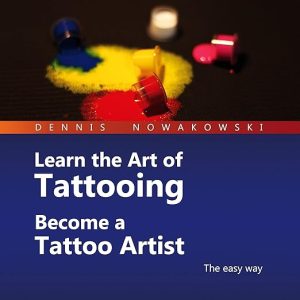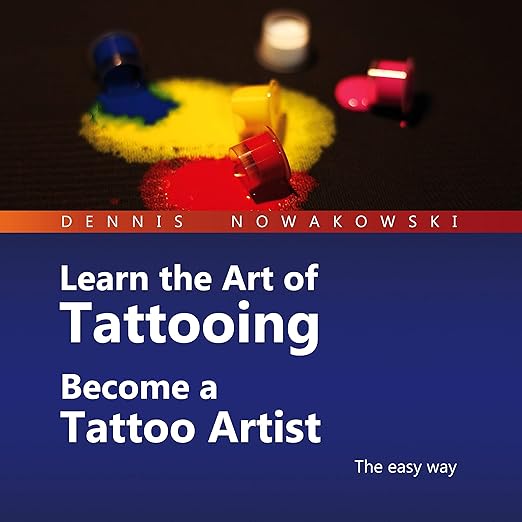
Tattooing as a craft resists the audiobook format in ways that most instructional topics do not. Every element that makes tattooing learnable: needle configuration, line weight, color mixing ratios, stencil placement, is fundamentally visual and tactile rather than verbal. Dennis Nowakowski's Learn the Art of Tattooing - Become a Tattoo Artist acknowledges this in its synopsis by describing itself as covering motifs, machines, needles, and colors, but an honest assessment of how well that material translates to pure audio requires engaging with what two reviewers report about the production quality of this specific title.
A Career Pipeline From Needle to Studio
The audiobook covers the career pipeline of a prospective tattoo artist: understanding the artistic and technical requirements of the craft, setting up a workstation, selecting machines and needles, handling color correctly, managing client relationships, and eventually running a studio. At 5 hours and 52 minutes, the runtime is appropriate for an introductory overview rather than a comprehensive technical manual, and the scope reflects that. This is a survey of what the field requires rather than a detailed instruction set for any individual component.
The Narrator's Mistakes Were Never Edited Out
The substantive criticism in the available reviews concerns two areas. The first is production quality: one reviewer notes that the narrator's mistakes were not edited out of the final recording, which is a basic failure for any audiobook production regardless of subject matter. When an instructor in any craft field leaves errors uncorrected in a learning resource, it undermines the authority of the surrounding content. James Ingram's delivery is also described as poorly executed, which compounds the issue. For a book about a craft that demands meticulous precision at the needle level, a sloppily produced audio equivalent creates a genuine credibility problem that the material itself cannot fully overcome.
The second area of criticism concerns the client management chapter, where one reviewer stopped listening entirely, citing generalizations and profiling as the reason. Client relationships in tattooing are genuinely complex. Artists must manage pain tolerance, communication about design changes, health considerations, and the often emotionally charged significance of permanent body art. A chapter that reduces that complexity to generalizations fails the listener on a professionally consequential topic.
One of Very Few Audiobooks in the Niche
The technical fundamentals section is described by at least one reviewer as reasonable for beginners. The sanitization protocols, workstation setup, and basic equipment information are factually standard and functional as an introduction to what the profession requires. For someone with no background who wants a verbal overview of the tattooing landscape before committing to an apprenticeship or more specialized training, the core technical content provides a reasonable orientation to the field's demands and its professional standards.
The audiobook is also one of very few in this specific niche. Tattoo artistry is primarily taught through apprenticeship and visual demonstration rather than through written or audio resources, which means the genre is sparse. The absence of competition does not make a mediocre entry excellent, but it does mean that even an imperfect audio introduction occupies a space that is otherwise mostly unfilled. Prospective tattoo artists who learn well from listening while their hands are otherwise occupied, sketching designs, for instance, may find value in having the career framework narrated even when the production quality leaves much to be desired.
A Single Author's View of a Varied Craft
The book also reflects Nowakowski's individual perspective and experience rather than a community or professional consensus. Tattooing practices vary significantly by style, regional culture, and professional community, and an audio resource from a single author presenting a particular way to handle specific situations may not reflect the range of legitimate approaches in the field. Apprenticeship under an experienced artist in a reputable studio will teach more in a week than this audiobook can convey in six hours, which is simply the nature of craft learning for this discipline.
Listeners who are serious about entering the tattooing profession should also be aware that regulation of the industry varies significantly by location. The audiobook covers general professional practice without engaging specifically with licensing requirements, health code compliance, or the legal dimensions of studio operation in different jurisdictions. Treating the book as a career orientation rather than a comprehensive professional guide is the appropriate framing for what it actually delivers.
Treating Tattooing as a Health Service First
The sanitization and health standards covered in the technical sections are worth acknowledging specifically, because this is an area where misinformation can cause direct harm. Nowakowski's treatment of bloodborne pathogen protocols, sterilization procedures, and cross-contamination prevention is described as factually standard by the reviewer who credits the technical content as reasonable. For a beginning listener who has no reference point for professional tattooing health standards, having those protocols described in detail before anything about artistic technique provides the right professional framing: tattooing is a health service first and an art form second, and any introduction to the field that reverses that priority does a disservice to beginners.
A Supplement to Hands-On Learning, Not a Foundation
Complete beginners curious about the tattooing profession who want an audio orientation before committing to deeper study or an apprenticeship search will find the technical overview sections adequate for that exploratory purpose. Listeners who can tolerate variable production quality and are not relying on the audiobook as their primary training resource will get more from it than those who expect a polished instructional experience. Experienced tattoo artists will find nothing new here. Anyone seriously pursuing a career in tattooing should treat this audiobook as a supplement to hands-on learning rather than a training foundation, because the format's limitations in conveying visual and tactile craft knowledge are simply too significant for this particular subject matter to fully overcome.
Is the production quality of the Learn the Art of Tattooing - Become a Tattoo Artist audiobook acceptable?
Reviewers report that narrator mistakes were left unedited in the final recording, which is a meaningful quality control failure. James Ingram's delivery is also described as poorly executed in at least one review. Listeners sensitive to production quality should factor this in before purchasing.
Does this audiobook include guidance on needles, machines, and color work, or only general career advice?
The content covers both technical material, including machines, needles, color handling, and workspace setup, and career management topics like client relationships and studio operation. The technical sections are described as reasonable for beginners. The client management chapter receives more critical reception from reviewers.
Can an audiobook realistically teach tattooing techniques given how visual and tactile the craft is?
No audiobook can substitute for hands-on practice and visual demonstration in tattooing. This title functions as a verbal orientation to what the field requires, not as a technical training tool. Aspiring tattoo artists should prioritize apprenticeships under experienced artists for actual craft development.
Who is the target audience for this audiobook on tattooing, and what level of experience does it assume?
The content is positioned for complete beginners with no prior tattooing experience. It covers foundational concepts about equipment, hygiene, client interaction, and studio operation without assuming existing knowledge of the craft. Intermediate practitioners or working artists will find the material too introductory for their level.