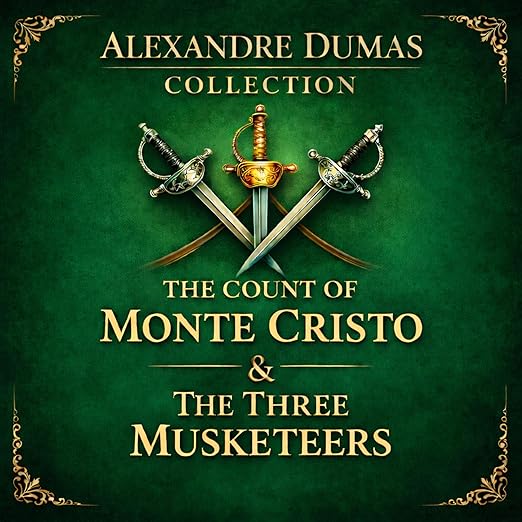
Alexandre Dumas wrote The Count of Monte Cristo and The Three Musketeers in the 1840s, producing two of the most widely imitated adventure narratives in Western literature in the process. This audiobook collection pairs them in a single seventy-nine-hour package narrated by Roberto Scarlato, and the sheer scale of that runtime is the first thing any prospective listener needs to reckon with honestly. At nearly eighty hours, this is not a casual commitment: it is closer to a months-long project for a regular listener, or an intensive multi-week focus for someone with serious daily listening time. The collection rewards that commitment, but it asks for it upfront rather than earning it incrementally.
The reviews in the data point to something interesting about how listeners have engaged with this specific collection. The most enthusiastic reviewer explicitly noted the translations are respectable while wishing for the French originals, and the critical reviews focused entirely on the physical print edition's impractical size and tiny font. This tells you something important about who has bought this collection and in what format: a significant portion came for a print omnibus and encountered its physical limitations. Scarlato's audio performance is the relevant question for listeners here, and the collection's 3.2 rating almost certainly reflects those print complaints rather than the audio experience itself.
Monte Cristo's Long Game, The Musketeers' Breezy Pace
The two novels paired here could not be more different in their narrative architecture. The Count of Monte Cristo is a long game: Edmond Dantès's imprisonment, transformation, and return as a figure of terrible purpose unfolds across hundreds of chapters and multiple decades of fictional time. The structure is deliberately slow at its centre, building toward a series of revelations that Dumas plants and detonates across the novel's enormous span. The Three Musketeers is comparatively breezy, moving through a series of adventures, duels, and political plots at a pace more suited to the episodic publication format in which it originally appeared. Pairing them creates an eighty-hour listening experience that shifts register dramatically between the two works, and Scarlato must shift with it.
Scarlato's narration suits the theatrical quality both novels share. Dumas wrote for serialised publication in newspapers, which means both texts are built for propulsion: scenes end at moments of tension, revelations are timed for maximum effect, and each major character is drawn in bold enough strokes to be immediately legible across hundreds of pages. In audio, that quality translates well. The material is designed to be consumed in episodes, which makes the listening experience feel more natural than the length might initially suggest to someone looking at the runtime in abstract.
Scarlato's Consistency Across Seventy-Nine Hours
The audiobook format resolves, at a stroke, the one complaint that the print reviews raise most consistently: the physical awkwardness of a three-to-four-inch paperback with very small font that requires both hands to hold open. Audio removes the medium entirely, leaving only the story and Scarlato's performance. For listeners who have wanted to read these novels but found the physical or time commitment daunting in print form, this collection presents both works in their full, unabridged scope without the page-turning fatigue or the eye strain.
Both novels are in the public domain, and translations of varying quality exist in numerous editions. The translation used in this collection has been described as respectable rather than distinguished, which is worth knowing in advance. For listeners who have never read either novel, the translation will not be a limiting factor: both stories are strong enough that a workmanlike translation renders them fully. For listeners who have read excellent translations of either novel and are returning to the text in audio, the translation quality may be more noticeable in places.
The collection also provides a useful continuity of narrator across both works, which matters significantly at this total length. Scarlato's consistent characterisation approach means that the shift from Monte Cristo to Musketeers feels like a deliberate change of register rather than a jarring break in the listening experience, and listeners who commit to the full seventy-nine hours will find that the listening stamina built during the first novel serves them well in the second.
A Seventy-Nine-Hour Commitment for Dedicated Listeners Only
Seventy-nine hours is the primary consideration, and it deserves more than passing acknowledgment. This is not a collection for casual listening or for someone who wants to sample Dumas and decide whether to continue. The Count of Monte Cristo alone would be one of the longer audiobooks most listeners encounter in any given year. Pairing it with The Three Musketeers creates a commitment that only listeners with genuine dedication to these texts, or with the specific listening habits that make very long audiobooks sustainable, should undertake. Those who want one or the other in isolation would almost certainly be better served by standalone editions.
The 3.2 average rating is misleading in context. The critical reviews that pull the score down are transparently about the print edition, complaining about font size and physical unwieldiness that are entirely irrelevant to audio. Listeners evaluating this collection for audio purposes should weight the content reviews rather than the format complaints, and should understand that the audio experience is likely to be substantially more positive than the aggregate rating suggests.
The Audio Format Resolves Every Print Complaint
This audiobook collection suits listeners who want to experience both Dumas novels in their full unabridged form and who have the listening commitment and discipline for an eighty-hour project undertaken over several weeks or months. It is an excellent choice for dedicated listeners who prefer classic nineteenth-century adventure literature in audio and who have not previously spent sustained time with either novel. Those with a clear preference for just one of the two novels should consider a standalone edition rather than committing to the full collection. Listeners with high sensitivity to translation quality may want to research the specific translation used before committing to the full runtime. The audio format resolves every complaint the print reviews raise.
Frequently Asked Questions
Does the audiobook collection include both novels in their complete, unabridged form, and roughly how long is each one?
The total runtime is seventy-nine hours and three minutes, covering both The Count of Monte Cristo and The Three Musketeers unabridged. The exact split is not specified in the collection data, but Monte Cristo is substantially the longer of the two novels, so listeners should expect the first novel to occupy a majority of the total runtime.
Is this audiobook collection a good entry point for listeners who have never read Alexandre Dumas?
Yes, with the caveat that the commitment is significant. If you want to try Dumas in audio before committing to nearly eighty hours, a standalone edition of The Three Musketeers, which is lighter in tone and faster-paced, would be a sensible starting point before deciding whether the full collection is worth the investment.
The print reviews mention font size and physical format issues. Do those problems affect the audiobook version of this collection?
No. Those print complaints are entirely irrelevant to the audio experience. The audiobook removes the physical medium entirely, and Scarlato's narration presents both texts without any of the accessibility issues the print reviews describe. The 3.2 average rating reflects print buyer dissatisfaction rather than audio quality.
How does Roberto Scarlato handle the tonal difference between the two novels across such a long audiobook runtime?
The two novels have genuinely distinct registers: Monte Cristo is dark, deliberate, and architecturally complex, while Musketeers is more episodic and swashbuckling. Scarlato adjusts his performance to reflect those differences across the full collection, which is essential for sustaining listener engagement across nearly eighty hours of material.