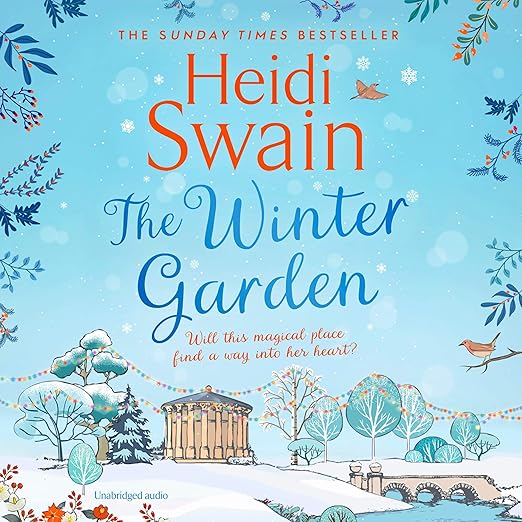
Quick Take
- Narration: Karen Cass brings warmth and gentle Suffolk cadence to Freya’s voice, well-suited to cozy seasonal romance.
- Themes: Second chances, community belonging, gardening as emotional labor
- Mood: Cozy and soft-edged, with a slow-burn antagonism that gradually thaws
- Verdict: A predictable but genuinely pleasant Christmas listen that delivers exactly what Heidi Swain readers expect from the Nightingale Square series.
There is a particular kind of audiobook that works best on a grey November afternoon when you have no urgent plans and a warm drink within reach. I finished The Winter Garden in almost exactly that setting, which is probably the most generous possible context for it. Heidi Swain writes comfort fiction with intention: she knows her audience, she knows the season, and she delivers. Whether that is enough depends entirely on how much you value surprise versus atmosphere.
This is the third book in the Nightingale Square series, and while it functions as a standalone in terms of its central plot, it assumes a familiarity with the community of Nightingale Square that makes newcomers feel slightly like late arrivals at a party. The returning residents appear with a warmth that suggests backstory, and some of that warmth is unavailable to listeners who have not spent time with the earlier books. That said, Freya Fuller is an immediately legible protagonist: she has lost her live-in gardener position on a Suffolk estate following the death of its owner, and she arrives in Nightingale Square with very little but her skill set and her late employer’s dog, Nell.
Our Take on The Winter Garden
The central conflict, Freya and local artist Finn’s persistent failure to get along while working together to build a winter garden for public opening before Christmas, is well-calibrated for this kind of story. The antagonism is light enough to be fun without producing genuine dramatic tension, and the garden project itself gives the narrative a structure and momentum that keeps it from drifting into pure domestic tableau. Swain writes about gardening with actual knowledge: the winter planting sequences, the logistics of opening a Victorian mansion garden to the public, the seasonal rhythms of what survives a hard frost. That specificity lifts the book above generic seasonal romance.
The complication introduced by a face from Freya’s past is handled with more restraint than you might expect. Rather than manufacturing artificial stakes, Swain uses the arrival to clarify what Freya actually wants and to force a choice the character has been avoiding. One reviewer noted that the story is like one big cuddle in a book, which is both accurate and a good measure of whether this audiobook is for you. If a cuddle is what you are after, this delivers. If you need genuine uncertainty about the outcome, the genre’s conventions will feel like limitations here.
Why Listen to This Instead of Reading It
Karen Cass is the right choice for this material. Her voice is warm without being saccharine, and she handles the Suffolk and London registers in the cast with enough variation to keep the characters distinct without leaning into parody. The gentle pace of her delivery matches the story’s own unhurried tempo. At just over ten hours, The Winter Garden is best consumed in long, unhurried sessions rather than commute-length fragments. The atmosphere is cumulative, and the gardening sequences in particular benefit from uninterrupted listening. A different review noted that it had a slow start but settled into an easy rhythm after the first few chapters. That is accurate: give it an hour before deciding.
What to Watch For in This Audiobook
The most consistent criticism in the reviews concerns Freya’s narrating voice, which one listener described as whiny and virtue signaling enough to prompt a DNF. That is a minority view and probably reflects a mismatch with the genre’s conventions rather than a structural flaw in the writing. Swain’s protagonists tend toward self-reflection and moral sensitivity, and readers who find that register grating will struggle here regardless of quality. The romance itself is kept at a notably clean register: kisses are described in detail, but nothing more explicit enters the narrative. For listeners who prefer their seasonal romance without heat, that is a feature. For others, it may read as a gap.
Who Should Listen to This Audiobook
Fans of Carole Matthews, Cathy Bramley, and Sarah Morgan will feel immediately at home here. Listeners who want a December audiobook that centers gardening, community, and low-stakes romance rather than family drama or holiday chaos will find this a good fit. Those new to the Nightingale Square series might prefer to start with Book 1 for full emotional payoff from the returning cast. Anyone looking for plot complexity or tonal variety should look elsewhere.
Frequently Asked Questions
Can The Winter Garden be listened to without reading the earlier Nightingale Square books?
Yes, Freya’s story is self-contained and the central romance resolves within this book. However, the returning Nightingale Square community members will have more emotional weight if you have spent time with the earlier entries. The gardening and romance plot stands alone, but the community warmth deepens with prior context.
Is Karen Cass’s narration consistent with the rest of the Nightingale Square series?
Karen Cass has narrated the Nightingale Square audiobooks, making her voice part of the series’ established audio identity. Her warm, measured delivery is well-suited to Swain’s writing style and the cozy seasonal atmosphere.
How explicit is the romance in The Winter Garden?
The romance is kept light in terms of physical content. One reviewer specifically noted that only kisses are described in detail, with nothing more explicit. Listeners who prefer clean romance will be comfortable; those looking for more heat will find this book on the milder end of the spectrum.
Does the gardening content in The Winter Garden require prior horticulture knowledge to enjoy?
Not at all. Swain uses the winter garden project as atmosphere and emotional backdrop rather than horticultural instruction. The planting and design sequences are descriptive and sensory rather than technical, making them accessible to non-gardeners while still feeling authentic to someone with actual garden knowledge.