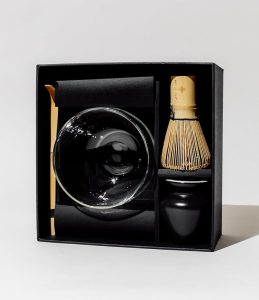
Nothing on this listing describes the book. The space where a publisher would summarize seven hours and forty-three minutes of tea talk is empty from top to bottom, and the two written responses underneath belong to a matcha whisk and bowl set that somebody had shipped to their house. What remains is an audiobook with a title, an author, a credited reader and a runtime, plus no account anywhere of what happens inside it.
Here is the complete inventory of what this page establishes. Steve Schwartz wrote it. Jay Aaseng reads it. It is filed under food and drink, it carries the title Art of Tea, and it runs long enough to be a substantial treatment rather than a primer. No publisher is named. No release date appears. The series line sits blank, so nothing indicates whether this stands alone or belongs beside other volumes.
Then the responses. Both are shopping complaints about a physical object: one describes thin glass that shattered in a sink and a whisk and scooper with splitting wood, the other a set that turned up in a damaged box with the whisk missing altogether. Neither mentions a book, a chapter, an author or a voice. They are retail feedback for tea equipment, attached to a recording about tea by what can only be a catalog error.
Arithmetic on the rating line makes the same point. It shows 3.2 from three votes, and three whole-star votes cannot produce 3.2 at all, since the nearest reachable figures are 3.0 and 3.3. Whatever score is being displayed, it was not computed from three ordinary star ratings on this entry. Add two written grades that belong to a kitchen product and the number stops carrying any information about the recording.
Tea Suits Audio, and Aaseng Carries It
Set the page aside and consider the proposition. Tea is one of the few practical subjects that genuinely suits long-form audio, because most of what a beginner needs is sequence and patience rather than pictures: water temperature, steeping time, leaf quantity, the order of operations for a given style. Those are instructions you follow with your hands busy, which is the exact situation the format was built for.
Length is the one substantive signal available. A treatment this size is not a quick guide; it sits closer to the range a publisher reserves for history, cultivation, processing and regional styles taken one at a time. Whether Schwartz actually spends it that way is precisely what the page declines to say, but a buyer weighing the purchase should read that number as a promise of breadth rather than convenience.
Jay Aaseng carries all of it alone, and on instructional material read straight through, the reader's job is unglamorous and decisive: keeping numbers distinct, keeping lists from blurring together, signaling where one section ends and the next begins. A sample is the only test available here. A short stretch of it will tell you whether the pacing suits material you mean to follow rather than merely absorb.
Four Purchases This Description Cannot Distinguish
Consequences of the empty description are practical. You cannot tell whether this is a cultural history, a brewing manual, a business book about the tea trade, or a memoir with recipes folded into it, and those four purchases suit four different people. You cannot tell whether it was written for a market outside the one you buy in. You cannot even tell how it divides, which matters when a chapter list is your only navigation.
A missing publisher line matters more than it looks. Without one you have no production house to judge, no imprint whose other recordings you might already know, and no way to tell whether this came out of an established audio program or was assembled independently. The absent release date compounds it: a tea book from a decade ago and one from last year make different assumptions about what is available to buy.
Transplanted responses cost you something beyond confusion. On an entry with three ratings and no description, written feedback is the only evidence a buyer would ordinarily have, and here it has been spent on packaging and glassware. Anybody researching this before purchase will find an account of a cut hand and a missing whisk, which is memorable, alarming, and completely irrelevant to whether the recording is any good.
Genre placement adds a smaller wrinkle. Filed under home and garden with a food and wine tag, the entry stands beside gardening manuals and cookbooks rather than beside the cultural histories a long tea book might belong with. Should the recording turn out to be history rather than instruction, the shelf it is sitting on will keep the right listeners from finding it, and nothing in the entry corrects for that.
Sample It First if You Are Unsure
Tea drinkers already deep enough into the subject to recognize a competent treatment from its first minutes are the only people who can buy this safely, because they are the ones a sample will actually inform. Should the approach to water temperature and leaf ratio sound serious straight away, the missing description costs you very little and the length starts to look attractive.
A second group worth naming: listeners who collect long-form treatments of single subjects and are content to be surprised by the shape. Nearly eight hours on one plant, from an author willing to spend that much time on it, carries its own appeal regardless of the specific approach. That buyer is not being asked to trust a summary, since none exists, and is purchasing the topic on its own terms.
Everyone else should wait until the page says what the recording contains. Beginners in particular are being asked to pay real money for an unlabeled box, and beginners are exactly the buyers a missing contents list hurts most. Sample it, and if the opening sounds like the book you wanted, the absence stops mattering. If it does not, nothing else on this entry will help you decide.
Good to Know
Does the audiobook work as a practical brewing guide?
Impossible to promise from the page, which describes no contents at all. Test it in the sample: a practical guide states quantities, temperatures and timings within its first few minutes and repeats them clearly enough to follow without a screen. A cultural treatment will open with history instead. Both are legitimate books, but only one brews you a cup.
Should I sample this audiobook before buying, or is that being overcautious?
Sample it without hesitation. On a normal entry a summary and a few responses let you skip that step, and neither exists here in usable form. A couple of minutes of a credited reader working through actual material will tell you more than every other element on this page put together.