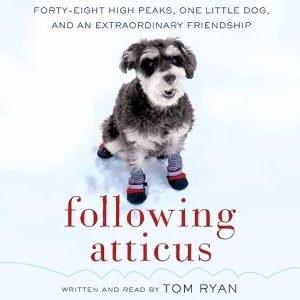
Two winters, forty-eight peaks, twice each, in the dead of a New Hampshire January, with a miniature schnauzer setting the pace. That is the shape of Tom Ryan's memoir, and the audiobook has one enormous advantage over the page: the man who did it is the one telling you about it, nine hours of a newspaperman's voice describing the coldest thing he ever chose to do and the small dog who made him keep choosing it.
A Closer Look at Following Atticus
Tom Ryan was a small-town journalist who owned and ran his own paper, which is the detail that explains the book's texture. He writes short, he writes for readers who are in a hurry, and he does not decorate. The background arrives before the mountains do, and that is the right order, because this is a reporter's memoir before it is an adventure story.
Max came first, and the book does not really work unless you know that. A five-star account from October 23, 2011 describes the e-mail that started everything, an acquaintance looking to rehome a miniature schnauzer, and the short time the two of them had before Max died. Atticus arrives afterward, from a breeder, into a house shaped by that loss. The climbing is what happens next, not what the story is about.
The description reaches for Into Thin Air and Marley and Me in the same sentence, and honestly, both comparisons are half right. The mountaineering is real and occasionally frightening, winter above four thousand feet does not forgive much, but nobody is summiting for glory here. What the book is actually doing is watching a man in his forties discover that a dog has organized his life around something other than deadlines and grievances.
What Makes Following Atticus Worth Hearing
Winter in the White Mountains is the setting, and it carries much of the book's tension. Ice, wind, four thousand feet of elevation and very short daylight give the walking sections real tension, and Ryan is good on the practical texture of it, the gear and the turnarounds and the decisions made at the wrong hour. Forty-eight peaks twice over is a target that generates its own suspense.
Ryan reads the memoir himself, which is the correct decision for this particular book. Author narration usually trades polish for authority, and here the authority is the whole product: nobody else can put the right weight on a dog's name. A memoir about grief and stubbornness in an unfamiliar landscape is exactly the case where hearing the person who lived it beats hearing somebody perform it more smoothly.
Loss is the engine underneath the hiking, and it keeps widening as the book goes. What starts as one dog's death becomes something about mortality generally, about a father, about the body at an age when it stops volunteering. A UK response from January 2013 puts it simply, saying the book produced laughter and at times tears, and that ratio is about right. The same account came to it by way of a stranger in a park who spotted a matching schnauzer, which is a fair summary of how this book has always spread.
Newspaper work explains the other half of Ryan's voice. The September 2011 verdict, five stars and the earliest here, comes from somebody who knew him first as the editor of a local political journal called The Undertoad, reviled by some and loved by many for intrepid reporting and stands against authority. That combative streak survives into the memoir, and it keeps the sentiment honest.
Things to Know Before Starting Following Atticus
Four ratings, five written verdicts. The counter on this page says four people have graded the book, and yet five graded responses sit right below it, so the counter is broken. The average is stranger still: four whole-star votes can only average 4.5 or 4.75, which display as 4.5 and 4.8. A 4.6 cannot come out of four votes at all. Treat the score as decoration and read the responses instead.
Fundraising never appears in the description, and it should. The page's only four-star verdict, written in Italian and filed from the Italian storefront in June 2019, describes a journalist who climbs the New Hampshire mountains to raise money for cancer research. That is a substantial part of why the climbs happened, and a buyer reading the sales copy alone would take the whole thing for a personal quest.
Storefronts scatter this pool across four countries, which is unusual for a memoir about one small corner of New England. Responses arrive from the United States, the United Kingdom, Italy and Germany, and the page displays them in whatever language they were written in. That reach counts in the book's favor. It also means the handful of verdicts here were posted years apart, between 2011 and 2019, so none of it reflects a single moment of enthusiasm.
Who Tom Ryan Is Writing For
Dog people first, obviously, and hikers second, and after that a wider group than either: this is a book about starting again at an age when starting again looks unwise. Anybody who has lost an animal and has not decided whether they can face a book about one will find this gentler than expected, because the grief is spread out rather than saved for the end.
Steer clear if you want a technical mountaineering account. Route detail is thin, the peaks blur together by design, and a serious hillwalker looking for conditions and lines will be frustrated. Anyone who cannot tolerate an animal death in a book should also weigh this carefully, since one arrives early and the whole memoir is built on the far side of it.
Atticus is the reason this book outlasted its moment, and it is worth saying why. The dog is never cute, never anthropomorphized into a sidekick with opinions, and the description's Little Buddha tag is a joke about stillness rather than wisdom. Ryan gives him the dignity of an equal partner on a hard route, and that restraint is what keeps nine hours of hiking and mourning from turning sentimental.
A Few Questions About Following Atticus
How much of the audiobook is actually about climbing?
Less than the premise suggests. The forty-eight peaks give the book its structure and its deadlines, but long stretches sit in a New England town, in a newsroom and in the aftermath of a death. A German storefront response from April 2013 frames it as two friends who keep finding new paths, which is closer to the truth than any summit count.
Is there an animal death in this book?
Yes, and it arrives early rather than at the end. A first dog, Max, comes into the story before Atticus and does not stay long, and everything afterward is shaped by that loss. Listeners who avoid animal deaths in fiction should know it is handled with restraint here, but it is not avoidable.
Does Tom Ryan reading his own memoir make the audiobook better?
For this kind of book, yes. The prose is conversational and reported rather than literary, so a polished performance would add nothing and might sand off the edges. What you get instead is the actual voice behind the decisions, including the stubbornness, which is a large part of why the story is worth nine hours.