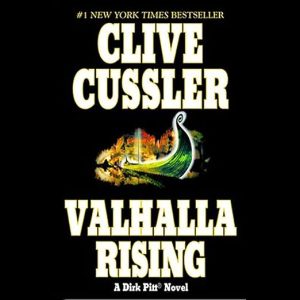
Dirk Pitt novels occupy a specific register in adventure fiction: unapologetically cinematic, globe-trotting, and constructed around the pleasures of watching a supremely competent man navigate impossible situations with style and occasional humor. Valhalla Rising, the sixteenth entry in Clive Cussler's flagship series, lands at a moment when Cussler's ambitions for the character were quietly shifting, and Ron McLarty's narration captures the propulsive energy that made these books a sustained publishing phenomenon. At six hours and five minutes, this audiobook compresses the novel into a tight listen that serves the genre's particular satisfactions, and the ending contains a development that distinguishes this volume from a pure formula installment and gives it a place in the series canon beyond its plot mechanics.
A Closer Look at Valhalla Rising
The setup is vintage Pitt. In July 2003, the luxury cruise ship Emerald Dolphin catches fire during its maiden voyage. NUMA special projects director Dirk Pitt races to rescue passengers and investigate the disaster. The revolutionary new engines powering the ship become central to the investigation, and what begins as maritime catastrophe quickly spirals into something considerably stranger, involving territory previously known only to legend and confrontations with what the synopsis calls monsters both human and mechanical, modern and ancient. Cussler plots these converging threads with practiced efficiency, and the novel moves through its six hours without the narrative lag that can undermine adventure fiction at longer lengths.
A reviewer who describes this as one of their favorite Dirk Pitt entries is responding to that plotting efficiency, and also to the ending, which they explicitly decline to spoil. That ending matters more to this entry than the typical adventure novel resolution does, because Cussler uses it to make a permanent change to Pitt's circumstances rather than resetting the character to baseline for the next volume. That willingness to actually change things in a long-running series is rarer than it should be, and it gives Valhalla Rising a significance in the broader series arc beyond its individual pleasures as a standalone thriller.
Ron McLarty's narration is the right voice for this material. The Pitt novels depend on momentum, on the sense that plot is moving faster than the listener can quite track without losing coherence, and McLarty's narration manages that quality without sacrificing clarity. Action sequences, which dominate a significant portion of the runtime, land with appropriate energy and scale. The quieter character moments, and there are more of them in this entry than in several preceding Pitt novels, are handled with equal ease. McLarty's delivery of Pitt's dry wit in crisis situations captures what Cussler's longtime fans have always found reliable about the character.
What Makes Valhalla Rising Worth Hearing
The audio format serves Cussler's descriptive instincts particularly well. The maritime disaster sequences, the underwater investigations, the confrontations with adversaries at scale all benefit from being heard rather than read, because McLarty's pacing creates a sense of physical immediacy that the set-pieces require. Cussler writes with the instincts of a screenwriter, building scenes for maximum kinetic impact, and those qualities translate more directly and efficiently to audio narration than they sometimes do on the page.
The Norse colonist subplot, which one reviewer finds somewhat contrived as a thread running through the Hudson River sections, is handled more compactly in audio than in print. McLarty's pacing across the six-hour runtime means the subplot does not drag the way it might in a more leisurely reading. Listeners who come to this with the previous fifteen Pitt novels as context will find the emotional payoff of the conclusion hitting with a weight that rewards series investment. Newcomers will still follow the plot entirely without that context, but will experience the ending differently, which is simply the reality of engaging with a series entry at volume sixteen.
Things to Know Before Starting Valhalla Rising
Series veterans should know that Al Giordino, Pitt's longtime NUMA partner, is less central to this entry than in several preceding novels. One reviewer notes this explicitly, describing Giordino as more like an afterthought than his usual prominent role. The shift is consistent with the novel's particular focus on Pitt navigating increasingly strange territory on his own terms, and the ending explains retrospectively why Cussler would have wanted to isolate Pitt more than usual in this volume. It is a deliberate creative choice rather than an oversight, even if it takes the full audiobook to understand why.
The genre metadata placing this in home-garden is a catalog error with no bearing on the content. This is unmistakably a maritime adventure thriller, sixteenth in the Dirk Pitt series, drawing on the full weight of the franchise's established world and cast. Listeners who enjoy action-driven adventure plotting, naval history threaded through contemporary thriller settings, and fiction in the Alistair MacLean tradition will find Cussler's register immediately familiar and comfortable. The six-hour runtime makes this one of the more accessible Pitt novels for listeners who want to sample the formula before committing to longer entries, while also delivering one of the series' more consequential conclusions.
Who Clive Cussler Is Writing For
Existing Dirk Pitt fans who have followed the series and are ready for a meaningful shift in the character's personal circumstances will get the most from this entry, and the payoff of the ending is substantially amplified by series familiarity. Adventure fiction listeners who enjoy maritime disaster scenarios, Norse mythology as contemporary thriller material, and high-octane adventure plotting will find the formula satisfying. Newcomers to Cussler can start here with sufficient context to follow everything, though the emotional impact of the conclusion is reduced without the sixteen-book history behind it. Those who prefer psychological interiority over action plotting will find this, like all Pitt novels, weighted heavily toward the external, with character serving the plot rather than the reverse.
At a Glance
- Narrator: Ron McLarty brings Dirk Pitt's characteristic swagger with the kind of unhurried confidence that suits Cussler's action-heavy pacing.
- Subjects: Maritime disaster, Norse legend woven into contemporary thriller, NUMA heroics under pressure
- Tone: Propulsive and old-school adventurous
- Bottom line: A satisfying Dirk Pitt entry that takes the character into unexpected emotional territory at its conclusion, with Ron McLarty's narration anchoring the momentum throughout.
Is Valhalla Rising different from other Dirk Pitt audiobooks in any meaningful way?
Yes. The ending sets this entry apart from the typical adventure-novel reset. Cussler uses the final pages to meaningfully and permanently change Pitt's personal circumstances, which is the reason multiple reviewers consider it among their favorites in the series. The novel also features less of Al Giordino than series regulars might expect, which is a deliberate choice that becomes clear in retrospect.
How long is this audiobook and is the pacing comfortable for an extended listening session?
The audiobook runs six hours and five minutes, which is compact for a Cussler novel and manageable in two or three sessions. McLarty's pacing is well-calibrated for extended listening: tight enough to maintain momentum, unhurried enough to avoid listener fatigue. The six-hour format suits both a single long drive and a multi-session commute.