Three votes are counted on this listing, and five people wrote about it. Those five award this audiobook four stars once and five stars four times, which averages to exactly the 4.8 printed above them, so the average is describing a pool the counter has apparently never met. Three whole-star votes cannot produce 4.8 in any combination that exists. Two of the five verdicts also predate this April 2023 recording, one by roughly ten and a half years and the other by nearly seven.
Rinella Narrates Ten Hunts Without Apology or Boast
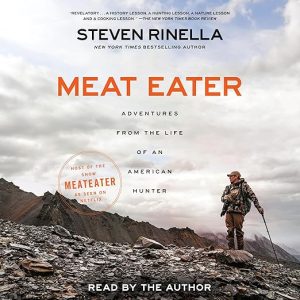
Steven Rinella reads his own book, which on a first-person hunting memoir is closer to a requirement than a bonus. Five stars in September 2012, from a buyer who says the book presents hunting, fishing and trapping for what they actually are, credits it with skipping the contorted, snobbish and apologetic philosophical hogwash that had characterized generations of hunting literature, and with refusing the self-indulgent glamor of trophy kill tales. That is the sharpest sentence anyone has written about this book, and it is accurate.
Ten hunts organize the whole thing, running from a ten-year-old aspiring mountain man to a thirty-seven-year-old Brooklyn father hunting the remotest corners of North America. That arc is both the structure and the argument. A fur-trapping career collapsing as fur prices fell, a dalliance with catch-and-release steelhead, canoeing the Missouri Breaks after mule deer as the river froze in November, Dall sheep in the glaciated mountains of Alaska: each hunt carries a different version of the same question about why any of it is worth doing, and the answers do not repeat.
Hunting writing usually fails in one of two directions, either apologizing for itself or sliding into trophy worship, and this book declines both invitations. The subjects on the table are the role of the hunter in shaping America, the vanishing frontier, the ethics of killing, and the disappearance of the hunter as eaters lose track of how anything reaches a table. Seven hours is a tight container for all of that, and the tightness works in its favor rather than against it.
Episodic Hunts Built for a Busy Kitchen
From the food side this is a better book than its shelving suggests. Anthony Bourdain called it a unique and valuable alternate view of where our food comes from, and the New York Times Book Review promised a history lesson, a hunting lesson, a nature lesson and a cooking lesson in every chapter. Both blurbs sit on the page, and both are pointing at the same quality: the meat arrives with its provenance still attached to it.
Cooking is where the four-star verdict, filed in July 2016, turns specific and genuinely useful. That buyer calls the book almost on point, praises a casual storytelling style that lets a reader picture the settings and half want to be there, and singles out the segments on the various meats, the methods of cooking and the potential recipes, having sincerely wondered how a person extracts the bones from squirrels. It is the most practical response on the page and the only one withholding a star.
Seven hours and one minute is the runtime, and the build is episodic by design, one hunt at a time. That makes it unusually forgiving of interruption, which matters for the audience this book will actually reach: people listening with their hands busy, in a truck or at a cutting board. You can lose ten minutes and rejoin without confusion. Very few pieces of narrative nonfiction at this length tolerate that kind of treatment, and it is a real argument for the audio over the paper.
Brooklyn Distance and a Netflix Halo Skew Ratings
Gift purchases distort this pool more than the small numbers already do. Five stars on December 28, 2025 comes from someone who ordered it for a father who loves to read and hunts and fishes, and who reports that the book hooked a reader who normally struggles to get into one. That is a recommendation about a recipient's taste rather than an account of a recording, and it is one of only five data points on the page.
Brooklyn is where the memoir lands, and the destination is worth flagging for the audience most likely to buy this. The arc runs from a boy trapping for money to a father in a city who travels to hunt, which means a fair share of the running time is about distance from the woods rather than time inside them. Anyone expecting seven hours of woodcraft instruction will find reflection where they wanted technique, and that mismatch accounts for most of the mild disappointment I would predict here.
Netflix and the cookbooks hover over this listing. Rinella arrives as a television host with a media operation attached, and the description leads with that rather than with the writing. It is not a flaw, but it changes what a top grade means when the person awarding it came in as an existing customer of the brand rather than as a reader meeting the work cold. Weigh the enthusiasm on this page accordingly, and remember the ratings tally covering it is broken.
Vegetarians Get the Fairest Opposing Argument Here
Hunters and anglers are the obvious core, and they get a book that neither flatters nor apologizes to them. The wider audience is everybody on the food side of the same argument: anyone who has wondered where meat comes from, anyone who cooks something they cannot trace. Five stars on January 4, 2026 comes from a listener who says plainly that this is not the story of their life, and who found the stories carrying them back into their own past adventures anyway.
Vegetarians looking for the strongest honest version of the other side will find it here, though nobody should pretend the ethics are argued neutrally. Skip it if you want practical instruction, because this is a memoir with cooking in it rather than a manual with stories attached. Skip it too if descriptions of killing genuinely upset you: nothing is gratuitous, but nothing is softened either, and seven hours is a long stretch to spend flinching at the specifics.
Rinella reading himself is the strongest reason to take the audio over the paper, and the episodic build is the second, since few nonfiction titles are this easy to put down and pick up without losing the thread. What I would ignore entirely is the arithmetic printed over all of this, which cannot be reconciled with the text underneath it. The book beneath the broken numbers has been the real thing for well over a decade.
At a Glance
- Narrator: Steven Rinella holds the byline and the narrator credit at once, so nobody stands between the hunts and the listener.
- Subjects: Hunting ethics, food provenance, the vanishing frontier, fatherhood at a distance from the woods
- Tone: Plainspoken and unsentimental, with a real argument running underneath
- Bottom line: The most persuasive writing about hunting on the shelf, and the audio is the version worth owning.
A Few Questions About Meat Eater
Does Steven Rinella narrate this audiobook himself?
He does. The narrator credit and the byline carry the same name, which on a memoir written entirely in the first person removes the layer of interpretation an outside reader would inevitably add. Seven hours of somebody recounting their own hunts in their own voice is a materially different experience from hearing those sentences performed by an actor.
Is this audiobook a good entry point for someone who has never hunted?
It is arguably the best one available, because the book was written for exactly that reader. The framing question throughout is why anyone does this rather than how it is done, and the first-person structure lets an outsider follow the reasoning without prior vocabulary. Nothing in it assumes you own a rifle or want one.