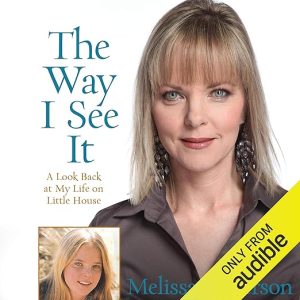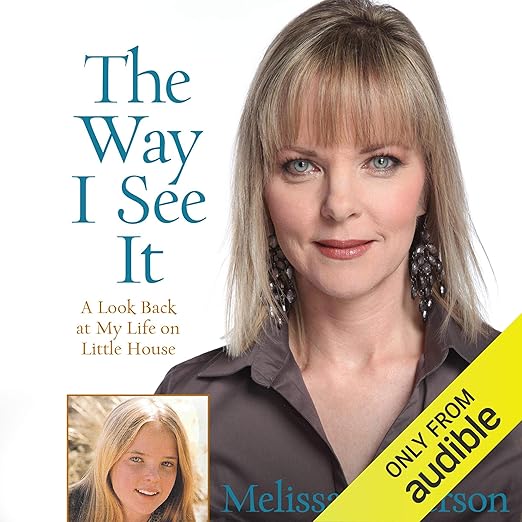
Eleven-year-old Melissa Sue Anderson was already fielding handwritten marriage proposals from fans her own age and younger by the time Little House on the Prairie made her a household name in 1974, and this audiobook memoir opens its account of that decade, 1974 to 1981, from inside that strange collision: a child living an ordinary adolescence off camera while playing Mary Ingalls, the blind sister, in front of millions every week, the role that made her the only cast member from the series ever nominated for an Emmy.
Narrated by Jane Pfitsch rather than by Anderson herself, this 6-hour-and-52-minute audiobook holds 3.6 out of 5 from 917 ratings, a number worth sitting with honestly rather than smoothing over. Pfitsch is a professional narrator, not the author, which matters for a book this personal: listeners specifically hoping to hear Melissa Sue Anderson's own voice recount her own memories will not get that here, and that gap between expectation and delivery is likely part of what shapes the more mixed reader response.
Michael Landon Was Not Perfect
The memoir's most interesting move is refusing straightforward nostalgia. Anderson is direct that Michael Landon, the show's creator and the industry's beloved image of paternal warmth, 'was not perfect, as much as he tried to be,' a line that reframes the entire project away from simple reminiscence and toward something closer to honest reassessment. That willingness to complicate a beloved figure, without tipping into score-settling, is what separates a genuinely useful child-star memoir from a clip-show retread of famous episodes.
The book's guest-star roster reads like a strange, specific time capsule of 1970s and early '80s American television: Sean Penn, Johnny Cash, Patricia Neal, Mariette Hartley, Todd Bridges all passed through the Little House set or crossed paths with Anderson elsewhere, and her memories of working alongside them give the book a breadth beyond a single show's history. The relationships she describes off camera, particularly with Melissa Gilbert, the other Melissa, and Alison Arngrim, who played her on-screen rival Nellie Oleson, add a layer of real interpersonal complexity that a purely episode-by-episode retrospective would have missed.
The book's title carries its own quiet argument too: 'The Way I See It' foregrounds subjectivity and perspective rather than claiming any definitive account of the Little House years, a notably modest framing for a memoir with this much cultural weight behind it. Anderson is not positioning herself as the authoritative historian of the show; she is offering one particular vantage point among several former castmates who have each written their own version of the same eight years, and the book is more interesting read that way, as one voice in a larger conversation rather than the final word.
A Page Turner Meant as Reflection
One Amazon reviewer, Tyler Millar, called the book 'a very interesting page turner,' and specifically praised the material as something Anderson was 'encouraged to write and reflect on' for her own family, friends, and fans after seven years on one of the most-watched shows of its decade. That framing, reflection rather than tell-all, matches what the book actually delivers: another reviewer describes Anderson on-screen as 'a reflective and reserved child,' and the memoir's tone carries that same restraint into adulthood rather than manufacturing drama for its own sake.
Playing a blind character convincingly, for seven consecutive years, as a child actor with no formal disability-acting training available to her at the time, is a genuinely underexamined piece of television history, and Anderson's account of how she approached Mary Ingalls' blindness physically and emotionally is one of the more substantive craft sections in the book. It is the kind of specific, process-focused material that separates an actor's memoir with real content from a book coasting purely on brand recognition of the show's title.
Playing Blind for Seven Years, No Training
Pfitsch's narration favors controlled, theatrical precision over confessional warmth, which suits Anderson's own described temperament, reserved rather than effusive, better than a more emotionally performative reading would have. For a memoir that is explicitly reflective rather than tell-all in nature, a narrator who lets the material's restraint stand rather than pushing extra feeling into every sentence is arguably the more faithful choice, even without the author's own voice behind it.
The book also captures something specific about leaving a long-running childhood role that adult-cast memoirs rarely have to reckon with: Anderson departed the show by choice before its final season, a decision that put her at odds with how the series itself would end, and that gives her account of leaving genuine tension absent from the simple 'and then the show ended' arc most cast memoirs default to.
The Narrator Gap Behind a 3.6 Rating
The 3.6 rating and the more mixed reader response deserve honest acknowledgment rather than a glossing-over. One reviewer found the book 'interesting at times, if a little dull,' and pointed specifically to Anderson's tendency to write scenes with what that reviewer called a 'script treatment' quality that can feel distancing rather than intimate. Tyler Millar's otherwise positive review flagged 'the recaptions' (episode recaps) as the book's specific downside, suggesting some listeners want less summary of familiar episodes and more new, previously unshared material.
The narrator gap is the other real consideration. Jane Pfitsch delivers a controlled, professional reading, but this is not the author's own voice, and for a memoir this specific and personal, some listeners will feel that absence more than others. Anyone whose primary reason for choosing memoir audiobooks is hearing the subject narrate their own life in their own cadence should know clearly, going in, that this is not that experience.
Confessions of a Prairie Bitch's Counterpart
Little House on the Prairie devotees are the obvious audience, but the book rewards a slightly wider circle too: readers of classic-Hollywood and child-star memoirs generally, anyone who enjoyed Alison Arngrim's own 'Confessions of a Prairie Bitch' and wants Anderson's counterpart perspective on the same set and same years, and listeners interested in the specific, still under-told history of how child actors of that era navigated fame with essentially no modern support structures around them.
Skip this one if hearing Melissa Sue Anderson narrate in her own voice is a dealbreaker; Pfitsch's professional reading is well executed but is not that experience. It is also not the pick for listeners chasing tabloid-style revelation or score-settling, since Anderson's reflective, reserved tone, the same quality reviewers noted in her on-screen performance decades ago, carries through here even when she is critical of people like Landon. And if the recaps of familiar episodes one reviewer flagged sound like padding rather than content to you, sampling a chapter before committing the full six hours and fifty-two minutes is a reasonable approach.