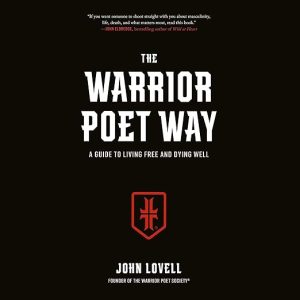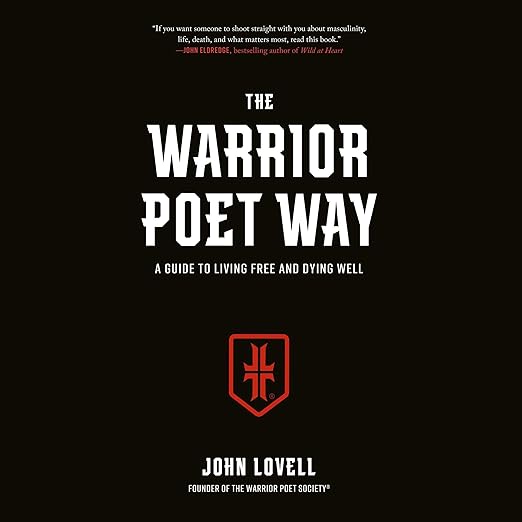
John Lovell's The Warrior Poet Way audiobook arrives at a moment when the conversation about masculinity in American culture is as polarized as it has been in decades. Lovell, founder of the Warrior Poet Society and a former Army Ranger, positions his book explicitly against what he describes as the "war on masculinity." That framing will land very differently depending on where the listener sits culturally and politically. The book's core argument is more nuanced than its adversarial premise suggests, however. Lovell is not simply championing aggression. He is arguing for a balance between what he calls the dangerous and the good: the warrior and the poet, the lion and the lamb.
The book cuts across several genres simultaneously: part self-help, part military memoir, part Christian devotional, part political manifesto. Lovell moves between these registers with varying degrees of smoothness. The chapters that draw directly on his military experience, including anecdotes from his time as an Army Ranger and reflections on discipline, physical courage, and the weight of protecting others, carry the most authority and feel the most earned. The chapters that engage more abstractly with cultural and political arguments are less rigorously developed but more rhetorically forceful, which is an accurate description of the genre Lovell is working in.
Rebekah Lovell narrates the audiobook, which is an unusual choice for a book aimed explicitly at men. One reviewer's response is telling: they came in expecting to like the book because they already knew Lovell's video content, and were surprised by how much the book delivered beyond their expectations. That reader profile, already part of the Warrior Poet Society audience and already sympathetic to the framework, is the listener for whom the audiobook is most clearly designed. Rebekah Lovell's narration adds an intimate domestic register to sections about marriage and family that a male narrator would not have achieved in the same way.
The book landed on the Wall Street Journal bestseller list immediately upon publication, which reflects both the size of Lovell's existing platform and the genuine appetite for this kind of framework among a specific demographic of American men. For listeners unfamiliar with the Warrior Poet Society, the book functions as an introduction to Lovell's philosophy and a standalone argument for his approach, not merely a companion to his video content.
The Best Parts of The Warrior Poet Way
At 7 hours and 46 minutes, the audiobook covers a genuinely wide range of practical and philosophical territory. Lovell includes practicums at the end of each chapter: structured reflection and action exercises that translate reasonably well to audio in the sense that listeners can pause and engage with them meaningfully. The book also covers explicitly practical territory that many books in the men's self-help space avoid: physical fitness, home preparedness, the specific dynamics of romantic relationships and courtship, and the concrete demands of fatherhood. Reviewers appreciate the willingness to be specific rather than vague about what the warrior poet ideal actually requires in daily practice.
The structure of the book is both philosophical and practical, as the synopsis suggests, and Lovell balances those registers more effectively in the middle chapters than in the opening and closing sections where the cultural argument is loudest. The biographical material from his Ranger service is the most consistently compelling content in the audiobook, grounding the philosophical framework in experience rather than assertion.
Before You Commit to The Warrior Poet Way
The book's political and cultural framing is explicit and unapologetic. Lovell's invocation of a crisis of masculinity, his references to preserving "our way of life" and "ancient paths," and his emphasis on Christian virtue as foundational to his framework position the book clearly within a conservative American Christian worldview. Listeners who do not share that worldview will find parts of the argument assertive rather than persuasive, and the sections on tyranny-proofing the home and the political dimensions of masculine virtue will read differently to listeners with different political commitments.
The book is not attempting ideological neutrality, and the audiobook format makes that positioning more vivid through delivery tone than print typically does. Rebekah Lovell's narration is warm but not neutral, and the devotional sections carry a register of personal conviction that is part of the book's appeal to its target audience and part of what may create distance for listeners outside that audience. The rating of 4.9 from a single review reflects an enthusiastic early reader rather than a broad critical consensus, and prospective listeners should weigh the content on its merits accordingly.
The book's most effective chapters are the ones where Lovell connects the abstract warrior-poet tension to specific decisions his readers actually face: how to maintain physical conditioning with a family and a job, how to approach the beginning of a romantic relationship with integrity, how to handle situations that require courage in daily civilian life rather than in combat. Those practical applications make the philosophical framework feel immediately relevant rather than aspirational, and Rebekah Lovell's narration grounds those sections with a domestic specificity that a more traditionally male-voiced narrator would likely have flattened into something more generic and less useful.
Should You Listen to The Warrior Poet Way?
Men already familiar with John Lovell's Warrior Poet Society content who are looking for a more developed philosophical framework will find the audiobook a satisfying extension of his public work. Listeners who identify with a Christian conservative understanding of masculine virtue and are looking for a book that takes that framework seriously rather than apologizing for it will find Lovell's tone and argument well-calibrated to their needs. Rebekah Lovell's narration works best for listeners who appreciate the intimacy it creates around the family and relationship chapters. Readers who prefer their men's self-help frameworks secular, politically neutral, or ideologically diverse will find the book's explicit cultural positioning a significant friction point throughout.