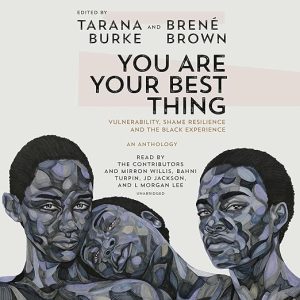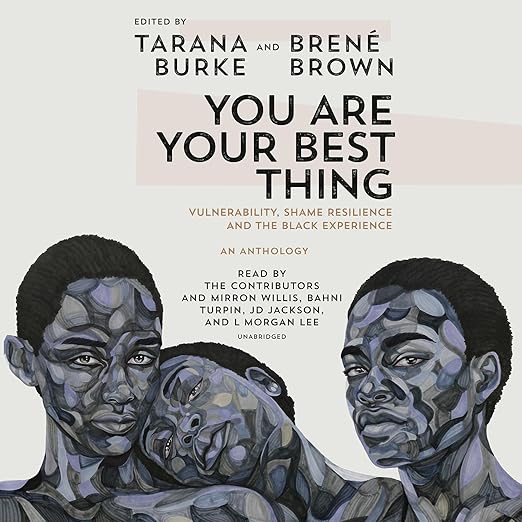
I picked up You Are Your Best Thing during a stretch when I was thinking carefully about whose work I was consuming and whose voices were shaping my understanding of resilience, shame, and healing. This anthology arrived with significant cultural momentum behind it, a New York Times bestseller, named a best book of the year by Marie Claire and BookRiot, but what kept me listening through all six and a half hours was the quality of the individual essays, not the marquee names attached to the project.
The origin story is worth understanding because it shapes everything about the collection. Tarana Burke called Brene Brown to say that Brown's work on vulnerability resonated deeply, but that as a Black woman she sometimes had to contort herself to fit its application. Brown's response, How do you take the armor off in a country where you're not physically or emotionally safe?, is the question that gives this anthology its animating tension. Burke and Brown assembled a group of writers, organizers, artists, and academics to work through that tension with their own experiences.
The contributors, Kiese Laymon, Imani Perry, Laverne Cox, Jason Reynolds, Austin Channing Brown, are writing from inside the specific conditions the collection addresses, and the essays have a rawness that is different in kind from the more polished vulnerability of mainstream self-help. These are not accounts of having moved through difficulty and arrived at resolution. Several of them are accounts of still being in it, of the conditions of racism being ongoing rather than historical, and of the specific work required to maintain self-worth and resilience within those conditions.
One reviewer who came to the collection as a white reader described wanting to deepen their understanding of the Black experience, and found the most profound aspect to be how applicable the frameworks were while remaining grounded in specificity. This captures something important about the anthology's dual function: it speaks directly to Black readers about their own experience while being genuinely illuminating to readers from outside that experience, without ever contorting itself to serve the latter audience primarily.
What Works
Tarana Burke narrating is the right decision for this kind of collection. Her voice carries the weight of the project's intention, and the framing sections between essays provide continuity and context that keeps the anthology from feeling like a series of disconnected pieces. Six hours and thirty-six minutes is a meaningful commitment, and Burke's presence gives you reason to treat it as a continuous work rather than individual pieces to be sampled.
Reviewers who used this in book clubs, including groups with mixed racial membership, describe productive and sometimes difficult conversations emerging from the essays. The collection has a generative quality that extends beyond the individual listening experience. One reader described it as giving them new tools for managing shame and vulnerability, which is high praise for any nonfiction work in this space.
Things to Know Before Starting You Are Your Best Thing
This is not the kind of collection you can absorb passively. The essays ask for genuine engagement, and some of them are difficult in the way that honest accounts of shame and trauma are difficult. Listeners who approach it as background audio will lose most of what it has to offer. It rewards being listened to with your full attention, ideally with time afterward to sit with what each essay raises.
The anthology format also means uneven emotional intensity across the contributions, some essays are devastating, some more analytical, some blend both modes. The sequencing is thoughtful, but listeners should expect variation and not approach it expecting a single consistent emotional register throughout.
Who It's For
This collection was assembled first and foremost for Black readers navigating shame resilience within conditions that mainstream wellness culture often fails to account for. It will be most immediately resonant for listeners who have had the experience of finding Brene Brown's work compelling but somehow insufficient. It is also genuinely valuable for readers from outside the specific experience who want to understand that gap with more clarity and humility. It is not for listeners who want uncomplicated inspiration. It is for listeners willing to encounter something more honest and more difficult than that.
Quick Take
- Voice: Tarana Burke narrating the anthology gives the collection an authority and intimacy it could not achieve otherwise, her framing sections hold the essays together with real emotional intelligence.
- Big ideas: Vulnerability and shame within the Black experience, healing from white supremacy's damage, the conditions required to safely remove armor
- Atmosphere: Searching, tender, and demanding in equal measure, this asks something of its listener
- Worth it?: A genuinely important anthology that earns its literary reputation through the quality and honesty of its contributors; not background listening, but essential listening.