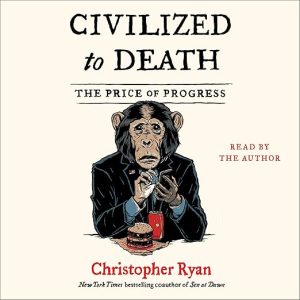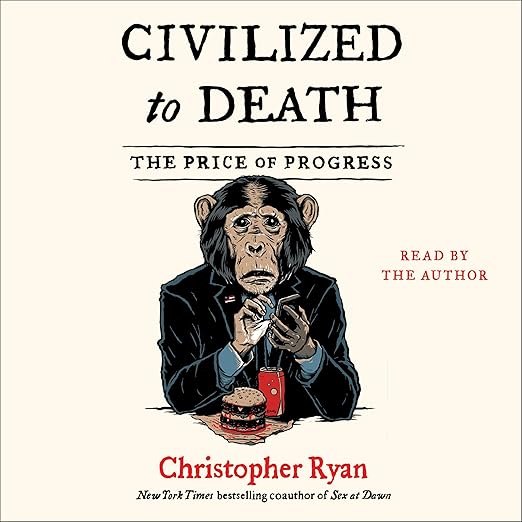
I came to Civilized to Death having already spent time with Sex at Dawn, Ryan and Jetha's earlier collaboration that did something similar with human sexuality and prehistory. Both books operate on the same basic engine: take the story we tell ourselves about progress and improvement, then methodically present the evidence that the story is at best incomplete and at worst a comfort myth we maintain against our own interests. I listened to the first two hours of Civilized to Death on a Sunday afternoon and spent the following week slightly paranoid about my own cardiovascular disease risk in ways that were probably not entirely rational but were certainly not uninformed.
Ryan's argument is not that we should go back to some idealized prehistoric existence. He is careful about this, the book explicitly acknowledges infant mortality, untreatable infections, the genuine dangers of a life without modern medicine. But his central question is whether those prehistoric dangers, on balance, produced more misery than our modern equivalents: car accidents, cancer rates, cardiovascular disease, the technologically prolonged dying process, stress and anxiety as chronic conditions rather than acute responses to immediate threats. The answer he builds toward is complicated, and he earns the complication rather than reaching for it rhetorically.
What Christopher Ryan Delivers
Reviewer Wayne Radinsky noted that this book will completely upend your worldview if you have not already encountered its core ideas elsewhere, and that if you have followed Ryan's podcast, the book offers a systematic version of those ideas that the podcast's episodic format cannot match. Both observations are accurate. The book's great strength is not that any individual claim is novel but that all the claims are organized into a single coherent argument with documented evidence throughout.
Reviewer Eric Garza drew a comparison to Ronald Wright's A Short History of Progress, which is the right literary lineage. Ryan sits in a tradition of writers who use deep history and anthropology to ask what we have actually gained and lost in the long march toward modernity. He offers no prescriptions, no recommendations for how to fix things, and Garza names this as a strength. The book refuses the easy comfort of a solution, which forces the reader to sit with the discomfort of the diagnosis.
Ryan narrates his own book, and the self-narration is the appropriate choice. This is an argument that requires someone who believes it, and Ryan clearly does. His delivery is not polished in the way a professional narrator's would be, there are moments of digression and conversational tangent that feel like a very good lecture rather than a recording session. But that quality is a feature. The intellectual energy is genuine, and it makes a nine-hour listen feel substantially shorter than it is.
The book assumes no prior knowledge of the anthropological literature it draws on. Ryan is a good popularizer, he explains the evidence clearly and does not hide behind jargon. This makes it accessible to listeners who have never opened an anthropology text while remaining substantive enough to engage readers who have.
Where Christopher Ryan Loses Some Ground
The sections on modern disease as a post-agricultural phenomenon are the book's most densely evidenced passages. Ryan draws on research connecting the rise of farming and settled civilization to specific disease profiles that hunter-gatherer populations did not share. This is not a new argument in academic literature, but Ryan's synthesis of it for a general audience is careful and well-sourced.
Also pay attention to the passages on social isolation and loneliness as modern epidemics. Ryan connects them to what anthropological evidence suggests about the social density and interdependence of prehistoric groups, and the argument here feels particularly acute in the current moment. The sense that something is structurally wrong with how we are living, the instinctive evidence Ryan describes in his opening, comes into focus most clearly in these sections.
Who Should Pick Up Civilized To Death
Readers who found Sex at Dawn compelling will find the same intellectual DNA here, extended to a wider range of human experience. Anyone who has felt the instinctive wrongness Ryan describes, the sense that contemporary life, for all its material abundance, is missing something, will find the book gives that feeling a framework and an evidence base.
Those who find the premise fundamentally wrongheaded, who believe progress is categorically positive and that prehistoric life was simply worse, will not be persuaded, and Ryan does not particularly try to persuade them. This is a book for people who are at least open to the question, not a conversion text.
- Narrator: Christopher Ryan narrates his own argument with the enthusiasm of someone who has been in this conversation for years, conversational, digressive, and fully committed.
- Subjects: prehistoric versus modern wellbeing, the costs of civilization, anthropological counternarrative
- Tone: Provocative and expansive, like the best kind of argument at a long dinner
- Bottom line: A book that genuinely reorganizes how you see everyday life, narrated by an author who has clearly thought about almost nothing else for a decade.