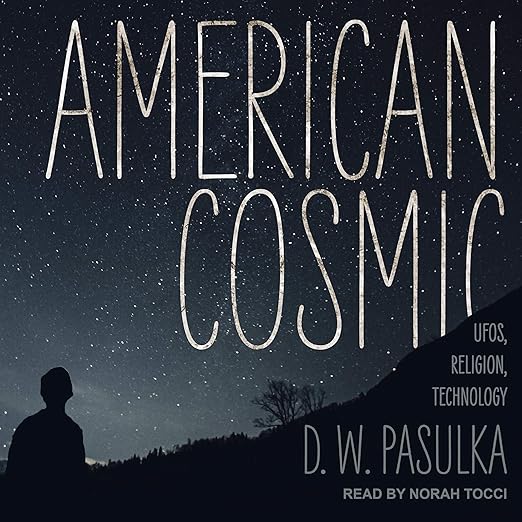
Belief in intelligent extraterrestrial life now runs level with belief in God among American adults, and above three quarters among the young, at least by the figures this audiobook opens with. D. W. Pasulka's move is to stop arguing about whether any of it is true and start asking what kind of thing such a belief is, which turns out to be a far more interesting question than the one everybody else is having.
Six Years of Fieldwork Behind a Sociological Claim
Reframing the question is the book's first real contribution. Treat widespread belief in non-human intelligence as a sociological fact rather than a claim to be refuted, and the whole subject changes shape: you are no longer counting sightings, you are watching a system of meaning assemble itself in public. Pasulka's argument is that this system is not merely resembling a religion but actively supplanting older ones, which is a large claim and the reason the book is worth eight and a half hours. It also changes what the interesting question is. If something is genuinely taking over the work older faiths used to do, the useful thing to ask is not whether it is warranted but what it supplies, and to whom.
Fieldwork backs it up. A six-year ethnographic study sits underneath the writing, built on interviews with scientists, professionals and technology entrepreneurs who hold these beliefs and hold serious jobs at the same time. That combination does the quiet demolition work: the assumption that only people at the margins take this seriously does not survive contact with the interview list, and the book never has to argue the point directly because the fieldwork argues it.
One of the earliest written responses, filed in 2019, comes from exactly the reader you would want as a test case: somebody who has spent years with this material and can spot the cranks and the charlatans on sight. That reader found information they had not met before and describes the treatment as academic in the useful sense, with consciousness, religion and myth wrapped up together rather than sorted into separate boxes.
Norah Tocci Reads Testimony, Not Data and Tables
Where belief comes from is the most portable idea in the book. Pasulka points at the sheer ubiquity of these stories in modern media, naming The X-Files, and at the way such material can shape what people later remember experiencing. Add the scientific search for planets that might support life, which lends the fiction a plausibility it did not have to earn, and you get a mechanism rather than a mystery. That mechanism transfers to almost any contemporary belief you care to examine. Once you have it, you notice it working elsewhere: a story repeated often enough starts to feel remembered, and a memory reported sincerely becomes evidence for whoever hears it next.
Most moving of the written responses arrives from a different direction entirely. An experiencer, writing in 2025, thanks Pasulka for writing the book they had always wanted to read, describing a search for meaning across religion, mysticism and the stars, and saying the work opened new perspectives on all of it. Academic books rarely land that way on the people they study, and the fact that this one did says something about the register Pasulka chose.
That register is what makes the recording work. This is argument and testimony rather than data and tables, and both carry aloud without loss. Norah Tocci reads it, and the material handed to that reading is mostly conversational: what somebody said, what they believed before they said it, what the researcher made of it afterward. Nothing here depends on a chart, which is more than can be said for most books built on fieldwork.
Quantum Mechanics, DNA Frequencies, and Strange Rating Math
The sharpest criticism on the page is also the most useful, and it comes from the only response below four stars. That reader, writing in 2024, objects that when non-physicists meet something they cannot explain they reach for quantum mechanics, which they understand no better, and extends the complaint to loose talk of frequencies and resonances. The example given is DNA: a molecule does not have a frequency, that reader points out, it has an enormous number of them smeared into a continuous band.
A second objection from the same response bears directly on the format: a dislike of anonymous characters. Pseudonymous informants are standard practice in ethnography and often unavoidable, but they impose a cost on a listener that a reader does not pay. When a figure introduced under a pseudonym resurfaces hours later, print lets you flip back and check. Audio does not, and a book with several anonymized sources asks you to hold them all in your head.
Strangest of all are the page's own numbers. The average reads 4.5 and the rating count reads one. A single vote can only be a whole number of stars, so 4.5 cannot come from one rating, and five written responses sit below a counter claiming a single person has graded the book. Grade those five yourself and the true figure is close but not identical. Read the accounts and ignore the number entirely.
The Wrong Reader Wants an Adjudication
This suits the reader who is curious about believers rather than about spacecraft. Anyone who works on religion, media theory or the sociology of knowledge will find familiar tools pointed at unfamiliar material, and the interview subjects are interesting company regardless of what you make of their convictions. One five-star response praises how neatly the book connects its three strands, which describes the pleasure on offer exactly.
The wrong listener is the one who wants an adjudication. Nothing here will tell you whether any craft has ever been recovered, and the physics complaint above is a genuine warning for anyone with scientific training who bristles at borrowed vocabulary. Skeptics who want debunking and believers who want confirmation are both being asked to accept a different project instead.
I would give it to anyone who has ever wondered why this particular belief refuses to fade while institutional religion keeps thinning out. The answer Pasulka builds is careful, researched and genuinely unsettling, and it lands harder in audio than it would on the page, because testimony spoken aloud is exactly the form in which most people first encounter these stories anyway. Underneath it sits a quieter book about how knowledge gets certified: the interviewees hold precisely the credentials our institutions use to decide what counts as serious, and they are spending them on a subject those same institutions refuse to take seriously.
A Few Questions About American Cosmic
Does the American Cosmic audiobook argue that UFOs are real?
No, and that is the point of it. The subject is belief itself: where it comes from, who holds it and what cultural work it performs. Pasulka's claim concerns media displacing religion as the authority people consult about non-human intelligence, which is a question about us rather than about the sky.
How academic is the writing in this audiobook?
Scholarly in method, readable in register. A six-year ethnography sits underneath it, with interviews rather than statistics carrying most of the weight, and the vocabulary stays accessible. If you can follow a well-written long-form article about religion or technology, you can follow this without difficulty.
Is it worth listening to if I already follow the UAP conversation?
One four-star response recommends it to anyone interested in UAPs and finishes by saying they cannot wait to read more from the author. The angle is sociological rather than investigative, so it adds a layer most reporting on the subject leaves out entirely.
Is this a religious book?
It is a book about religion rather than a religious one. The argument treats belief in non-human intelligence as an emerging system of meaning that answers the questions traditional faith used to answer, so faith appears throughout as a subject of study rather than as a commitment being defended.