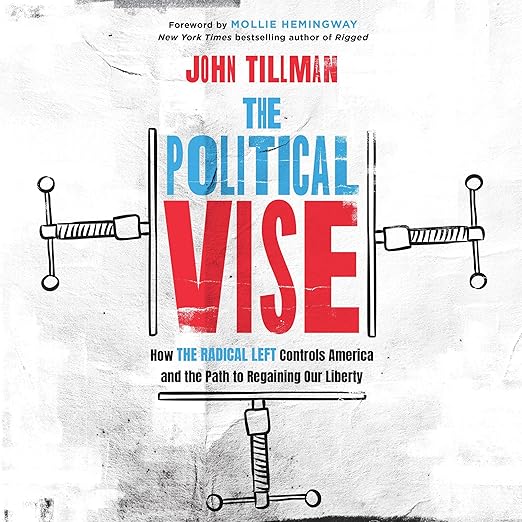
Quick Take
- Narration: Tillman narrates his own book, which gives the arguments personal authority but also means there is no editorial distance between the author and the material. The delivery is practiced and confident.
- Themes: conservative political strategy, institutional power and cultural coercion, grassroots vs. elite influence
- Mood: Combative and energizing if you share the premise; abrasive if you do not
- Verdict: Tillman is a credible insider voice in the conservative policy world, and his framework for understanding political power is genuinely interesting beneath the partisan framing.
I went into The Political Vise knowing exactly what kind of book it was going to be. John Tillman is a conservative political strategist whose most notable public achievement, a Supreme Court victory in Janus v. AFSCME, sits at the intersection of labor law and political organization. He is not a neutral commentator. He is a participant with a specific theory of how power works and how it has been used against people who share his politics. That orientation shapes every page.
What I found more interesting than I expected was the underlying framework. The ‘three-sided vise’ Tillman describes, media, elite influencers, and the public as the three pressures that hold politicians accountable, is a structural model worth engaging with regardless of where you fall politically. The argument that this mechanism has been captured and inverted is where the book becomes more specifically partisan, but the underlying observation about how political accountability operates has real analytic value.
Our Take on The Political Vise
Tillman’s central claim is that conservatives have been losing cultural ground not because their ideas are unpopular but because the mechanisms of accountability have been captured by their opponents. The media, professional institutions, and what he calls elite influencers have been aligned in ways that make it very difficult for conservative politicians to hold to their positions once they reach office. His term for this is the Radical Left’s version of the vise, which applies pressure to the people rather than to politicians.
That framing is explicitly partisan in a way that the book does not pretend otherwise. The specific policy positions Tillman invokes as examples of Radical Left overreach, gender-transitioning children, mass illegal immigration, critical race theory in schools, are precisely calibrated to resonate with his intended audience. Listeners outside that audience will find the framing polemical. What remains underneath is a genuine argument about how political coalitions build and sustain power, and that argument is worth taking seriously even when the examples make it harder to.
Why Listen to The Political Vise
Tillman narrates his own book, and that is a meaningful choice. Self-narrated political books can feel like extended speeches, but Tillman has enough discipline as a communicator to vary his register. The personal anecdotes he includes, including behind-the-scenes accounts from the Janus litigation and his years running policy organizations, ground the strategic analysis in something that reads as lived rather than theoretical. At eight hours and twenty minutes, the book has more depth than a political manifesto but does not overstay its welcome.
One reviewer described Tillman as someone whose influence most listeners have felt without knowing his name, pointing to his role in founding and leading organizations that have shaped conservative policy advocacy at the state and federal level. That context matters. This is not a pundit writing a campaign book. It is an insider giving readers visibility into how he and people like him think about political organization. That is more valuable than another generic left-right culture war polemic.
What to Watch For in The Political Vise
With only one verified review, there is essentially no listener consensus to consult. The review is positive and comes from someone already familiar with Tillman’s work, which means it reflects enthusiasm from the existing base rather than a signal about how the book lands with new readers. The book was published in March 2026 by RealClear Publishing, which is the book arm of the RealClearPolitics media organization. That institutional affiliation places it clearly within the conservative media ecosystem.
Listeners who come to this book hoping for a bipartisan analysis of how political power operates will be disappointed. The framework Tillman introduces is genuinely interesting, but it is deployed exclusively in service of a conservative argument. The battle plan section of the book is squarely aimed at conservative readers and offers little that would be immediately useful to listeners outside that coalition.
Who Should Listen to The Political Vise
Recommended for conservative listeners interested in political strategy at a level deeper than talk radio, particularly those curious about how advocacy organizations build institutional influence over time. Those interested in understanding how a sophisticated conservative political actor thinks about power and persuasion will find the insider perspective valuable even if they do not share all of Tillman’s premises. Listeners seeking a neutral or centrist analysis of American political dysfunction should look elsewhere.
Frequently Asked Questions
What is the three-sided vise framework Tillman introduces, and is it original to him?
Tillman describes a model in which media, elite influencers, and the American public form three sides of a vise that historically held politicians accountable. He argues this mechanism has been inverted by the Left to pressure ordinary people rather than politicians. The model draws on established political science concepts but the ‘vise’ framing and its specific application are Tillman’s own.
Does Tillman’s narration of his own book feel like a lecture or a conversation?
It leans toward the former but is disciplined enough to avoid feeling like a monologue. The personal anecdotes break up the strategic analysis effectively, and Tillman has enough public-speaking experience that the delivery is polished rather than stiff.
Is the Janus v. AFSCME Supreme Court case central to the book or just mentioned in passing?
It appears as a significant personal reference point and illustrative case study rather than the book’s central subject. Tillman uses it to ground his analysis of how legal strategy can serve broader political objectives and to establish his credibility as an insider in conservative policy circles.
Is this book useful for understanding American politics even if I am not a conservative?
The framework Tillman introduces has genuine analytic value for understanding how political accountability operates and can be disrupted. Listeners who can bracket the partisan framing will find observations about institutional influence and coalition-building that apply more broadly. The battle plan sections are squarely aimed at a conservative audience and will feel alienating if you are not in that camp.