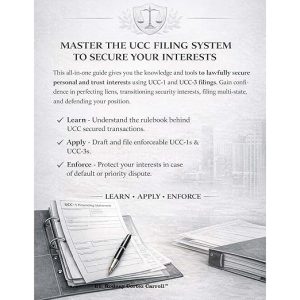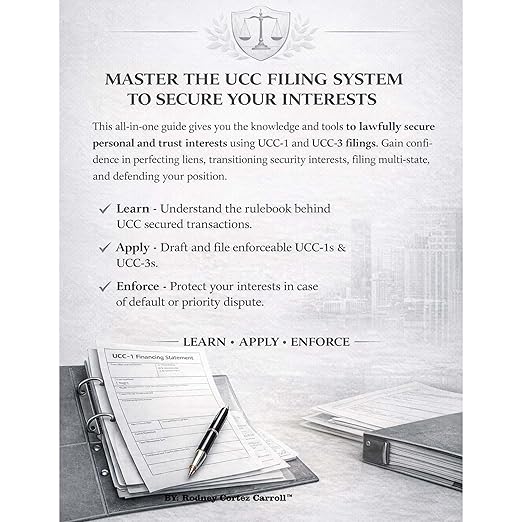
UCC filings occupy one of those peculiar zones in practical legal knowledge where the information genuinely matters, to entrepreneurs, business owners, trustees, and anyone structuring commercial agreements, but the available resources tend to sit at one of two unusable extremes. Either the material is so technically dense that it requires a law degree to parse, or it edges into the kind of fringe interpretation that gives the Uniform Commercial Code a reputation it does not deserve. How to Lawfully Secure Interests Using UCC-1 and UCC-3 Filings arrives as an audiobook attempting a middle path: clear, state-agnostic, and grounded in how the UCC is actually applied by secretaries of state, secured creditors, and commercial attorneys in real transactions.
At three hours and eight minutes, this is a compact listen. The narrator here is a Virtual Voice production, which means the delivery is synthesized rather than performed by a human narrator. That distinction matters in this genre more than in others: the material is dense enough that a flat or mechanical reading can make abstract concepts harder to track. Listeners who find synthesized narration disorienting may want to supplement the audio with the book's text version. That caveat noted, the content itself, authored by Rodney Carroll, is notably well-organized for the complexity of the subject matter.
Why This Guide Stays State-Agnostic on UCC Filings
The book's stated purpose is to give people the practical understanding of the UCC that banks, corporations, and attorneys use every day. Carroll is explicit about what the book does and does not claim to be: it is educational, not legal advice. That framing is important and appropriate. The UCC governs secured transactions in commercial law, and Article 9 specifically, which covers security interests in personal property, is the territory this book addresses most directly. Understanding how UCC-1 financing statements and UCC-3 amendment statements work, what priority means in the context of competing creditors, and how to structure a security interest correctly is genuinely useful knowledge for anyone operating a business or managing a trust.
What Carroll does well is sequence the material logically. The book begins with the distinction between the two extremes he is trying to avoid, the overly technical and the ideologically motivated, and establishes early that his approach is based on enforcement-level reality rather than theoretical interpretation. This framing helps listeners calibrate their expectations before the technical content begins. By the time he gets into the mechanics of filing, maintaining, and enforcing UCC records, the context is already in place.
The book covers real filing standards, legal definitions as they apply in commercial practice, step-by-step breakdowns of the filing process, and Secretary of State practices that vary by jurisdiction. The state-agnostic approach means the book does not get lost in the specific procedural quirks of individual states, a smart choice for a three-hour audiobook, while still noting that implementation will require checking the requirements of the relevant jurisdiction.
Business Credit and IP Uses for Secured Creditors
The audiobook format is useful here for an audience that is likely consuming professional development content on the move. Entrepreneurs and business owners who are learning about UCC filings alongside the demands of running a business often find audio the most accessible format for this kind of reference material. Three hours is a manageable investment for a subject that most practitioners have never been formally taught.
Carroll's specific value proposition is in the intellectual property and business credit applications. If you are a business owner who wants to establish a UCC filing against your own intellectual property as a secured creditor, or a trustee structuring private commercial agreements, the book provides the conceptual grounding for those specific use cases. The illustrated diagrams mentioned in the synopsis are, of course, absent in the audio format, listeners who want the visual reference should acquire the print or ebook version alongside the audio.
The avoidance of fringe interpretation is worth emphasizing as a feature. The UCC has been extensively misused in sovereign citizen and related pseudo-legal frameworks, and anyone researching this area will encounter that material quickly. Carroll's explicit commitment to accuracy and enforcement-level clarity provides a reliable alternative for listeners who want real commercial law knowledge rather than speculative theory.
Synthesized Narration Without the Printed Diagrams
No listener reviews are available for this title yet, which limits the external read on how different audiences are experiencing the content. The absence of reviews also means there is no community feedback on which sections are most practically useful or where the explanations could be stronger. Listeners approaching this audiobook should treat it as a foundation rather than a complete resource, the UCC is a substantial body of law, and three hours addresses the key concepts without exhausting the subject.
The Virtual Voice narration will be the deciding factor for some listeners. Those who are accustomed to synthesized audio will find it workable. Those who have a strong preference for human narration in technically dense material may struggle with the delivery on complex passages. The practical diagrams referenced in the text are not available in audio form, which is a genuine limitation for visual learners working through the filing mechanics.
Preparing Non-Attorneys to Ask Better Questions
Business owners, entrepreneurs, trustees, and anyone dealing with commercial agreements who want a working understanding of UCC Article 9 without hiring an attorney for every question will find this audiobook addresses a real knowledge gap. It is also useful as background preparation before engaging with a commercial attorney, giving the client enough grounding to ask better questions and understand the answers.
Listeners who are already practicing commercial attorneys or who have formal legal training in secured transactions will find the material basic. This book is not written for practitioners, it is written for the people who need to understand the system well enough to participate in it intelligently.