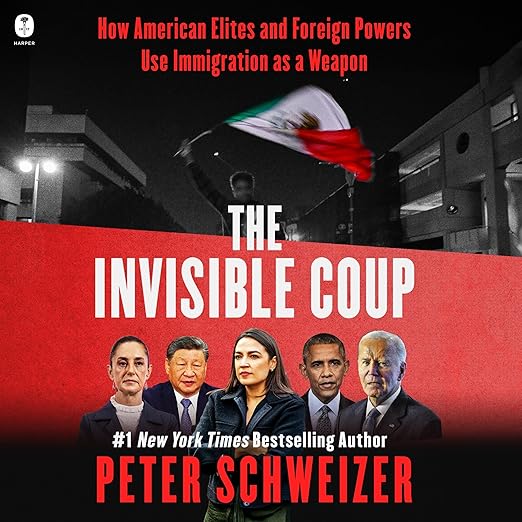
Quick Take
- Narration: Charles Constant brings a clean, authoritative delivery that suits Schweizer’s investigative framing, though the material itself drives the urgency rather than the performance.
- Themes: immigration as political weapon, elite manipulation, national security and foreign influence
- Mood: Urgent and prosecutorial, pitched at readers who already feel something has gone badly wrong
- Verdict: Schweizer’s sourcing is the book’s real claim to seriousness, but listeners should weigh that against a strongly ideological frame that shapes how that evidence is presented.
I came to The Invisible Coup already familiar with Schweizer’s previous books, including Clinton Cash and Secret Empires. His method is consistent: gather documents, trace financial connections, and build an argument that institutions most people trust have been compromised in ways they are not being told about. Whether you find that method compelling or frustrating tends to depend a great deal on where you start politically.
The book dropped in January 2026 and landed immediately at number one on the New York Times bestseller list, which tells you something about the appetite for this kind of work right now. Schweizer is not a neutral observer, and he does not present himself as one. What he is, is disciplined in the way he marshals evidence, and The Invisible Coup is the most ambitious of his projects in scope if not in methodological novelty.
Our Take on The Invisible Coup
The core argument is that mass migration has been transformed into a deliberate political weapon aimed at the United States, engineered by domestic elites in coordination with foreign adversaries and facilitated by global NGOs and, according to Schweizer, drug cartels. He backs this with what he describes as confidential documents and intercepted communications. The framing is maximalist: this is not border policy failure, it is coordinated sabotage.
That framing will immediately sort listeners into two camps. For those who already believe the immigration debate has been captured by bad-faith actors, the book will feel like confirmation backed by receipts. For those who approach the thesis skeptically, the question is whether Schweizer’s sourcing actually supports claims as sweeping as the ones he is making. The book is most persuasive on its narrower claims, the specific individuals, organizations, and documented financial flows. It is weakest when those particulars are asked to bear the weight of the broader thesis.
Why Listen to The Invisible Coup
At seven hours and thirteen minutes, Charles Constant’s narration moves the argument along at a good clip. Constant has the kind of measured authority that makes investigative material feel credible without tipping into alarmism, and that steadiness is useful here, because the material itself is pitched at a high temperature. The listen is accessible even to those who are not deeply versed in immigration policy mechanics, which is part of Schweizer’s skill as a communicator: he writes for the engaged general reader, not the policy specialist.
For listeners who want to understand why immigration has become such a flashpoint in American politics in 2026, this book offers one coherent framework. Whether or not you accept all of Schweizer’s conclusions, the factual record he assembles around the role of NGOs, the financial connections between political campaigns and advocacy organizations, and the documented coordination with foreign governments provides material that is worth engaging with on its own terms.
What to Watch For in The Invisible Coup
The review base, at the time of this writing, is very thin (just a single verified rating) and the reviews that do exist are enthusiastically one-directional. That should temper expectations somewhat. When a book lands with a single rating of 4.8 stars, you are seeing early-adopter enthusiasm rather than a broad critical consensus. The book’s partisan reviewers describe it as ‘investigative brilliance’ and compare it favorably to Schweizer’s earlier work, but substantive critical engagement has not yet had time to surface.
Listeners should also know that the audiobook version is narrated by Constant rather than Schweizer himself, which matters for a book that depends heavily on the author’s credibility and personal authority. It is a competent performance, but the distance between author and narrator is something you feel when the argument demands trust in the source.
Who Should Listen to The Invisible Coup
Readers who engage regularly with conservative investigative journalism and have followed Schweizer’s previous work will find this the most developed iteration of themes he has been building across several books. It is not recommended as a standalone primer on immigration policy, because the framework is too ideologically structured to serve that purpose. Listeners who want a challenging counterpoint to establishment immigration narratives and are comfortable interrogating strongly argued theses will find it a dense and rewarding seven hours.
Frequently Asked Questions
How does The Invisible Coup compare to Schweizer’s earlier books like Clinton Cash?
The investigative method is similar: document-based, financial-connections-focused, and built around a thesis of institutional compromise. The Invisible Coup is broader in scope, attempting to connect immigration policy, foreign adversaries, NGOs, and domestic political elites into a single framework.
Does Schweizer name specific individuals and organizations, or is the argument primarily structural?
He names specific individuals and organizations throughout. The book includes what Schweizer describes as confidential documents and intercepted communications linking named political leaders, NGOs, and in some cases drug cartels to the patterns he is documenting.
Is Charles Constant’s narration a good fit for this type of investigative political audiobook?
Yes. Constant delivers a clean, authoritative performance that keeps the material moving without dramatizing it. For a book that makes very large claims, the measured delivery is appropriate and prevents the audiobook from feeling like a polemic being performed.
Should I listen to this if I already disagree with Schweizer’s political conclusions?
That depends on your appetite for engaging with strongly argued opposing views. The factual record Schweizer assembles around NGO financing and documented political coordination has value independent of his conclusions. Skeptical listeners will find it most useful as a window into how a specific political argument is being constructed and why it has resonated with a large audience.