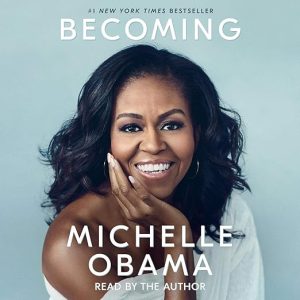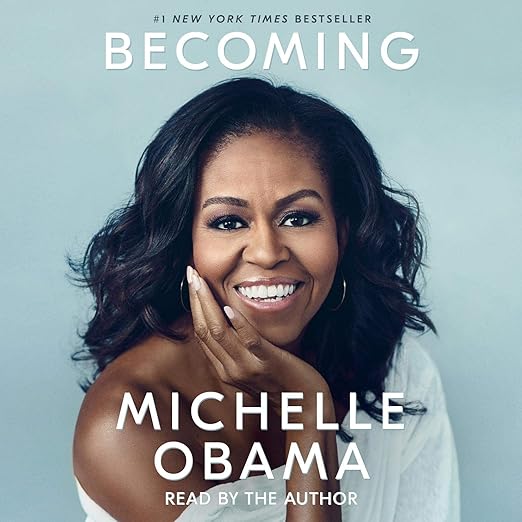
Michelle Obama narrating her own memoir is one of those decisions that reframes what an audiobook can be. Becoming is already a remarkable memoir on the page - precise, honest, and structured with unusual intentionality for a political autobiography - but hearing it in Obama's voice converts it into something closer to an extended conversation. Her Chicago South Side cadences are still present. The warmth she brings to stories about her father and brother Craig is not performed; it is simply felt. When she laughs at something that happened in the White House, you are not listening to a narrator conveying humor - you are listening to the person who was actually there, still amused by it nineteen hours later.
The memoir covers, broadly, three phases of Obama's life: her childhood on the South Side of Chicago, her adult years navigating Princeton, Harvard Law, and corporate work while building a relationship with Barack Obama, and her time as First Lady. But the organizational scaffolding is less important than the quality of attention she brings to each period. Obama writes about class and race in America with a specificity that resists both self-congratulation and grievance. Her parents, Fraser and Marian, come through as fully realized people rather than origin-story props. Her brother Craig, who gets more space here than in most political memoirs, emerges as one of the book's most vivid presences.
Obama's Ambivalence Refuses a Triumph Narrative
What separates Becoming from other political memoirs is Obama's consistent interest in her own ambivalence. She does not flatten her story into a triumph narrative. She describes the specific costs of ambition - the ways her early career left her feeling hollow despite its objective success, the difficulty of building a marriage to a man whose political calling was always going to demand more than she had bargained for, the exhaustion and exposure of eight years in the White House. The book's honesty about what was hard feels genuinely earned rather than strategically placed to inoculate against criticism.
The chapter dealing with the couple's marriage counseling is often cited as one of the most unexpectedly candid passages in any memoir by a major political figure. Obama is matter-of-fact about the difficulty and about what therapy did and did not fix. That matter-of-factness, that refusal to make the admission feel more dramatic than it was, is characteristic of her writing voice throughout. She trusts the material to carry its own weight.
The White House years are handled with more reserve than the earlier chapters, which makes sense given the proximity to events that are still politically live. But even here, Obama finds specific and personal angles that avoid the ceremonial flatness of most accounts of life in that building. The Let's Move campaign, the garden on the South Lawn, the effort to make the White House feel welcoming to people who had historically been excluded from it - these are described through her experience rather than as policy achievements.
Obama's Own Voice Carries the Memoir's Geography
The case for the audiobook over the print edition is unusually strong here. Obama's narration runs nineteen hours and three minutes, which is a significant time commitment, but the self-narration makes that time feel qualitatively different from listening to even a skilled third-party reader. Her voice carries the memoir's emotional geography in a way that print cannot. When she describes her father's multiple sclerosis progressing through her childhood, the restraint in her voice is part of the content. When she talks about the Carpool Karaoke moment or the dance moves at state dinners, you can hear that she is not embarrassed by these things - she is genuinely amused, and that changes how the passages read.
For listeners who approach the memoir with questions about how she processes Barack Obama's political career - the costs, the compromises, the sacrifices of her own professional ambitions - the audio format rewards close listening. The pauses matter. The moments where she chooses particular words carefully are more audible in her own narration than they would be in a read-through by someone else.
One reviewer described this as a great read regardless of politics, and I think that is accurate. The memoir is not a defense of the Obama administration's policy record - it is a personal account of how one woman moved through a specific set of extraordinary circumstances while trying to remain legible to herself. That project does not require political agreement to be interesting.
Personal Over Political, and Occasionally Compressed
Listeners expecting a political memoir in the conventional sense - one that provides inside-the-room accounts of policy debates, diplomatic crises, or legislative strategy - will need to recalibrate their expectations. Obama is clear throughout that her interest is personal rather than political. The memoir gives readers her experience of eight years in the White House; it does not attempt to account for the administration's decisions or to set a record straight on policy matters.
The memoir's structure moves chronologically but occasionally telescopes, moving quickly through periods that feel historically significant and slowing to linger on personal ones. Some readers find the treatment of the White House years somewhat compressed relative to the earlier Chicago chapters. This is a function of Obama's subject matter priorities rather than a craft failure, but it is worth knowing going in.
At nineteen hours, this is a considerable commitment. But unlike many long audiobooks that could have been edited shorter, this one earns its runtime. Obama does not pad or repeat herself. The length is a function of the scope of the life being described.
Essential Listening Unless You Want Policy Only
This audiobook is essential listening for anyone interested in American political culture, race and ambition in the late twentieth and early twenty-first century, or the specific experience of navigating institutions built for people who do not look like you. It is equally valuable as a memoir of a marriage, a meditation on identity, and an account of public life's private costs. The self-narration makes it the definitive format for this text. Listeners who prefer political memoirs focused primarily on policy substance should look elsewhere, but for everyone else, this is exactly as good as its reputation suggests.