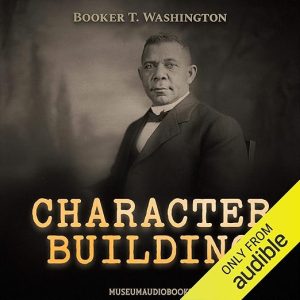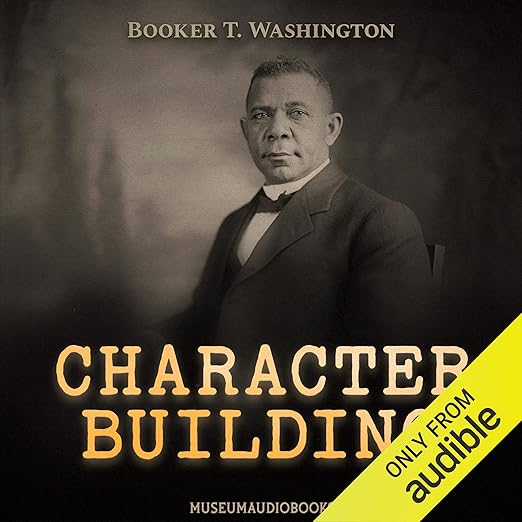
Booker T. Washington delivered this material out loud before anybody printed it, which makes an audiobook a closer relative of the original than any edition on paper. Character Building collects the talks he gave to students and faculty at the Tuskegee Institute, where he was the leader, and it was published in 1902 with those speeches standing as the core of his teaching. Six hours and thirty-nine minutes of it survive here, addressed to an audience of young people who were the children and grandchildren of enslaved Americans, by a man born into slavery himself in 1856.
Repetition That Reads as Padding but Is the Pedagogy
One response calls it a pamphlet, which is a revealing description of a book that takes most of a working day to hear. That reader means it affectionately, describing a comprehensive guide to being the best individual you can be and a treatment of what nobility looks like when it is expressed in every arena of life rather than reserved for the big occasions. The word pamphlet fits the register: nothing here is elaborated for its own sake, each talk makes one point and stops, and the accumulated effect is much larger than any individual piece.
The subjects are ordinary on purpose. Thrift. Cleanliness. Sharing what you have learned. The need to read. The value of educating the heart alongside the head. None of it was novel in 1902 and none of it was meant to be. Washington was talking to people whose margin for error was nonexistent, and the advice is calibrated to that reality: small disciplines, compounded, held to without excuse. Read as self-help it can seem plain. Understood as instruction given by a former slave to the first generation with a chance at institutional education, the plainness is the argument. Nothing in the delivery reaches for uplift. Washington returns to the same handful of behaviors from different angles, on the theory that a habit named once is forgotten while a habit named twenty times gets installed, and the repetition that reads as padding in print is the actual pedagogy.
The room matters to how it reads. These were not essays composed in private and later collected; they were addresses delivered by the head of an institution to the students and faculty whose futures he was accountable for. That accountability comes through in the tone. Washington is not offering a philosophy for consideration, he is telling people he is responsible for how to conduct themselves, and the stated aim in the description, developing oneself for lifelong success under the highest moral standards, was a practical program with an enrollment attached to it rather than an abstraction.
Rodney Louis Tompkins Inherits a Pulpit Cadence
A May 2009 response supplies the strongest practical endorsement in the record: a teacher who reads one of these essays to a class regularly, because the material connects directly with problems the students are actually having. That is the original use case reproduced almost exactly a century later, and it argues for the audio edition better than any appeal to convenience. The same reader describes the essays as well written and easy to follow, which matters for a text of this age. Nothing here has to be translated out of 1902 syntax, which is not true of most prose from the period and is one reason the book keeps finding new readers.
Something else in that response is worth flagging. It opens by naming a different edition, Character Building presented as an African American Heritage Book, which is a reminder that a public-domain text from 1902 exists in many printings and that responses to all of them can accumulate under a single listing. Anyone comparing versions should assume the commentary is describing several different books.
Rodney Louis Tompkins takes the reading. What a performer inherits with this text is the pulpit cadence, since these were spoken addresses with a room in front of them, built on repetition, direct address and the pauses an audience fills. Delivered as level prose, the structure sounds repetitive. Delivered with the rhythm it was written for, the repetition is the point. No director, studio or second voice appears in the credits.
A 2003 Response Flags the Uncle Tom Dispute
September 30, 2003 is the date on the earliest response here, almost seventeen years before this recording existed, and a second predates it by eleven. That matters for anyone reading the 4.6 average across two hundred and nine ratings as a verdict on this performance, because a good share of that number was accumulated by people holding one of many print editions of a text that has been in the public domain for decades.
That 2003 response is also the most historically alert item on the page. It calls the talks Sunday sermons to Tuskegee students, judges that they have not dated too badly, and then raises the argument that shadows Washington's whole reputation, observing that uninformed readers dismiss him as an Uncle Tom. Anyone arriving without knowing that his standing is disputed will hear the advice as uncomplicated. It is not uncomplicated, and the listing supplies no introduction, notes or context of any kind.
One more mismatch worth naming: the page files a collection of speeches under biography and memoir with a cultural and regional tag. Neither label fits a set of addresses on thrift and self-discipline, and a buyer expecting a life story will get moral instruction to an assembled hall instead.
Self-Contained Talks Built for Classrooms and Groups
Lemichael Dotson's July 2020 response identifies the audience with real force: a text teaching ethics, leadership, education, personal finance, entrepreneurship, giving and a growth mindset, which is not being taught in schools and which that reader argues should be a staple within the black church. That response also names the ideal listener directly, imagining a young person meeting this material during the years when character is actually forming. Educators, mentors, parents and anyone building a reading list for a teenager will find it lands.
Listeners wanting a narrative will be frustrated, since this has no story, no arc and no protagonist beyond the reader being addressed. Historians of the period will want a scholarly edition with apparatus. And anybody expecting the twenty-first century vocabulary of self-improvement should be ready for a moral seriousness that does not apologize for itself. Groups and classrooms are the exception worth calling out, since the self-contained talks make this unusually easy to use a piece at a time with a discussion afterward. Nothing here has been softened for a modern audience, which is precisely why it still works.
Before You Press Play
- Narrator: Rodney Louis Tompkins reads material originally delivered from a platform, where pulpit rhythm supplies structure that an even delivery would reduce to repetition
- Subjects: thrift and self-discipline as survival strategy, an education of the heart as well as the head, moral instruction for the first generation out of slavery
- Tone: Plainspoken, insistent and quietly urgent
- Bottom line: A durable collection of spoken moral instruction that belongs in audio, though it arrives without a scrap of the historical context it needs.