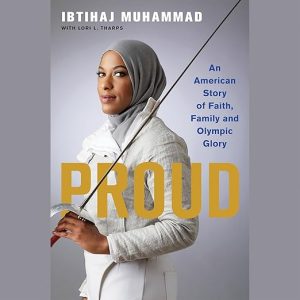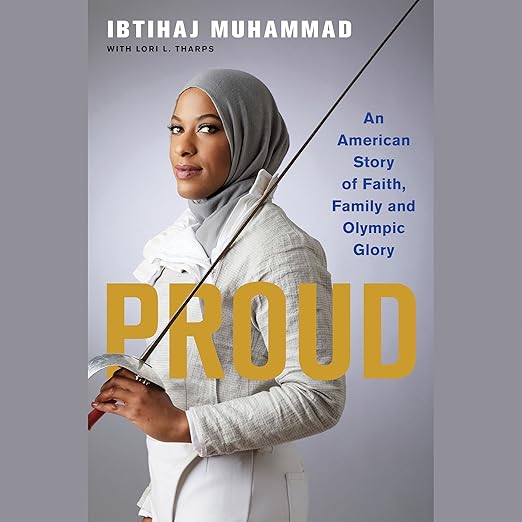
Fencing was, when Ibtihaj Muhammad found it, a sport reserved for families who could afford it, and the description says so without softening. She was the only African American Muslim at her school in New Jersey, and she went on to state championships, three-time All-America selections at Duke University, and a place on Team USA's saber squad as the only woman of color and the only religious minority on it. This audiobook is her account of how that happened, read in her own voice across nine hours and twelve minutes.
Muhammad Reads Her Own Testimony Aloud
Specificity is what makes the exclusion land. Not the abstract fact that a sport skewed wealthy, but what that meant week after week for a teenager who had to keep turning up regardless. NLM, Esq., at five stars, wrote as a saber fencer and coach and identified exactly what the book delivered: a way to better understand what a student arriving from somewhere unfamiliar experiences on the way into the room, plus a specific fascination with how the hijab worked underneath the mask. That last detail is the sort only a practitioner would register, and it is a reliable indicator of how granular the book is willing to get.
Class runs underneath the whole account and gets handled with more precision than race does, which is unexpected. A sport that requires equipment, club fees, coaching and constant travel filters its participants long before anybody reaches a national squad, and the description names that filter in its first sentence. What follows is a chronicle of the specific arrangements a family makes to stay in a room built for other people: the logistics, the driving, the cost of continuing. Sports memoirs usually skip this in favor of the training montage. Skipping it would have removed most of what makes this one useful.
Hearing the author read her own memoir matters more here than it usually does. Discrimination described by a hired performer becomes reportage. Described by the person it happened to, it stays testimony, and the difference is audible in the passages where the account turns from what she achieved to what it cost. Nine hours is also close to the right length for a life told at this level of detail: long enough for the grinding years to land as years rather than compressing into a highlight reel on the way to the podium.
A Sport Invisible to Spectators, Vivid in Description
Working as motivation without turning into a motivational book is a narrow line, and this walks it. PG, at five stars, described being carried through a hard stretch by it and pointed straight at the reason: the success did not arrive overnight, the discrimination and the comments about skin color and religious background are detailed rather than summarized, and the response throughout was to keep going anyway. That is the shape of the whole thing. The account also runs past the Olympic result into the fashion company built afterward, which that same notice singles out as the part worth staying for.
For a recording specifically, the sport is a gift. Fencing is fast, physical and close to invisible to spectators who have not been taught to read it, and it is described here by somebody who competed at the top of it. None of the technical material depends on a diagram, and the tempo of a bout, the pressure of a tied score, the strangeness of a venue, all of it belongs to description rather than illustration. Sports memoirs frequently fight their own medium in audio. This one does not.
Pacing helps as well. A career of this shape supplies natural chapter breaks, since seasons end, selections are announced and championships resolve, so the account arrives in units a listener can hold. Nothing needs to be tracked across a hundred pages or reconstructed later from a chart of results. You can put it down after a competition and pick it up before the next one without losing your footing, which is not true of every memoir at this length and matters more than it sounds when the listening is spread over a couple of weeks.
Two Publisher Names on One Listing Page
One notice deserves reading closely before you weigh any of the others. Kaitlyn Connelly, at four stars, opens by disclosing a reviewer copy received from the publisher through NetGalley in exchange for an honest review, and names that publisher as Hachette Books. The listing itself credits Legacy Lit. The disclosure is precisely what a reader should want to see and it thins the pool by one independent voice at the same time; the two publisher names sitting unexplained on the same page is a separate puzzle, and the buyer is left to reconcile them alone.
Content Warnings the Official Description Skips
The same four-star response supplies something the product page does not: content warnings. Racism, xenophobia, religious bigotry toward Muslims, hate letters and death threats. Nothing in the official description prepares a listener for the last two of those, and a memoir willing to go there has earned the flag rather than being damaged by it. Anyone buying this as a straightforwardly uplifting sports story for a younger reader should factor that in and decide deliberately rather than by accident.
The shelving is thin in a way that costs the book readers. The single tag on this listing reads Cultural & Regional. That is not wrong so much as almost empty: a memoir about Olympic saber fencing, American Muslim identity and the construction of an elite athlete is being represented by the vaguest available label, sitting across biography and sports categories without either one being specified. For a book a great many people would want if they knew it existed, that is a genuine discovery problem, and it is the kind nobody ever goes back to correct.
A High School Book Club Called It Inspirational
Young readers, and the adults who buy books for them. AwesomeMom, at five stars, ran it as the book of the month for a high school book club and reported the students describing it as inspirational, which is evidence rather than aspiration. The combination of a sport almost no teenager has tried, an identity story with real stakes, and an Olympic outcome at the end of it makes this an unusually easy sell to a reluctant reader, and the author's own voice does more of that work than a cover ever could.
It also serves fencers, readers assembling a shelf of American Muslim writing, and anyone who enjoys hearing an athlete describe the unglamorous middle of a career rather than only its summit. Skip it only if what you want is tactical or technical fencing content, because the sport here is the setting for a life rather than the subject of a manual, and the pages spent on blade work are pages spent on what the blade work meant.