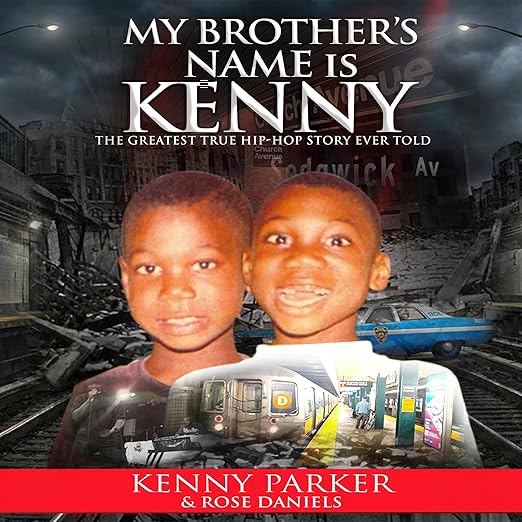
Every written response attached to this audiobook was posted before the audio edition existed. The listing dates the release to February 2026; the reviews run from November 2022 through October 2025. All five are discussing a book that had been in print for years. Kenny Parker, the deejay for Boogie Down Productions and the older brother of KRS-One, has now recorded it himself, and the fourteen hours that resulted are the newest thing on a page full of older opinions.
Written by Somebody Who Was in the Van
Hip-hop history is usually written by people who were nearby. This one was written by somebody who was in the van. Parker's account runs from two brothers in New York City housing at the harshest end of the 1970s and 1980s, through homelessness, violence and betrayal, to a rap career that reshaped the form. His own working life behind the decks spans three decades, which means the behind-the-scenes material comes from a participant rather than from an archive, and the people in it are family before they are figures.
KRS-One supplies the epigraph, and it reframes the entire book before the first chapter starts. People assume Criminal Minded is where the story begins, he says; for the two of them it is where a story ends. That single reversal tells you what kind of memoir this is. The famous record is the finish line of the hard part, not the opening of the glamorous part, and everything worth knowing happened in the years nobody documented.
Perseverance is the word one five-star response reaches for first, in a list that also includes sadness, joy, pain, excitement and agony. That reader, a lifelong follower of the group who also works as a college professor and administrator, singles out something the marketing does not mention at all: that Parker earned a college degree and played D1 ball while his younger brother became famous, and did it without any visible resentment at all. That detail changes the shape of the book.
Parker Wrote It, Reads It, Owns It
Three separate credits on this listing carry the same name. Kenny Parker wrote it, Kenny Parker reads it, and the publisher is Kenny Parker Books LLC. Complete authorial control over a memoir carries obvious risks, since an outside editor catches things a self-published account will not, but it does mean nothing here was shaped by a label with a stake in how a particular artist is remembered. For a story about betrayal inside a music business, that independence has value.
Oral transmission is how this material has always traveled. Hip-hop history lives in interviews, in radio, in the stories deejays tell between records, and very little of it began as prose. Putting a first-hand golden-era account back into a speaking voice is closer to the native form than a printed page ever was, and the person doing the speaking is the one who was standing behind the turntables while it happened.
Survival principles are what one response takes away, praising the book for what it reveals about coming through the adversities the brothers met in the Bronx and Brooklyn, and describing the effect of KRS-One's music and teaching on the reviewer's own life before turning to the pleasure of learning where all of it started. Reaching backward from the art to its root conditions is exactly what the book is built to do, and that response confirms it lands.
A Review Pool That Predates the Recording
Dates matter more than usual on this page. Because the whole review pool predates the recording, nobody in it has commented on the audio at all, and the vocabulary shows it: four of the five reach for a read, a reading, an in-depth reading. That is not a criticism of the production. It does mean the enthusiasm you see here was earned in a different format, and a buyer choosing this edition is committing on the material and the casting rather than on any verdict about the recording.
Somewhere between the cover and the listing, the subtitle went missing. One response cites the book by its full name, which continues past My Brother's Name Is Kenny into a claim that this is the greatest true hip-hop story ever told. That is a substantial promise, and it belongs on the page where buyers can weigh it. Leaving it off makes the title read as a quiet family memoir rather than the assertion the author actually made.
Scope is the caveat to hold onto. This is a brother's memoir, not a discography, not a critical history and not an authorized biography of KRS-One, even though KRS-One is the reason most listeners will click. The description's own register is promotional in places, and the golden-era revelations it promises are framed as never-before-told stories rather than described. Go in wanting a family account with music history attached, and it delivers. Go in wanting a documented history of the era and it will not.
Buy This for the Vantage Point
Hip-hop listeners of a certain vintage are the core audience, above all anybody who came up on Boogie Down Productions and has only ever had the artist's side of the story. The book assumes affection for the music without requiring expertise in it. Beyond that, this works for readers of New York memoir, for anyone interested in what the crack-era city did to families, and for people who like sibling narratives where one sibling becomes famous and the other has to decide what that means.
Critics of the music will find nothing to work with. Nobody here is analyzing records; the interest is in the lives that produced them. Anyone who needs an independently edited account should also hesitate, since a self-published memoir by a participant will always be a version rather than the record. Listeners with no connection to the group and no interest in New York across those decades may find the middle stretch, which is mostly hardship, longer than they bargained for.
Parker's position is what persuades me. The brother who did not become the icon, who was there for everything and got none of the mythology, is the best-placed witness any hip-hop story could have, and he is now the one delivering it aloud. Buy this for the vantage point. Ignore the fact that the ratings above it were earned by a book nobody could listen to, and take the recording as the first edition that actually matches the material.