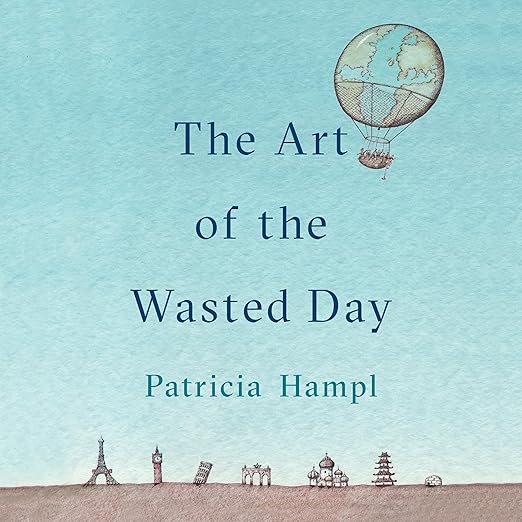
Hampl's audiobook arrived in my queue during a stretch when I had been filling every available hour with something purposeful, and the title alone stopped me cold. The Art of the Wasted Day is a picaresque travelogue of leisure, a book that makes a serious case for doing nothing in particular and thinking deeply about whatever surfaces. Patricia Hampl self-narrates, and that choice turns out to be essential: her voice carries both the precision of a memoirist and the quiet authority of someone who has earned the right to advocate for stillness. At nine hours and nine minutes, the audiobook takes precisely as long as it needs to.
The structure is deliberately unhurried. Hampl visits the homes and habitats of historical figures who made leisure a practice rather than an indulgence: two eighteenth-century Irish women who fled court life for rural Wales, choosing what they called retirement; Gregor Mendel, the monk-geneticist in Moravia who cultivated peas in solitude and rewrote the rules of inheritance; and Michel Montaigne, who retreated to his chateau tower and invented the personal essay by writing about whatever came to mind. These pilgrimages are not biography in any conventional sense. Hampl is not trying to document these lives so much as understand what their retreats meant, what they protected, and what they produced.
Her own life winds through all of it with a discretion that takes time to notice. Childhood afternoons under a neighbor's beechnut tree, a long fascination with monastic rhythms, a complicated relationship with solitude that is not the same as loneliness. And the grief that forms the book's quiet center: the loss of her husband, which she describes as the silver thread of the inquiry. That loss gives The Art of the Wasted Day an emotional depth that distinguishes it from philosophical treatises on the same subject. Hampl is not writing Marcus Aurelius for the modern era. She is writing something much more fragile and ultimately more persuasive for it.
The book's argument is simple to state and difficult to actually absorb: the real work of being human is getting lost in thought, and only leisure can provide the conditions for that kind of thinking. But Hampl does not state it so baldly for most of the nine hours. She demonstrates it instead, which is what the essay form is for. One reviewer wrote that the book helped them confront a lifetime of chasing accomplishment even after loss, describing difficulty finding words for their gratitude. That response makes sense. This audiobook does not moralize. It shows, and showing is harder.
Hampl's Pauses Perform the Very Leisure
Hampl's prose is the kind that rewards being heard rather than read. Her sentences are long but not labored, and she punctuates them with observations that arrive suddenly and stay. The self-narration is the right choice precisely because Hampl's timing is part of her meaning: the pauses she takes between ideas perform the very leisure she is arguing for. A professional narrator reading the same words at standard audiobook pace would lose something essential about the book's relationship to its own content.
Another reviewer writing from within a high-achievement academic environment described the book as a breath of fresh air, a sharp corrective to what they called the American pursuit of advancement at all costs. That positioning is accurate. Hampl is not anti-ambition in any reductive sense, but she is rigorously skeptical of a cultural economy that has no language for the value of sitting still. The audiobook makes that skepticism feel earned rather than reactive, because she has actually gone to the places where people chose stillness and reported back on what she found there.
The nine-hour runtime gives Hampl room to be discursive, which is fitting for a book about the value of not rushing. Listeners who prefer tight argumentation and clean conclusions may find the structure loose. Listeners who value the essay tradition, in which the form performs its own subject, will recognize what Hampl is doing and appreciate the fidelity to it throughout.
The Mississippi Chapter Hits Hardest of All
The Mississippi River chapter near the end is where the audiobook hits hardest. After all the international pilgrimages to Wales and Moravia and Bordeaux, Hampl returns to a remembered journey down the Mississippi with her husband on an old cabin cruiser, and she concludes that this modest, local voyage was the great adventure of her life. The turn is not sentimental. It feels genuinely earned, and it reframes everything that came before it. The book's argument about presence and leisure arrives most fully in that chapter, not in the European sections with their famous exemplars and their literary precedents.
Montaigne's shadow falls across the whole work, and listeners who have encountered him before will notice how Hampl uses him not just as a subject but as a model for her own method. She is, in a sense, writing essays about the inventor of the essay, and the recursion is deliberate rather than accidental. For those unfamiliar with Montaigne, the audiobook serves as a warm and intellectually generous introduction to his significance without functioning as his biography.
The passages on monastic life are also worth sustained attention. Hampl does not romanticize monasteries or present them as achievable models for secular life. She approaches them as spaces where a particular commitment to structured inwardness was institutionally supported, and she is honest about the gap between that support and what ordinary life provides. That honesty keeps the book from becoming a fantasy.
Doing Nothing as a Form of Knowledge
Readers drawn to the personal essay tradition, those who admire Annie Dillard, Joan Didion, or E.B. White, will find Hampl a worthy companion in that lineage. Anyone navigating grief alongside a demanding professional life will hear something in this audiobook that most productivity literature cannot provide or even imagine. Listeners expecting a conventional travel memoir or a linear narrative should know that the book's pleasures are accumulative and associative rather than plot-driven. Those who need a fast-paced or argumentative nonfiction style will find the nine hours long. But for anyone who has ever felt that doing nothing was itself a form of knowledge, Hampl's extended meditation is a rare and welcome vindication that takes its subject seriously enough to exemplify it.
Questions Listeners Ask
Does Patricia Hampl narrating her own audiobook work for this kind of reflective, essayistic material?
It works exceptionally well. Her pacing is unhurried and her voice carries the meditative quality the subject demands. Hampl reads with the ease of someone who has spent a long career thinking about the music of sentences, and the pauses she takes between ideas are themselves meaningful, performing the leisure the book is arguing for rather than just describing it.
Is this audiobook primarily a travel memoir, a philosophical essay, or a grief narrative?
It operates as all three simultaneously, which is both its strength and its challenge for listeners expecting a single register. The pilgrimages to Wales, Moravia, and Bordeaux provide structure, but the real subject is Hampl's interior life and the grief she carries after losing her husband. Montaigne functions as both destination and method throughout the nine hours.