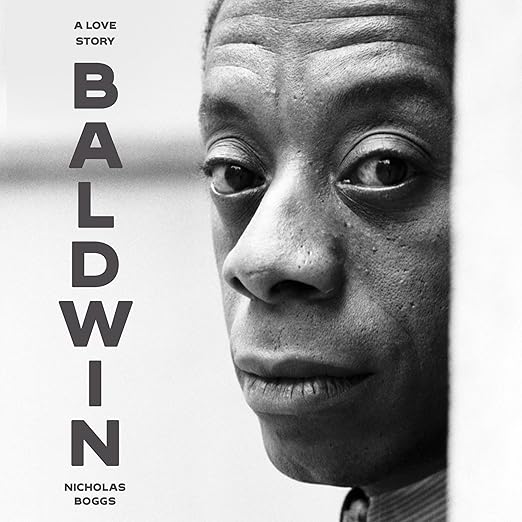
When AudioFile awarded Ron Butler its Earphones distinction for this performance, the citation read: a master class in maintaining the listener's attention over the course of a lengthy audiobook. That summary undersells what Butler actually accomplishes in nearly twenty-five hours of narrating Nicholas Boggs's biography of James Baldwin. This audiobook, which won the 2026 Audie Award for Best History/Biography, asks its narrator to hold emotional range across decades of one of the most complex literary and personal lives of the twentieth century, and Butler does not simply hold it. He makes it feel continuous.
Baldwin: A Love Story is the first major biography of James Baldwin in three decades, and the delay matters. Boggs has had access to newly uncovered archival material, conducted original interviews, and built a portrait that centers, as no previous biography has done, the four relationships that shaped Baldwin most profoundly: his relationship with the Black American painter Beauford Delaney, his long partnership with Swiss painter Lucien Happersberger, his collaboration with Turkish actor Engin Cezzar, and his last great love, the French artist Yoran Cazac, whose significance in Baldwin's life appears here for the first time with the depth it deserves.
Four Relationships Behind Every Baldwin Book
The question that drives this audiobook is not what Baldwin wrote or what he said in interviews, though both are covered extensively. The question is how his personal relationships generated the conditions under which his writing became possible. Boggs's thesis is that Baldwin's novels, essays, and plays are not separable from the loves and collaborations that surrounded them. Giovanni's Room, Another Country, The Fire Next Time, the plays at the Actors Studio in Istanbul: each is situated within a web of personal relationship that Boggs argues shaped the work in traceable, specific ways. That argument gives the biography a structural coherence that moves it beyond the conventional cradle-to-grave life summary.
The geographical scope of Baldwin's life, between Harlem, Paris, Switzerland, Istanbul, the American South, and the South of France, could easily become disorienting across a biography of this length. Boggs and Butler together prevent that by anchoring each location to specific relationships and to the particular work Baldwin was producing there. Istanbul, where Baldwin spent years working with Engin Cezzar and where Cazac eventually enters the story, receives the most sustained attention and emerges as the most illuminating section of the audiobook. These chapters reveal dimensions of Baldwin's creative life that have been largely invisible in previous accounts.
Butler's Intimacy Never Turns Into Impersonation
Butler's narration carries an additional significance given the subject. Baldwin's own voice, his rhythms of speech and his cadence in interviews, is well-documented enough that listeners familiar with it will bring that echo to the listening experience. Butler does not imitate Baldwin. But his delivery, particularly in the passages drawn from Baldwin's letters and private correspondence, carries a quality of intimacy that honors the subject without impersonation. The Macmillan Audio production from Farrar, Straus and Giroux also deserves acknowledgment: the audio engineering supports a listening experience that sustains over nearly twenty-five hours without fatigue.
One reviewer raised an irony worth naming: a biography of a man who never attended university, written by someone with the full apparatus of academic credentialing. That tension is real, and Boggs does not entirely escape the occasionally stiff register of academic prose. But the irony cuts in multiple directions. The archival depth that Boggs's institutional position allowed him to access, the archives, the interviews with people who knew Baldwin across his various lives, is precisely what makes this the most complete portrait available. Baldwin himself was never hostile to rigorous scholarship. He was hostile to bad faith.
From Delaney's Mentorship to Cazac's Final Chapter
The Beauford Delaney chapters early in the audiobook set the template for everything that follows. Delaney, thirty years Baldwin's senior, functioned as mentor, spiritual father, and introduction to the world of Black American modernism. Boggs's account of their relationship is the most fully rendered in the book and the most moving, in part because Delaney's mental decline in later years, and Baldwin's loyalty to him through it, reveals dimensions of Baldwin's character that his more famous public writing does not.
The Yoran Cazac chapters are essential reading for anyone who thought they knew Baldwin's later life. Cazac, the French artist who illustrated Baldwin's children's book and who was his companion in Saint-Paul-de-Vence, has been a background figure in earlier accounts. Boggs makes him central, drawing on interviews and materials not previously available, and the result changes the shape of what Baldwin's final years looked like. This is the kind of archival discovery that justifies a new biography of a figure who has already been written about extensively.
Butler's Performance Makes the Case for Audio
Listeners with an existing relationship to Baldwin's writing, whether through Go Tell It on the Mountain, The Fire Next Time, or the essays collected in Notes of a Native Son, will get the most from this audiobook. The biography presumes some familiarity with the work, and the arguments about how the relationships shaped the writing land with more force when you have the texts in memory. But the biography is rich enough as a human story that listeners coming to Baldwin for the first time through this book will not be lost. The two-hour-per-day listener will take about twelve days to complete it, and the investment is proportionate to the reward. Ron Butler's performance alone makes the case for audio over print.
Before You Press Play
- Read by: Ron Butler won an Earphones Award for this performance, and the recognition is deserved. His ability to sustain attention over nearly twenty-five hours while varying tone, volume, and pace with careful purpose is exceptional.
- At its heart: Love and artistic creation, Black and queer literary history, the geography of exile and belonging
- Vibe: Richly immersive and emotionally layered, demanding but deeply rewarding
- Short version: The most complete portrait of James Baldwin yet assembled, essential for anyone invested in American literary history and brilliantly served by its audio production.
Is this audiobook appropriate for listeners who have not read James Baldwin's writing before?
Yes, though familiarity with Baldwin's major works deepens the experience considerably. Boggs provides enough context to orient new readers, and the human story of the biography stands on its own. But listeners who know The Fire Next Time or Giovanni's Room will find the connections between biography and work significantly more resonant.
Why is the Ron Butler narration particularly significant for this audiobook?
Butler won an AudioFile Earphones Award for this performance, and the biography also took the 2026 Audie Award for Best History/Biography. At nearly twenty-five hours, sustaining genuine emotional range and listener attention requires a narrator of unusual skill. Butler varies tone, volume, and pace with what AudioFile called careful purpose, and the result makes a demanding listen feel continuous rather than exhausting.
What makes this biography different from previous accounts of James Baldwin's life?
Boggs centers the four relationships that most shaped Baldwin's life and work, two of which, particularly his partnership with Yoran Cazac, have never received serious biographical attention. The book draws on newly uncovered archival material and original interviews. Its structural argument, that the personal relationships and the literary work are inseparable, also distinguishes it from earlier, more event-focused biographies.
How long does this audiobook take to complete, and is the length justified?
At twenty-four hours and twenty-nine minutes, the audiobook is a significant commitment. The length is justified by the scope of the research and by the complexity of the four major relationships Boggs traces. Listeners who pace it across two to three weeks will find the extended immersion adds to rather than detracts from the experience.