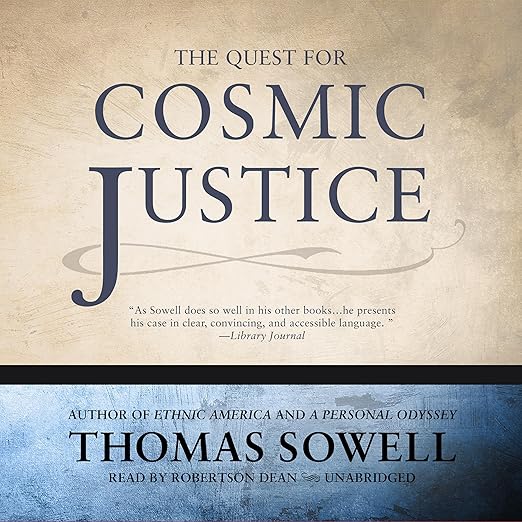
Two words carry the whole argument here, and one of them is doing double duty. Justice means one thing when a judge applies the same rule to two people, and something else entirely when a society tries to even out the circumstances those two people were born into. Thomas Sowell spends five hours and fifty-one minutes refusing to let those meanings blur, and the audiobook asks you to hold both in your head at once without a printed page to keep them separated.
What Thomas Sowell Delivers
Sowell builds by accumulation rather than by assertion. Each chapter sets a familiar phrase beside its consequences and asks what follows if you actually mean it. R. Davis, writing at five stars in May 2025, describes that shape exactly: every chapter as a comprehensive treatment of the competing views of justice, equality and visions. It is a fair description of the structure and also a quiet warning about the pace, because nothing arrives as a scene or an anecdote you can coast through while doing something else.
Numbers on this page do not survive a second look. The counter reads one rating against a displayed average of 4.8, and a single whole-star vote cannot produce a decimal at all. That counter also sits below the five written responses printed underneath it, graded five stars on four occasions with a single four among them. Average those five and the result is 4.8 precisely. Whatever the rating counter is measuring, it is not the pool of accounts a buyer can actually read.
Victor Bolles filed something in September 2019 that is not quite a review. That entry opens with its own headline, its own date line and its own byline before a word of commentary arrives, which is what a re-posted column looks like when it lands in a retail text box. The substance is real and it still counts toward the visible five. Treat it as an article that migrated rather than as a note written for this page.
What Thomas Sowell Gets Right
Clarity is the reason to spend the time. Steel Magnolia, whose January 2023 notice runs to five stars, credits Sowell with separating traditional justice from social justice so plainly that anyone can follow why the two are held to be incompatible. Accept the conclusion or reject it; the explanation itself is genuinely legible, which is rarer in political argument than it ought to be. Sentences stay short. Terms get defined before they get used. Structure of that kind repays a listener who cannot underline anything. Sales copy for the book warns in its own second sentence that this is not a comforting read but one about disturbing and dangerous trends, which is an unusually candid thing for a publisher to advertise.
Darla filed four stars in March 2019 and wrote the most useful thing on the page. The grade is not an endorsement of the conclusions, by that account's own admission, but recognition that Sowell does a fine job expressing his views, which opens a window onto a mindset the reviewer says is often vastly different from their own. Political argument rarely earns that kind of grade, and it tells you the prose is doing work independent of whether you agree.
Robertson Dean is credited with the reading, and this book asks something unusual of whoever holds that credit. One word, justice, has to land with two different senses depending on the sentence around it, without italics, without a footnote, without the visual scaffolding a printed page supplies for free. The recording is also compressed for a book of ideas, which means the distinctions arrive fast and the listener carries the burden of keeping them apart.
Where Thomas Sowell Loses Some Ground
Buyers hoping for a survey of competing theories should reset that expectation now. This is one thinker's case, pressed hard, and rival positions appear mainly as things to be dismantled. Duane Linstrom's August 2018 response shows what the book produces in a sympathetic listener: several paragraphs on federal control of local schools and the tenth article of the Bill of Rights, written as a continuation of the argument rather than as any assessment of the edition being sold.
Dating is the next thing to know, and the page hides it. No line anywhere states when the book was written; the only date on the record is the 2017 recording. Two written accounts place the writing in 1999 outright, and the January 2023 response quoted above counts 24 years back to the same year. Anyone who wants current illustrations is buying a book whose examples stop in the 1990s, and nothing in the description says so.
Shelf placement is the remaining problem. Filed under Law, the page implies a legal treatment, and that is not what arrives. The description promises the moral issues underneath political controversy, confused conceptions of equality, and what it calls "a quiet repeal of the American revolution." Law is one thread inside that rather than the frame around it. Listeners shopping by tag will find the first stretch disorienting; listeners who read the description will get precisely what it advertises.
Who Should Pick Up The Quest for Cosmic Justice
Argument-first listeners are the core audience, meaning readers who want a case constructed rather than proclaimed, along with anyone obliged to engage the equality-of-outcome position professionally who would rather meet its sharpest opponent than a caricature of one. Publisher copy bills the book as the summation of a lifetime of study, fair warning that it condenses positions developed at length in other volumes. Four written accounts out of five come from people who already share the conclusions, which tells you who tends to find this page. The fifth, the four-star account quoted earlier, proves the book survives contact with someone who does not.
Anyone wanting a balanced survey of theories of justice is in the wrong place, and should say so to themselves before buying rather than afterward. Current data is the second filter, since the illustrations stop where the writing stopped. Temperament is the third: a listener who bristles at being walked steadily toward a conclusion will bristle for most of the running time, and no amount of clear prose changes that. Sowell is not neutral and never pretends otherwise.
Practically, buy this for the argument and not for the consensus. Ignore the average on the page, which measures nothing, and read the five written accounts instead, because they are unusually specific about what the book does to a reader. Short chapters make it a workable commute companion for anyone who can follow abstract reasoning without rewinding. Give it your attention or give it nothing, because half-attention will lose the distinction the whole book rests on.
Quick Take
- Read by: Robertson Dean is credited with the reading, on a book where one word has to arrive with two separate meanings and no printed page is there to keep them apart.
- At its heart: Competing definitions of justice, equality of process against equality of result, the cost of unexamined social visions
- Vibe: Cool, insistent, argued rather than told
- Short version: Worth the time if you want the strongest construction of this position; the star rating on the page is broken and the five written responses are the only usable evidence.
Good to Know
Why does the rating on this audiobook page look wrong?
One rating is what the counter claims, and one person cannot generate a fractional star. Underneath it sit five people who each wrote several sentences, which is a great deal more evidence than the figure above them represents. Skip the average and read those five, who are unusually candid about their own positions.
How current are the examples in this audiobook?
Not current at all, and the page never says so. Nothing on the record states a writing date; two written responses place the book in 1999, one of them counting 24 years back from January 2023. The recording dates from 2017. Expect illustrations drawn from debates of the 1990s rather than from the present decade.
Is this a good introduction to Thomas Sowell's work?
It works as an entry point to his social thought rather than to his economics, which is present but assumed rather than taught. The structure is self-contained, no prior volume is referenced as required reading, and under six hours makes it one of the shorter routes into the way he builds an argument.