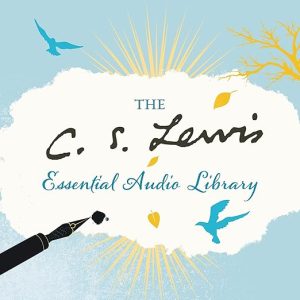
C. S. Lewis Essential Audio Library is the kind of audiobook collection that changes your relationship with a writer. At nearly thirty-nine hours across nine works, this is not background listening. Julian Rhind-Tutt's narration of works spanning Christian apologetics, moral philosophy, literary criticism, and memoir makes the case that Lewis in audio is not a lesser version of Lewis in print, it's a different, often more intimate encounter with the same extraordinary mind.
The nine works assembled here are: Mere Christianity, The Screwtape Letters, The Great Divorce, Miracles, The Problem of Pain, A Grief Observed, The Abolition of Man, The Weight of Glory, and the anthology George MacDonald. That is a formidable range. It includes Lewis's most systematic theological arguments alongside his most personally raw writing, his satirical fiction alongside his literary scholarship. The editorial choice to gather them in one edition invites the kind of cross-reading that reveals Lewis's obsessions and the deep coherence of his thinking across genre.
Rhind-Tutt Navigates Grief Without Sentimentality
The case for Rhind-Tutt as the ideal Lewis narrator rests on his ability to honor Lewis's characteristic register without caricaturing it. Lewis wrote for the intelligent general reader, not the specialist. His prose is lucid, occasionally playful, always precise, and at moments of intense personal feeling, devastatingly direct. Rhind-Tutt finds the right temperature for each of these modes without flattening them into a single, uniform performance tone.
A Grief Observed presents the most demanding tonal challenge. Written in the immediate aftermath of Joy Davidman's death, it is raw in a way that little of Lewis's other work is. The precision doesn't leave, Lewis cannot write imprecisely even in grief, but the emotion is close to the surface in ways that The Screwtape Letters, for instance, are not. Rhind-Tutt navigates this without either sentimentalizing the text or performing grief theatrically. The restraint is the right choice.
Weight of Glory Was Written to Be Heard
The sequential argument for beginning with Mere Christianity and proceeding through the collection is real. Mere Christianity establishes the logical architecture that underpins almost everything Lewis wrote for a general audience. The Problem of Pain extends it into theodicy. Miracles addresses the philosophical objections to supernatural belief more directly. The Abolition of Man applies the moral framework to education and modern technocratic thinking. Hearing these in proximity, which a collected audiobook makes natural in a way that buying individual volumes doesn't, reveals the internal consistency of Lewis's project across multiple decades of writing.
The Screwtape Letters occupies its own category in this collection. It's the only fiction in the set, and it demands a slightly different narration mode, Wormwood's senior mentor Screwtape writes with demonic bureaucratic complacency, and Rhind-Tutt's performance captures the satire's dark comedy without overdoing it. Listeners who have read The Screwtape Letters in print may find it lands differently in audio, where the irony of the infernal office-memo format is closer to how a performance piece operates than to how it reads on the page.
The Weight of Glory and Other Addresses collects Lewis's public lectures and sermons, which are in many ways the most audio-native works in the collection. Lewis wrote them to be spoken. Hearing Rhind-Tutt deliver them brings back something of their original rhetorical context, particularly the famous title address, which builds its argument about longing and desire toward one of Lewis's most sustained and moving conclusions.
Belief Is Not a Prerequisite Here
At nearly thirty-nine hours, this collection rewards a different listening posture than most audiobooks. Sustained engagement with Lewis's arguments benefits from pausing, re-listening to specific passages, and giving the denser philosophical sections room to settle. The Abolition of Man, in particular, is dense enough that some listeners may want to revisit it in print. Lewis himself was a Cambridge and Oxford don, and even when he's writing accessibly, he assumes a reader who will slow down.
The George MacDonald anthology is the collection's most specialist entry. Lewis credited MacDonald as the writer who most shaped his imagination, and the anthology he edited presents excerpts from MacDonald's fiction and devotional writing. For listeners who don't already know MacDonald, this entry may feel less immediate than the Lewis originals. But as a window into the literary inheritance that produced Narnia and the Space Trilogy, it's genuinely illuminating.
A reviewer noted that this collection works for listeners across a spectrum of belief, those seeking spiritual growth, those uncertain about faith, and those approaching the material as intellectual history rather than personal devotion. That range is real. Lewis is not easily confined to the devotional shelf, and his arguments are worth engaging on their own terms regardless of where the listener stands on the theological questions he raises.
Newcomers Should Start With Mere Christianity
Readers who have encountered one or two Lewis works and want to understand the full shape of his thinking will find this collection an ideal way to move through the canon in a format that makes the cross-reading easy. The coherence of Lewis's project is much more visible in a collected edition than it is when the works are encountered separately and years apart.
Listeners who are already deep Lewis readers will find Rhind-Tutt's narration a worthy companion to however they've previously engaged these texts. And those coming to Lewis entirely fresh should probably begin with Mere Christianity before committing to the full collection, it's the work that most clearly establishes what Lewis is trying to do and why his method of argument is distinctive enough to reward nearly forty hours of attention.
- Narration: Julian Rhind-Tutt is an exceptional match for Lewis's prose, he navigates the tonal range from the precise argumentation of Mere Christianity to the lyrical grief of A Grief Observed without making either feel forced.
- Themes: Christian apologetics, moral philosophy, the nature of suffering and loss, imagination and reason
- Mood: Intellectually demanding and emotionally resonant across nearly forty hours of sustained engagement
- Verdict: Nine essential Lewis works in a single collection narrated with genuine craft, for serious readers of Lewis, this audiobook is the definitive listening edition.