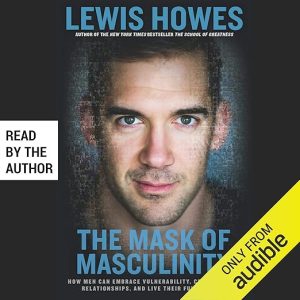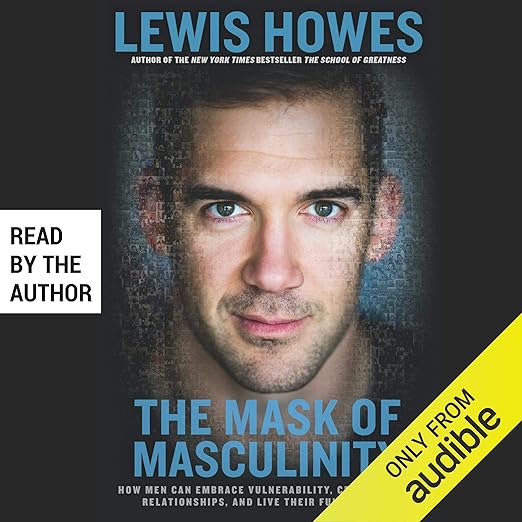
Key Details
- Narration: Lewis Howes reads his own work with the energy of a podcast host, direct, warm, and occasionally breathless. Self-narration works here because the book's confessional sections need his voice.
- Themes: Toxic masculinity and identity, vulnerability as strength, emotional suppression and its costs
- Mood: Earnest and searching, like listening to someone think through something they are still figuring out
- Verdict: A worthwhile audiobook for men ready to examine why the version of strength they were handed is not actually working.
I listened to The Mask of Masculinity on a long Saturday drive, and somewhere around the chapter on the Stoic Mask, the man who has learned to express absolutely nothing, I had to pause and sit with it for a while. Not because it was devastating, but because it was precise in a way I had not expected from a former professional athlete who hosts a business podcast. Lewis Howes is not operating at the theoretical distance of an academic. He is pulling from his own history, his own locker rooms and training tables, and the masks he wore so long they stopped feeling like masks.
The book's premise is built around nine distinct personas men construct to avoid vulnerability: the Material Mask, the Joker Mask, the Stoic Mask, the Invincible Mask, the Aggressive Mask, and others. Howes draws on conversations with psychologists, behavioral researchers, and figures ranging from Tony Robbins to Ray Lewis to Alanis Morissette to examine how each mask forms, what need it serves, and what it costs.
How The Mask of Masculinity Holds Up
The self-narration is a genuine asset. Howes reads his own confessional sections with a rawness that a hired narrator could not replicate. There is something in the slight unevenness of his delivery that signals authenticity. He is not performing vulnerability; he is actually sitting in it. That matters for a book whose central argument is that performed invulnerability is the problem.
What he is less skilled at is sustaining analytical rigor across nine chapters. The masks are identified and named effectively, but several chapters follow an almost identical structure: here is the mask, here is how I wore it, here is an expert who explains the damage, here is how to take it off. One critic noted the takeaway sections across chapters feel basically the same verbatim, and that is a fair complaint. The framework needed more variation in execution.
Why The Mask of Masculinity Works as an Audiobook
The most valuable chapters are the ones where Howes goes personal rather than prescriptive. The material on the Stoic Mask, men who equate emotional expression with weakness and spend decades building elaborate systems of avoidance, is particularly well-observed. And the chapter on the Aggressive Mask, examining how suppressed emotional vocabulary turns into rage, connects behavioral research to lived experience in a way that avoids both condescension and self-pity.
The book is also genuinely useful for women trying to understand the men in their lives. Multiple female reviewers noted this, including a mother of teenage boys who found the framework helpful for understanding what her sons were experiencing. The nine-mask structure gives language to dynamics that often go unnamed in households and relationships, which is itself valuable, separate from any program of personal change.
Weak Spots in The Mask of Masculinity
The celebrity interview sections have an uneven quality. Tony Robbins and Ray Lewis feel like genuine conversations; others feel more like promotional cameos. And Howes's background as a podcast host means he sometimes writes like he is building toward an ad break, punchy, motivational, occasionally substituting intensity for depth. Readers looking for something with the rigor of Terrence Real's work on male depression will find this lighter than they might want.
At under seven hours, the audiobook does not overstay its welcome, and Howes's delivery keeps the pacing energetic. The book is best understood as a first conversation, an entry point into examining masculinity for men who have not had that conversation yet, rather than an exhaustive resource.
The Right Listener for The Mask of Masculinity
Men in their twenties and thirties who are beginning to sense that the version of strength they built their identity around is not serving them will find this the most useful. It is especially well-suited for men who consume podcasts, who respond to personal story over academic argument, and who would not pick up a therapy-adjacent book described in more clinical terms.
Women who want to understand why the men they love shut down, deflect, or escalate in emotional conversations will also find the nine-mask framework genuinely illuminating. It is not a book about what is wrong with men, it is a book about what men were taught that turned out to be wrong.
Frequently Asked Questions
How does Lewis Howes's self-narration compare to a professional narrator for this kind of content?
For the personal and confessional sections, his self-narration adds authenticity that would be hard to replicate. For the more analytical or interview-based sections, the delivery can feel like a podcast rather than a narrated book. Overall the trade-off favors self-narration for this particular title.
Is this book similar to Brene Brown's work on vulnerability, or does it cover different ground?
There is significant conceptual overlap, both argue that vulnerability is strength and that emotional suppression is self-defeating. Howes's approach is more personal narrative and interview-based, while Brown's is more research-driven and systematic. They complement each other and many readers find both useful.