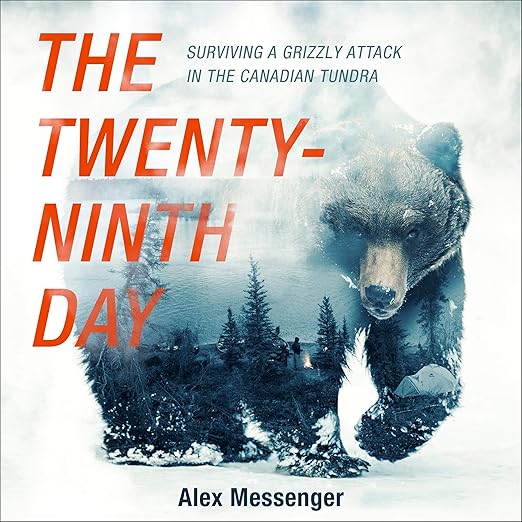
I was in a library when I read the first description of this book and I felt the animal alertness that good survival writing produces - a slight quickening, the body registering danger from a safe distance. A seventeen-year-old alone on a hiking trail in the Canadian tundra, twenty-nine days into a canoe trip, a barren-ground grizzly approaching. What happens next is not a spoiler; it is the premise. What Alex Messenger does with that premise across seven and a half hours is where the book's real achievement lives.
The Twenty-Ninth Day does something intelligent with its structure. It does not begin with the attack. It begins at the beginning: the preparation, the departure, the first days on the water with five companions, the growing relationship between a seventeen-year-old from Minnesota and the Canadian tundra he is paddling through. By the time day twenty-nine arrives, you have spent enough hours in that landscape to understand what is at stake in a way you could not if Messenger had opened in medias res.
The writing is exceptional for a debut, and exceptional full stop. Reviewers consistently note that they felt the driving rain, the cold, the immense beauty, the ache in their arms from imagined paddling. One reviewer says they could almost smell the hot breath of the grizzly during the attack sequence. That kind of somatic response to prose is not common and it is not accidental. Messenger writes with the precision of someone who needed to remember everything correctly in order to survive, and that precision translates directly into the reading experience.
The aftermath of the attack - the hours and days during which Alex and his companions tended his wounds and moved toward a remote village a thousand miles north of the US-Canadian border - is where the book's emotional stakes fully arrive. This is a coming-of-age story in the most literal possible sense: a boy who left as someone who wanted adventure and returned as someone who understands what survival actually costs, both physically and in terms of the people around you who have to hold things together when you cannot.
Why Listen to The Twenty-Ninth Day
Messenger narrating his own memoir is the right choice, and it pays off throughout. There is a quality to his voice when he describes the landscape - the way he holds the beauty of the tundra before he tells you what it almost took from him - that suggests a real relationship with this material rather than a performance of one. The production values from Blackstone Publishing support the narration well, and the seven-hour-forty-two-minute runtime is well-paced throughout.
The book rewards listeners who love the outdoor adventure tradition - Jon Krakauer, Sebastian Junger's The Perfect Storm - but it stands apart from that company through the specificity of its subarctic setting and the youth of its protagonist. There is no one else in recent wilderness memoir who has written from exactly this vantage point.
What to Watch For in The Twenty-Ninth Day
A reviewer who knows wilderness travel deeply notes that the book's detailed passages about canoe technique, camp craft, and subarctic terrain are not padding - they are essential context for understanding both what the companions accomplished and what the attack interrupted. If you find the early chapters slow, it is worth staying with them. The landscape earned in those hours is the landscape that makes the attack sequence land as hard as it does.
One reviewer found certain early passages to reflect the perspective of someone who had not yet earned their difficulties. Messenger is self-aware about this but it is worth noting as a potential friction point for listeners who find pre-crisis chapters too comfortable.
Who Should Listen to The Twenty-Ninth Day
Anyone who has ever been drawn to wilderness or survival narrative will find something exceptional here. It is also an ideal gift for the teenager in your life who loves the outdoors but has not yet found the right gateway into serious memoir - the combination of a young protagonist, visceral action, and genuine literary quality makes it accessible in ways that adult wilderness memoirs often are not. Listeners who want their memoirs fast and plot-driven may find the atmospheric early sections slow. Those who want to inhabit a landscape before a crisis arrives in it will find exactly that.
Quick Take
- Narration: Alex Messenger narrating his own survival account gives the story an authenticity that a hired voice could not replicate - you are listening to someone who actually lived this.
- Themes: Wilderness survival and human resilience, coming-of-age through extreme experience, the beauty and indifference of subarctic nature
- Mood: Immersive and visceral, with stretches of genuine wonder before the terror arrives
- Verdict: A standout wilderness memoir that earns its dramatic premise through exceptionally vivid writing and an author whose storytelling instincts match his survival instincts.