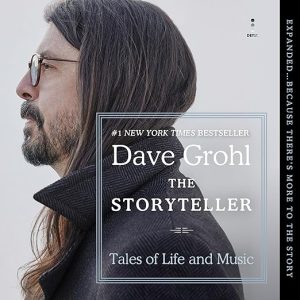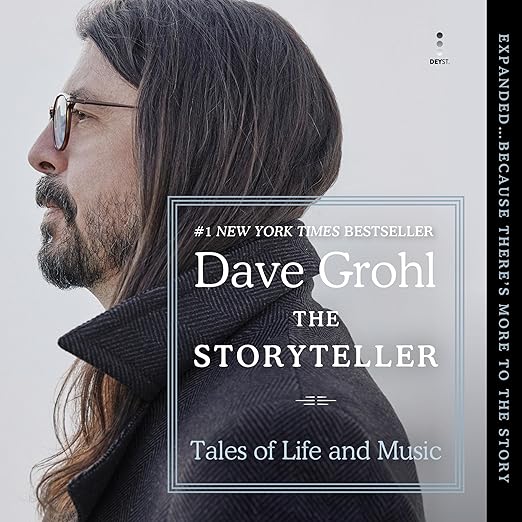
Remastered is a word borrowed from records, not books, and Dave Grohl uses it deliberately on this expanded audiobook. The original memoir sold two million copies worldwide, landed on best-of-2021 lists at Variety, NME, and Business Insider, and then came back two years later with four documented additions bolted on. Eleven hours and thirty-eight minutes, self-narrated, published by Dey Street Books. The question any returning buyer will ask is whether the new material justifies a second purchase, and I want to answer that squarely rather than bury it.
Avoiding the Book Version of Social Media
The spine of the book has not changed. Grohl moves from a childhood in Toughskins in the Virginia suburbs, through a skinny adolescence drumming for the punk band Scream, into the explosion and implosion of Nirvana, and out the other side into a life where the defining anecdote involves flying halfway across the planet so he could take his daughters to a Father Daughter dance and then being ignored the instant they spotted their friends. The publisher's own framing calls it an extraordinary life assembled out of ordinary moments, and for once that is a structural description rather than a compliment.
One reviewer articulated the standard complaint about celebrity memoir better than most critics manage. Their issue, they write, is that too often such books 'highlight the glamorous bits of the subject's life, which doesn't make for a great story.' They go further: 'It's the book version of social media.' What they want instead is simple: 'You want the ups and downs.' Grohl supplies both, and the reason he can is that his ups and downs are not evenly weighted. The poverty and the punk years occupy as much narrative space as the stadiums, and he does not treat the early material as prelude.
Reviewers Who Own Zero Foo Fighters Records
Self-narration is the obvious argument for this format, and here the reasoning is structural rather than sentimental. The prose was built out of told stories, the kind refined by repetition in interviews and green rooms before they ever reached a page, and the author is a man whose profession involves holding a room. A memoir written that way loses less in the transfer to audio than most, because the sentences were shaped for the ear first. The eleven and a half hours ask for a commitment, but the episodic construction means you can leave and return without losing a thread.
The book also travels well outside the fanbase, which surprised me. One reviewer opens with a flat admission: 'I have never owned a Foo Fighters record.' More than thirty-five years in the music business, a love of music they rate second to none, and exactly one Foo Fighters song heard since the band's debut. They read it anyway and kept breaking off to look up everything they had missed. Another reviewer, deep in drummer memoirs generally, concluded that 'Dave Grohl has to be the most entertaining of all of them,' praising his candor about both Nirvana and the years after.
As for the additions, the listing names them precisely, which I appreciate. You get an essay on how Grohl approaches creativity, summarized in the description with a line worth quoting because it is the whole thesis: 'you don't have to think outside of the box. Just ignore it.' You also get the story of the first time he met Paul McCartney, a set of prompts intended to start your own creative work, and a collection of curated playlists drawn from the music he loves. The McCartney story is the piece that most obviously belongs in this book rather than in a bonus track.
Playlists and Prompts Don't Survive the Move to Audio
So, the returning-buyer question. Owning the 2021 edition in any format means what you are paying for here is those four items and nothing else. The core narrative is unchanged, and no revision to the original text is claimed anywhere in the listing. That is a fair deal for a listener who wants the creativity material and the McCartney anecdote, and a poor one for anyone hoping the remaster reopened the Nirvana chapters. I would not buy this expecting reopened chapters, and the four additions have to carry the purchase on their own.
Two of the four additions also sit awkwardly in audio, and it is worth being honest about that. A curated playlist is a functional object: in print it is a list you can photograph and rebuild, and on a streaming service it is a link. Read aloud, it becomes a sequence of song titles you have to write down or forget. The creativity prompts have a related problem, since prompts exist to be answered on paper and a listener has no paper in hand. Neither element is spoiled, but both work better with the print or digital edition open alongside.
The most useful critical note comes from a reviewer who loved the first half without reservation, the unknown punk years, living with Kurt, the arrival on the big stage, the poverty and the hunger, and then found that the 'Second part feels a bit less compelling,' pinning it on the Foo Fighters chapters and their endless touring. Their own conclusion is generous: 'But so it was Dave's career, after all.' I think that is exactly right as both criticism and defense. The back half is less dramatic because the life became less dramatic, and a memoirist who reshaped it would be lying.
The Narrative Alone Doesn't Justify a Rebuy
Music readers who want a working musician's account of the trade, rather than a rise-and-fall arc, should start here, and so should anyone who has enjoyed a drummer's memoir before and wants the best-argued version of that subgenre. Listeners with no attachment to either band are a genuine audience too, on the evidence of the reviewer who arrived owning nothing and left with a search history. Creative-work readers, the kind who collect books about process, will find the added essay and prompts more interesting than the tour stories.
If you already own the 2021 book and want only the narrative, stay put and save the money. Readers who need forward momentum will feel the second half slow, and readers who came specifically for Nirvana should know that band occupies one movement of a much longer piece. The playlists and prompts genuinely want a screen or a page nearby. Everything else about this audiobook holds up, and its central claim, that ordinary moments carry an extraordinary life, survives eleven and a half hours of testing.
In Brief
- Read by: Grohl reads his own memoir, and the prose was built from told stories, which is the structural case for hearing rather than reading it.
- At its heart: punk apprenticeship, sudden fame and its aftermath, fatherhood, creativity as a working habit
- Vibe: Warm, profane, and conversational, with real grief underneath
- Short version: Worth every hour if you are new to it, and worth a careful look at the four additions if you already own the original.
Good to Know
What is actually new in the Expanded edition of this audiobook?
Four documented items: a piece on how Grohl approaches making things, exercises meant to get your own work moving, an account of first meeting Paul McCartney, and a set of playlists pulled from his own listening. The narrative itself is untouched, so returning buyers pay for those four alone.
Do the playlists and creativity prompts work in an audiobook?
Only partly. Both were designed for a page. A spoken sequence of song names has to be transcribed before it becomes useful, and exercises want somewhere to answer them. Nothing is ruined, though keep a notes app open if those sections are the reason you are buying this version.
Is this worth hearing if I have never listened to Nirvana or the Foo Fighters?
Yes, on the evidence. One reviewer with decades inside the industry admitted to owning nothing by the band and read it regardless, stopping repeatedly to chase down songs. Apprenticeship, luck, poverty, and family carry the book far more than any discography does.
Does the second half hold up as well as the early years?
Less well, and reviewers say so. One loved the punk apprenticeship and the Nirvana period, then judged the later stretch weaker once it settled into touring. Their own conclusion was that the career simply went that way, which strikes me as fair to the book and to the author.