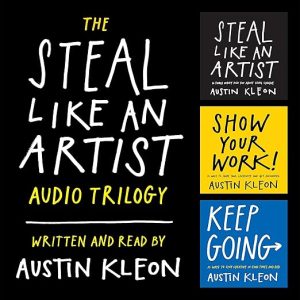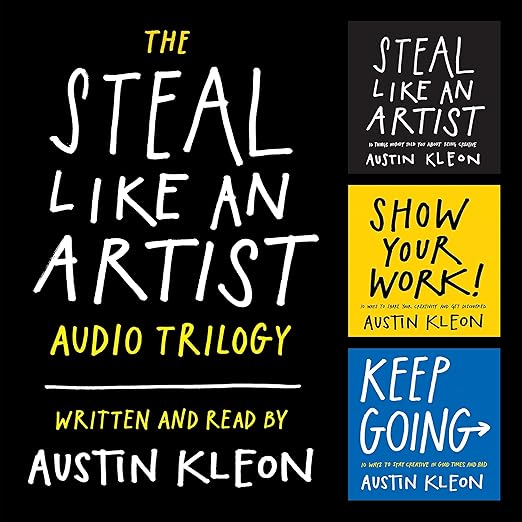
Austin Kleon's desk is famously covered in newspaper clippings, blackout poetry, and bits of other people's work that he has repurposed into something new. His audiobook trilogy, Steal Like an Artist, Show Your Work, and Keep Going, is built on the same principle: take what is useful from everywhere, make it yours, and then share it back out into the world. The fact that Kleon reads this compilation himself, with the casual directness of someone talking to a friend rather than delivering a keynote, is not incidental. It is the whole argument made audible.
The three volumes arrived between 2012 and 2019, but they sit together naturally because they form a genuine progression rather than a repeated thesis. Steal Like an Artist addresses the anxiety of originality, the fear that everything has already been done, and argues that influence is not failure but the engine of all creative work. Nothing is original; everything comes from somewhere; the act of making something new is always an act of transformation rather than invention. For a musician, a writer, a designer, a filmmaker, this is either deeply liberating or obvious, and if it feels obvious, you probably already absorbed it from someone who got it from Kleon.
Show Your Work, the second volume, takes the argument one step further into territory that was newer and more contested when it was published: the case for transparency, process-sharing, and building in public rather than waiting until you have something finished and polished to present. The social media ecosystem Kleon was writing about has changed considerably since 2014, but the underlying argument, that creative community is built through showing the work as it develops, not just the finished artifact, has only become more relevant as the anxiety around self-promotion and audience-building has intensified for working artists.
Keep Going, the third volume, is the most practical and in some ways the most durable. Published in 2019, it addresses what happens after the initial energy of creative conviction cools, the daily-ness of sustaining a practice, the discipline of not letting output metrics become the measure of value, the importance of protecting the time and attention that creative work requires from an environment designed to fragment both. One reviewer, a musician, noted the specific resonance of Kleon's observation about the twelve notes that repeat before you run out, how can anyone create something original in that constraint? The answer, which threads through all three volumes, is that originality was never the point.
A Polished Performance Would Undercut the Message
At 4 hours and 32 minutes, the full compilation is shorter than many single audiobooks, which itself makes an argument. Kleon writes short and dense rather than long and diluted. Each of the three volumes was designed to be read in a sitting, and the audio trilogy maintains that compactness. You could listen to the whole thing on a single long drive and arrive at your destination with a usable philosophy of creative practice.
The self-narration is the right choice for this material. Kleon is not a professional narrator, and that amateurism is appropriate, he sounds like a person who makes things and has thought seriously about what that means, not like someone performing the role of creative sage. The conversational quality is particularly effective in the Keep Going sections, which deal with the mundane, unglamorous aspects of sustaining creativity over years and decades. A polished performance would undercut the message.
Repetition Across Three Volumes Written Seven Years Apart
Because the volumes were published separately over seven years, listening to them as a compiled trilogy reveals some repetition of themes and even specific examples. Listeners who have already read one or two of the books will notice Kleon returning to certain formulations, the newspaper blackout poetry, specific citations from artists and writers he admires. This is not necessarily a flaw; it speaks to the coherence of his worldview. But listeners coming to this as a first encounter with the series will have a richer experience than those revisiting familiar territory.
The Show Your Work section in particular reflects the specific moment of its composition. The platforms Kleon references for building audience and sharing process have been through significant transformations since 2014. The principles he articulates, share process, find your audience through consistency, be useful to other people in your field, are more durable than the specific platform examples, and listeners should be prepared to translate the practical advice into contemporary contexts.
A List-Maker and a Quoter, Not a Storyteller
This audiobook serves anyone who makes things for a living or seriously for themselves, writers, musicians, designers, visual artists, filmmakers, and the significant number of people in other fields who maintain a creative practice alongside their primary work. One reviewer described it as "a better value" than any individual volume, and that is a fair assessment of the compilation. The progression across all three volumes builds an argument that none of them makes completely on its own.
Listeners who prefer their creative advice embedded in narrative, memoir, biography, or extended case study, will find Kleon's aphoristic style concentrated across four hours a bit relentless. He is a list-maker and a quoter, not a storyteller, and the short-form density of his thinking is either energizing or exhausting depending on what you are looking for. But for anyone who has stalled on a creative project because they could not find the original idea, or who has finished something and felt paralyzed about sharing it, the Steal Like an Artist trilogy offers practical, un-mystified thinking about the actual conditions of creative work.
- Voice: Austin Kleon reading his own trilogy is part of the point, the voice is conversational and unpretentious, exactly matching the philosophy that influence and authenticity are not opposites.
- Big ideas: Influence vs. originality, building in public and finding community, sustaining creative practice over a lifetime
- Atmosphere: Energizing and low-pressure, the creative equivalent of a productive afternoon in good company
- Worth it?: Three tight volumes that together make a more coherent argument than any one alone, the compilation format is the right way to encounter them.
Good to Know
Is the audiobook of the Steal Like an Artist trilogy useful for people in non-artistic fields, like business or technology?
Yes. The principles around influence, process-sharing, and creative community apply broadly to anyone doing knowledge work or building something. The musician reviewer's note about originality and the twelve-note scale translates readily to code, product design, or writing in any domain.
Does Austin Kleon's self-narration of the audiobook work well, or would a professional narrator have been better?
The self-narration is part of the book's argument in practice, a person who makes things reading their own work about making things. Kleon is not a trained narrator but is a comfortable, clear speaker, and the conversational quality suits the material better than a polished performance would.