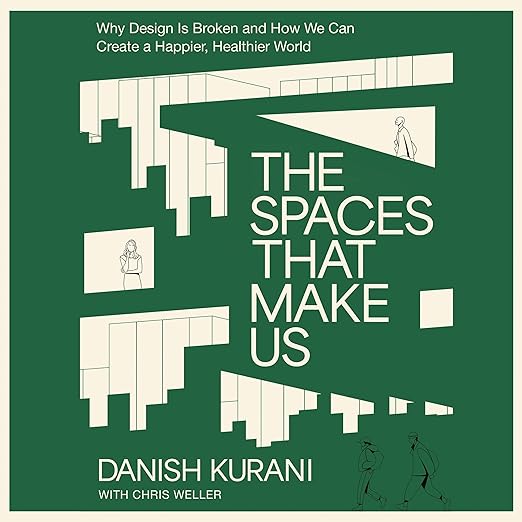
Baaham, pronounced BAH-hum, is an Urdu word meaning in tandem, and Danish Kurani has built an entire design philosophy on it. The audiobook runs six hours and forty-six minutes and opens on three questions that sound like small talk until you sit with them: whether the arrangement of your living room is shaping your relationship, whether a classroom's layout moves test scores, whether a hospital room changes how fast a patient recovers. Kurani has spent twenty years designing schools, homes, offices and community centers across four continents, and the argument that comes back is that people build spaces and then the spaces get to work on the people.
Two Reviewers Say They Have Not Started
A flat 5.0 sits beside 24 ratings on this listing, and that combination is tighter than it looks. To display 5.0 at all, at most one of those twenty-four ratings can have been anything other than a five, and it can only have been a four. Nothing about that is improper for a book published on February 10, 2026 whose five written notices all landed between February 11 and February 15; launch weeks concentrate the people who were already waiting. It does mean the number is measuring early enthusiasm rather than a settled verdict, and a buyer should read it that way.
Read the notices themselves and the picture sharpens further. Two of the five say outright that they have not started yet, one reporting the parcel just came in and the other that it has only just arrived and the reading is still ahead. Both are responding to an object rather than an argument, and three of the five mention the physical object at all: a gorgeous hardback with the cover art printed under the jacket, a beautiful looking book, the graphics and the design. That leaves three readers describing the content, which is a small but genuinely positive sample: Pete C could not put it down, Renee Haines learned a lot and insists you need not be an architect, and Ethan reports a lasting change in how the architecture of an ordinary day now registers.
Teaching How to Design, Not What to Design
Kurani's method is the appeal. Baaham draws on psychology, sociology, anthropology and evolutionary biology, organizes into seven core principles, and is pitched deliberately at any scale from a bedroom to a city block and any budget from a broke student to a manager reshaping a team's floor. The book is explicit that it will not tell you what to design but how, which is the difference between a catalog and a method, and it is the reason Renee Haines can report applying it without professional training. Ethan, who reports not normally reading nonfiction, is the second data point for that accessibility, and the breadth of the sources is what makes the method portable: a principle drawn from evolutionary biology transfers to an office floor in a way a style rule never would.
Maskati Gets One Word Fixed by the Publisher
Scope is more ambitious than a home improvement shelf suggests. Kurani runs the argument back through two million years of human settlement to reach a claim about how current design practice makes life worse, then turns forward into what should replace it. Whether six and three-quarter hours can carry that span is a fair question, and my own view is that the deep history functions as an origin story for the seven principles rather than as scholarship in its own right. Taken that way it earns its place, because it explains why the principles are framed as recoveries rather than inventions. The three questions the book opens on are a fair sample of the method: the claim is never that a living room causes a good relationship, only that the way you arrange it makes some interactions easier and others harder, and that we have been making those choices without noticing.
The narrator credit belongs to Omar Maskati, and the text hands the recording one pleasantly concrete task straight away. Baaham is repeated throughout the book, and the publisher's copy supplies its pronunciation in parentheses on first use, which means the production has a fixed target rather than a judgment call on the word the entire philosophy is named for. That small detail is a good sign about how the material was prepared. The larger demand is the register shift between research citations from four different disciplines and practical instructions you are meant to act on this weekend.
A Worksheet You Can Only See in the PDF
Visual dependency is the one substantial issue, and the publisher is honest about it. The description promises engaging illustrations throughout every chapter to illuminate each principle, and then states that the line drawings and the Baaham design canvas live in the audiobook companion PDF download. That PDF is not optional decoration; a design canvas is a worksheet, and a book teaching you how to assess a room is asking you to look at diagrams. Download it before you start, and expect to pause and consult it rather than listening straight through while doing something else.
Reviewers unintentionally confirm the same point. Several of the warmest remarks about this book are about how it looks: the graphics, the design, the cover art under the jacket. A listener gets the argument and loses the artifact, which is a real trade on a book whose own admirers keep praising its physical presentation. Weigh that against the convenience, and note that with twenty-four ratings and a five-day-old review pool, none of the written responses had yet had time to describe living with the ideas over months.
The Wrong Book for Building Codes and Theory
People mid-renovation, mid-move or mid-classroom-setup are the natural buyers, along with managers who suspect their office layout is quietly working against the team. It suits people who like popular science with an applied edge, since the psychology and anthropology arrive attached to instructions rather than as background color. Teachers have a particular claim, given that the book opens by asking whether a classroom's layout changes grades, and Renee Haines is the proof that no design training is required to use what follows.
Wrong book for architecture as a discipline: no structural detail, no building codes, no professional practice. Listeners who refuse to deal with companion PDFs should choose print here, because the drawings and the design canvas carry real instructional weight rather than serving as illustration. Framework skeptics, the readers who bounce off any book that anchors a philosophy to a coined term and seven principles, will find the packaging harder to get past than the ideas deserve.
At a Glance
- Performance: The narrator credit belongs to Omar Maskati, and the book supplies its own pronunciation for the coined term it repeats throughout.
- What it covers: Design psychology, seven principles of Baaham, how rooms shape health, learning and relationships.
- Feel: Curious and applied, closer to a workshop than a lecture.
- Our call: A genuinely usable design method for non-architects, so long as you download the companion PDF and treat it as part of the book.