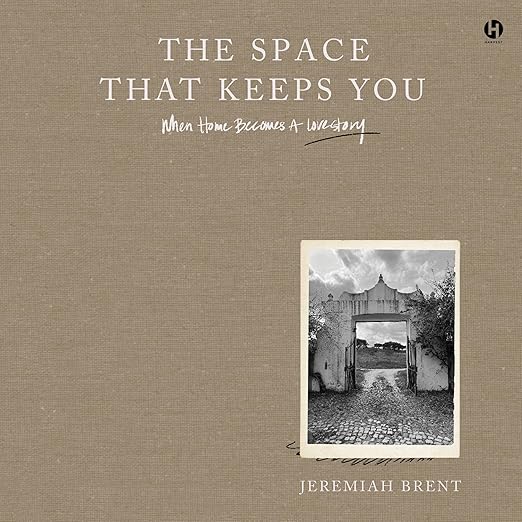
Jeremiah Brent has spent years renovating other people's homes on television, and in this slim audiobook he turns that same attention toward a harder question: why certain houses hold onto their occupants while others, no matter how beautiful, never quite become home. Running just two hours and seventeen minutes and narrated by Brent himself, the audiobook gathers conversations with nine individuals and families, ranging from an artist couple who turned an abandoned plot in Merida, Mexico into an accidental paradise to Giberto and Bianca Arrivabene, who fought to hold onto their family's historic Venetian palazzo. Brent bookends their stories with his own, tracing what home has meant across a series of moves with his husband, fellow designer Nate Berkus, and their two children.
An Apartment's Beams, Still Etched With Hearts
The real subject of The Space That Keeps You isn't design in the showroom sense at all, it's belonging, and Brent structures the book to make that clear from the opening pages. Tracy and Brian Robbins found refuge during the pandemic in a single-story Montecito home surrounded by fields of lavender; Oprah Winfrey speaks about the importance of nature to her own dream of home; a kitchen still nourishes the grandchildren of the couple who first cooked in it fifty years earlier. None of these are staged before-and-after reveals. They're conversations about why a specific physical space became emotionally load-bearing for the people living in it, which is a much harder thing to capture in audio than a room's color palette.
Brent's own throughline, the years he and Nate Berkus spent moving between one beautiful home after another before finally understanding what they were actually searching for, gives the book its emotional spine. It would have been easy to let the celebrity-adjacent guest list, Oprah Winfrey included, overshadow that personal material, but the book keeps circling back to Brent's own family rather than treating the famous names as the main event. The detail of an apartment's exposed beams etched with hearts, left there by people who lived there decades earlier, is the kind of small, specific image the whole project is built around.
Building From Nothing or Defending What Exists
The James and Alexandra Brown story, an abandoned plot of land in Merida, Mexico that the artist couple turned into what the book calls an accidental paradise, works as a useful counterpoint to the more polished, camera-ready homes elsewhere in the book. It's a reminder that the book's real interest isn't square footage or renovation budgets but the specific, often accidental process by which a piece of land or a rundown structure starts to feel inhabited and claimed rather than simply occupied. Placed alongside the Arrivabenes' fight to keep an inherited Venetian palazzo, the two stories frame home-making as something that can happen through either building from nothing or defending what already exists.
Tracy and Brian Robbins' story lands with particular resonance for anyone who spent real time reassessing their own relationship to home during the pandemic; their lavender-ringed Montecito refuge became less an escape from the world than a place that finally let them sit still inside it. Brent doesn't over-narrate the parallel to his own family's pandemic experience, letting the Robbins' account stand largely on its own, but its placement within the book's overall structure makes the connection to a more universal moment hard to miss.
A Hired Narrator Would Have Had to Fake This
Self-narration is doing real work here. Brent's television background gives him an obvious comfort in front of a microphone, but what actually lands is the intimacy in how he handles the personal passages specifically, the parts about his own family and his own uncertainty about what home even meant before he went looking for an answer. A hired narrator, however skilled, would have had to construct that vulnerability from the outside; Brent doesn't have to construct anything, which is exactly the kind of gap self-narration is built to close.
Reviewer Bibliotheque calls it, pointedly, 'not a typical design book,' and that framing matches the listening experience closely. Their review notes that Brent's 'love for Nate and their children resonates throughout' the book, and for listeners already familiar with the couple's television work, that emotional throughline lands with extra weight. Other reviewers keep their praise shorter but just as warm, one calling it simply 'a beautiful book,' which tracks with a project more interested in emotional resonance than architectural instruction.
Nine Households, Bookended, With No Music Cues
The interview-based structure, nine separate conversations bookended by Brent's own narrative, gives the audiobook a natural episodic rhythm that suits shorter listening sessions well; a listener could reasonably take in one household's story at a time rather than needing to consume the whole two-hour-plus runtime in a single sitting, even though the throughline connecting Brent's own journey to his subjects' stories rewards a more continuous listen.
The production overall stays simple, no music cues or sound design layered over Brent's voice, which suits a book built on unadorned personal testimony rather than dramatized scenes.
Closer to Essays Than a Design Manual
At two hours and seventeen minutes, this is a short listen by nonfiction standards, closer to an extended personal essay collection than a comprehensive design book, and anyone expecting practical, room-by-room design guidance should recalibrate those expectations before starting. The book trades scope for depth, nine family stories plus Brent's own, rather than trying to cover a wide range of design principles or renovation techniques.
Filed Under Architecture, Really Closer to Memoir
The category placement, filed here under Architecture alongside home and garden content, undersells how much of this book is memoir and interview rather than reference material. Listeners hunting for practical renovation advice or design theory in the technical sense will find very little of that; what's here instead is closer to an oral history of nine households, anchored by Brent's own search for the same thing his subjects already found.
Because the book moves between nine different households plus Brent's own story in just over two hours, individual profiles stay relatively brief; listeners hoping for an extended deep dive into any single family's full history, rather than a compact, impressionistic portrait of each, should adjust expectations toward breadth over depth.
Fans of Brent and Berkus Will Feel at Home
Fans of Brent and Berkus's television work, and anyone who already gravitates toward design content that treats a home as a story rather than a showroom, will find exactly what they're hoping for here. The short runtime also makes it a genuinely easy single-sitting listen for anyone curious about the premise without wanting to commit to a longer audiobook.
Design enthusiasts hoping for concrete technique, color theory, furniture arrangement, the mechanics of a renovation, will want a different book entirely, since none of that is really on offer here. The emotional register stays warm and personal throughout rather than critical or analytical, which is a feature for the audience it's built for and a real limitation for anyone approaching it as a design reference instead of a memoir.
Key Details
- Performance: Jeremiah Brent narrates his own material with the ease of someone used to talking on camera, and the warmth reads as genuine rather than rehearsed.
- What it covers: home as identity, belonging, the emotional weight of domestic spaces
- Feel: Warm, reflective, intimate
- Our call: A short, personal listen best suited to fans of Brent's design work and anyone thinking hard about what makes a house feel like home.