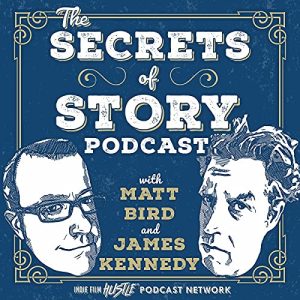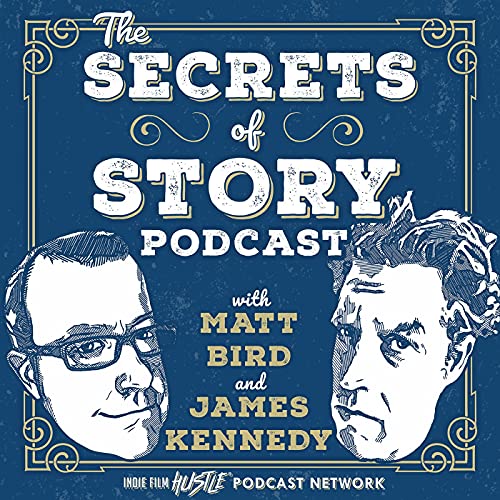
Two writers sit down to argue about craft, and what results is more useful than most writing guides produced under calmer conditions. The Secrets of Story, at one hour and six minutes and narrated by Eric Michael Summerer, is drawn from the podcast conversations between Matt Bird, author of the full-length craft book of the same name, and James Kennedy, author of the novel The Order of Odd-Fish. The audiobook is definitively in the second category of craft education: not the kind that teaches writing by delivering principles, but the kind that teaches writing by arguing about principles. The two writers disagree about things, and their disagreements are the actual content rather than a framing device for consensus positions both already hold. That quality makes this audiobook unusual in the craft-education space and gives it an energy that most writing guides, in any format, do not achieve.
Bird's full book, The Secrets of Story: Innovative Tools for Perfecting Your Fiction and Captivating Readers, is a comprehensive craft manual with a specific methodology built around audience engagement as the primary metric of storytelling success. The audiobook takes a different approach, using Bird's framework as the starting point for conversations with Kennedy that probe where the methodology holds and where it meets genuine friction. Kennedy, as a novelist whose work operates in the more eccentric registers of literary genre fiction, provides the kind of pushback that makes Bird's positions sharper rather than simply restating them. Summerer narrates the resulting material with the clean precision that good audiobook narration of multi-voice content requires.
Summerer Keeps Two Fighting Voices Distinct
The raucous quality that the synopsis advertises is real. Bird and Kennedy do not perform collegial agreement; they fight about craft, and the fights are productive in the way that good editorial arguments are productive: both participants emerge from each exchange with a clearer sense of what they actually believe rather than what they assumed they believed going in. For writers who have spent time with prescriptive craft manuals that present a single methodology as essentially the answer to storytelling problems, the audiobook's sustained engagement with the edges and exceptions of those methodologies is genuinely useful.
Eric Michael Summerer has a career built on audiobook narration, and his work here reflects experience with content that requires tonal clarity without emotional flatness. The debate format could easily produce a listening experience where the back-and-forth feels indistinguishable over time, and Summerer prevents that through the kind of micro-adjustment in delivery that distinguishes his narration quality. At one hour and six minutes, the audiobook is short enough that sustaining that clarity is achievable without demanding exceptional narrator range, but the execution is solid throughout.
Kennedy's Pushback Refines Bird's Own Methodology
The specific value this audiobook offers that the full book does not is the Kennedy variable. Bird's full text presents his methodology with the coherence and completeness that a book-length argument requires, but it does not include the sustained intellectual sparring with a writer whose aesthetic commitments are meaningfully different from Bird's own. Kennedy's presence is not ornamental; his challenges to Bird's framework produce passages where Bird refines or qualifies positions that the full book presents more cleanly, which gives listeners insight into the live edges of the methodology in ways that a finished text cannot.
For writers attempting to bridge between screenwriting and novel writing, or who are trying to understand how craft principles that originated in one medium translate to another, the audiobook addresses that translation explicitly. Both Bird and Kennedy bring experience in multiple forms, and their debates frequently surface the points where medium-specific assumptions about how stories work come apart under pressure from the other form's conventions.
One Hour Samples, Rather Than Replaces, the Book
The one-hour runtime is a real constraint, not a feature. The audiobook delivers a sampling of Bird's methodology through debate rather than a comprehensive treatment of it. Listeners who approach this expecting the equivalent of the full book in audio form will find the scope significantly narrower than anticipated. This is a companion audiobook, best understood as a supplement to Bird's written work or as a taster that might prompt engagement with the full text, rather than a standalone resource for writers building a comprehensive understanding of the methodology.
The absence of listener reviews on this specific listing also suggests a narrow audience, likely writers who already know Bird's work and are interested in hearing his ideas tested through live argument. That self-selected audience tends to find the format valuable; listeners discovering the audiobook through general craft-education browsing may find the debate format less immediately accessible than a structured how-to presentation would be.
Skip It If Bird's Work Is New to You
This audiobook is for writers who are already engaged with Bird's storytelling methodology and want to hear it argued about rather than explained, and for listeners who find that their own craft thinking sharpens through exposure to productive disagreement rather than consensus instruction. The debate format rewards active listening; it is not an audiobook you can process passively while doing something else, because the arguments build on each other in ways that require attention to track.
Skip it as a primary craft resource if you are new to Bird's work and want a comprehensive introduction to the methodology. The full book is the right starting point; this audiobook is most valuable to listeners who already have enough familiarity with the framework that the Kennedy-driven challenges and refinements land with meaning. At one hour, it is a modest investment for writers who want to engage the material, but the return depends substantially on prior engagement with Bird's ideas.
- Voice: Eric Michael Summerer's clean narration suits the conversational debate format between Matt Bird and James Kennedy, keeping the argumentative back-and-forth legible without over-producing the material.
- Big ideas: Story craft and structure, the mechanics of captivating readers, screenwriting versus novel writing
- Atmosphere: Raucous and intellectually combative, in the best way
- Worth it?: A brisk audiobook that packages genuine craft debate into a one-hour format, best suited for writers who want their storytelling theory delivered with friction and humor rather than prescription.