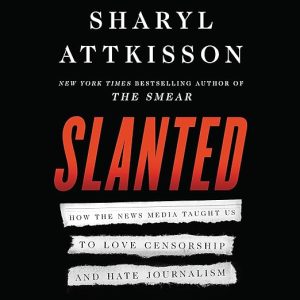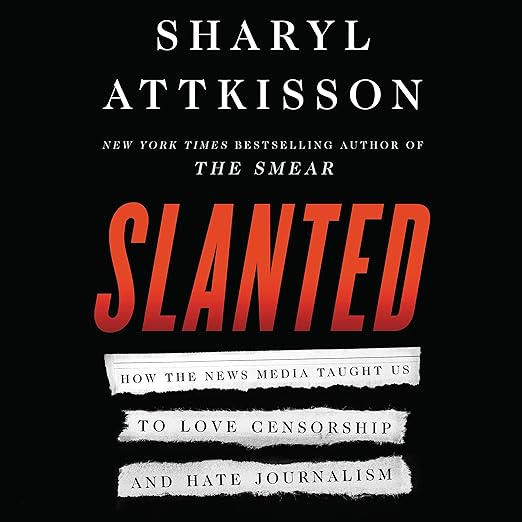
Every media-criticism book asks its reader to take one thing on trust: that the account being offered has not itself been curated. Does Slanted earn that? Sharyl Attkisson is credited with the reading of her own nine-hour-and-forty-nine-minute argument, and the audiobook ships with a supplemental enhancement PDF, which signals from the outset that the case leans on material she expects you to see rather than only hear. I came to it as someone who works in media and who is genuinely interested in the craft question underneath the politics, and that turned out to be the right frame for it.
Case by Case, the Book Earns Its Keep
What the book actually is matters more than what the subtitle suggests. This is not a general theory of bias; it is a catalog. Attkisson collects specific incidents across four years of coverage and dissects each one, and around that catalog she sets interviews with senior figures at the major national television outlets, from ABC, CBS, NBC and CNN through FOX and MSNBC. The publisher makes a pointed claim about those sources, that 'Their concern transcends partisan divides', and the sourcing does reach across newsrooms that would not normally agree about anything. The selection of incidents, on the other hand, points in a very particular direction, and the copy says so outright by naming coverage of Black Lives Matter, coronavirus, Joe Biden and Silicon Valley censorship as the targets.
My own read is that the book is at its most persuasive at the level of the individual case and least persuasive when it generalizes upward from those cases into a single explanation. When Attkisson takes apart the language of a particular report, the work is concrete and checkable. When the argument moves to what the profession as a whole has become, it starts asking you to accept a pattern on the strength of examples that were chosen to demonstrate it. That gap is worth holding in mind over the length of the book, and holding it does not require dismissing what the book gets right.
Attkisson Reading Herself Closes the Distance
The strongest reason to take this in audio is that the author is the subject. Attkisson spent decades as an investigative reporter inside the institutions she is now criticizing, and a working journalist reading her own critique of the profession closes the distance between the argument and the person making it. The demand on the recording is not dramatic; it is organizational. Long stretches of the book are lists of outlets, quoted terminology, dates and named sources, and a listener has to hold that apparatus by ear without a page to glance back at. Whether that lands for you is partly a question of what you normally listen to.
The most durable section is the one on the language of propagandists. Attkisson assembles a working taxonomy of rhetorical moves, and a taxonomy is portable in a way that individual grievances are not. You can carry it into coverage from any outlet and any direction, including hers. I would rate that chapter as the reason to buy the book even if you disagree with most of the rest of it, and it is the part I have found myself citing since.
The review pool tells its own story. All three visible reviews award five stars, and all three come from people who had already read her earlier work. One calls her 'the real deal, she talks the talk and walks the walk' and credits the book with 'strong, coherent, well researched evidence'. Another writes, 'I have read all of her books and they are all extremely enlightening regarding the underbelly of American Journalism'. A third observes that 'Sharyl Attkisson has found a niche' and that the books 'are not shallow, they are deep'. That is a consistency signal rather than a conversion signal. It tells you she has delivered what her existing readership expects, which is genuinely useful information, but nobody on this page arrived skeptical and left convinced.
Download the PDF Before You Press Play
Start with the PDF, because the audio edition depends on it. The publisher describes a supplemental enhancement document accompanying the recording, and on a book built from sourced incidents that is where the visual apparatus lives. Download it before you press play rather than three hours in, and expect to want a screen nearby for the passages that quote documents and headline language. This is the same format tension every heavily sourced work of reported nonfiction faces in audio, and it is not a flaw so much as a condition of the format.
Be clear-eyed about the framing as well. A book can be well sourced and still be arguing from a settled position, and this one is. Listeners who share the premises will find the evidence confirming; listeners who do not will notice how much work the choice of examples performs before any analysis begins. Neither reaction is unreasonable, and I would rather say that plainly than pretend the book occupies neutral ground it never claims for itself.
Four-Year-Old Examples Behind a Two-Rating Score
The examples are also pinned to one specific stretch of news. Attkisson describes four years of collecting, and the incidents belong to those years. The taxonomy of techniques outlives them easily; the case studies increasingly read as period documents, which changes what you are listening for. That is a normal fate for topical media criticism rather than a defect, but it does mean a listener arriving now is getting a snapshot alongside the method.
Treat the score with caution too. This listing carries two ratings, which is nowhere near enough to mean anything, and the written reviews describe reading rather than listening, with one reviewer referring explicitly to having read all of her books. The commentary attaches to the text, not to this recording, so the 4.8 should not be read as a verdict on the audio production.
Journalism Students Get the Most From the Taxonomy
This suits people who follow media criticism as a craft question and want a specific, incident-level argument rather than a survey. It suits journalism students, who will get more from the taxonomy chapter than from a semester of abstract ethics discussion. It also suits existing readers of her earlier books, who by the evidence of this page know exactly what they are getting and want more of it.
I would steer away anyone who wants a balanced overview of how American news gets made, because the book does not offer one and does not claim to. Anyone who wants the opposing case argued at full strength before it is rebutted should look elsewhere too. And if you cannot get to the supplemental document, weigh whether the print edition serves you better, since a fair amount of what makes the argument checkable sits in the material you are meant to be able to see.
Before You Listen
Do I need the supplemental PDF to follow the Slanted audiobook?
You can follow the narrative without it, but the sourcing is the whole point of the book, and the document is where the visual material lives. Grab it before you start. Passages that quote headline language and internal wording reward having a screen within reach rather than a memory of what was said an hour ago.
Is this audiobook a good entry point if I have never read Sharyl Attkisson before?
It works as a standalone, though the reviews on this listing all come from people deep in her back catalog, which tells you who the book is calibrated for. A newcomer will find the incident analysis accessible; the broader conclusions assume a reader already sympathetic to the framing.