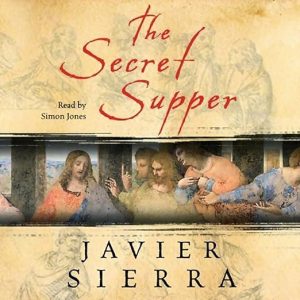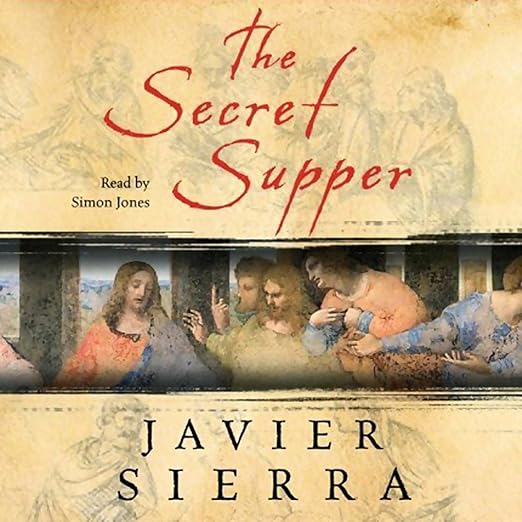
The Secret Supper audiobook, Javier Sierra's New York Times bestselling novel narrated by Simon Jones, arrives with a premise that could hardly be more cinematically inviting: Milan, 1497, and a Papal Inquisitor is sent to decode a blasphemous message hidden in Leonardo da Vinci's nearly complete Last Supper. Sierra wrote the book in Spanish, and its translation carries something of the baroque texture of Spanish historical prose, a quality that Simon Jones renders with the kind of deliberate formality appropriate to its setting. The audiobook runs just over nine hours, which is long enough for Sierra to develop his arguments about the painting at real length.
The arguments themselves are the audiobook's primary attraction. Sierra's reading of the Last Supper, that the missing Eucharistic elements, the absent Holy Grail, the absent bread, the apostles portrayed as known heretics, and Leonardo's self-portrait with his back turned to Christ, constitute a coherent visual sermon from a different theological tradition, is more sophisticated than the typical Da Vinci Code-style puzzle narrative. Where Dan Brown's books treat the coded painting as a mystery box to be opened, Sierra treats it as a theological document to be read, and that difference in approach produces a substantially different kind of audiobook.
Leyre Reads Paintings the Way Experts Read Texts
The protagonist, Agostino Leyre, is a Papal Inquisitor sent to Milan specifically because he is known for his ability to decode cryptographic messages within sacred art. This is not a trained detective or an accidental witness; it is a professional reader of visual heresy, and Sierra uses that professional lens to give the investigation a procedural credibility that more casual mystery treatments of Leonardo's work lack. Leyre approaches the painting the way an expert in his field would approach a text: methodically, with attention to convention and deviation, and with an awareness that what looks like artistic license may be deliberate communication.
The historical backdrop is rendered with genuine care. Sierra situates the investigation within the political and theological tensions of Ludovico Sforza's Milan, with Pope Alexander VI's ambitions looming over everything, and he populates the story with real historical figures alongside the fictional ones. This kind of historical fiction requires a particular kind of research, the ability to inhabit the assumptions and anxieties of a period rather than merely to furnish it accurately, and Sierra demonstrates that ability in the sections that deal with the institutional politics of the Church in the late fifteenth century.
Jones Finds Variation in Art-Historical Analysis
Simon Jones's narration is well-suited to the academic and atmospheric dimensions of this audiobook. His voice carries a quality of measured authority that fits the historical setting, and he handles the extended passages of art-historical analysis, which in print might feel like a lecture, with enough vocal variation to keep them engaging. The sections in which Leyre processes what he sees in the painting are the audiobook's strongest passages; Jones treats them with the seriousness they deserve, and the result is more like listening to a thoughtful lecture on Renaissance heresy than following a thriller plot.
A Lecture on Renaissance Heresy, Not a Thriller
That comparison is also the audiobook's central tension. Listeners who come to Sierra expecting the frictionless pace of a blockbuster historical thriller will find The Secret Supper more measured than they anticipated. One reviewer described it as a slow-moving literary whodunit in a more mature style than Dan Brown, and that is accurate. The pacing reflects Sierra's priorities: he is more interested in establishing what Leonardo might have believed and why it would have been dangerous than in sustaining the mechanical suspense of a chase narrative. For listeners whose taste runs toward serious historical fiction with genuine intellectual content, this is an asset. For those who want pure entertainment, it can feel like a cost.
The audiobook has a genuinely distinctive quality in its treatment of the sacred art of the period more broadly. Sierra is not only reading Leonardo's Last Supper; he is situating it within a tradition of encoded religious communication that predates the Renaissance, and his account of that tradition opens up a framework that listeners can apply to other works. Several reviewers noted that the audiobook permanently changed how they see the painting, which is perhaps the highest compliment available for a work of this kind.
Doctrinal Passages That Stall Too Close to the End
The pacing issue flagged by multiple reviewers is real. The book stalls at several points for extended passages of doctrinal explanation and historical background that serve Sierra's intellectual argument but interrupt the narrative momentum at inconvenient moments, including, one reviewer noted, too close to the ending. This is a characteristic of historical fiction that privileges scholarship over plotting, and listeners should adjust their expectations accordingly. The audiobook is most enjoyable when treated as an extended essay in narrative form rather than a conventional thriller.
The translation also leaves occasional traces on the prose. Certain passages have a slightly formal quality that reflects the original Spanish more than it reflects natural English sentence rhythm, and while this rarely impedes comprehension, it can create a slight distance between the reader and the narration. Jones's delivery handles these passages professionally, but listeners attuned to prose rhythm may notice the seams.
Closer to Umberto Eco Than Dan Brown
This audiobook is a natural choice for listeners who are interested in Leonardo da Vinci's work beyond the standard biographical accounts, particularly those drawn to the theological and heretical dimensions of Renaissance painting. It is also well-suited to fans of literary historical fiction who prefer Umberto Eco's density to Dan Brown's accessibility and who regard extended doctrinal argument as a feature rather than a drawback.
Listeners who want a fast-moving thriller with Leonardo as the hook should look elsewhere. The Secret Supper is not trying to be that book, and judging it against that standard misreads its intentions. Approach it as serious historical fiction with a genuine intellectual argument at its center, and it delivers substantially more than its genre category suggests.
Common Questions
How does The Secret Supper audiobook compare to The Da Vinci Code as a listening experience?
The comparison is inevitable but the books operate at different registers. Sierra's novel is slower, more academic, and more interested in the actual theology of Renaissance heresy than in mechanical thriller plotting. Listeners who found The Da Vinci Code too breezy will likely prefer The Secret Supper; those who found it perfectly paced may find Sierra's book more demanding.
Does Simon Jones's narration suit this audiobook?
His measured, slightly formal delivery suits the historical setting and the investigative tone of Leyre's perspective. It makes the extended passages of art-historical analysis feel authoritative rather than academic in the pejorative sense, though listeners who want more dramatic range in their narrators may find his approach subdued.
Do I need to know The Last Supper well before listening to this audiobook?
Basic familiarity with the painting helps considerably, since much of the audiobook's intellectual pleasure comes from following Sierra's analysis of specific visual details. Having an image of the painting available while listening is recommended; it allows you to follow the argument about missing elements and portrait identities much more vividly.
Is the mystery resolution in this audiobook satisfying?
Opinions divide on this. Readers who came for the art-historical argument and the historical atmosphere tend to find the ending satisfying within the book's own terms. Those who came primarily for the thriller mechanics report that the resolution arrives quickly relative to the buildup. The audiobook is more successful as intellectual historical fiction than as a puzzle narrative.