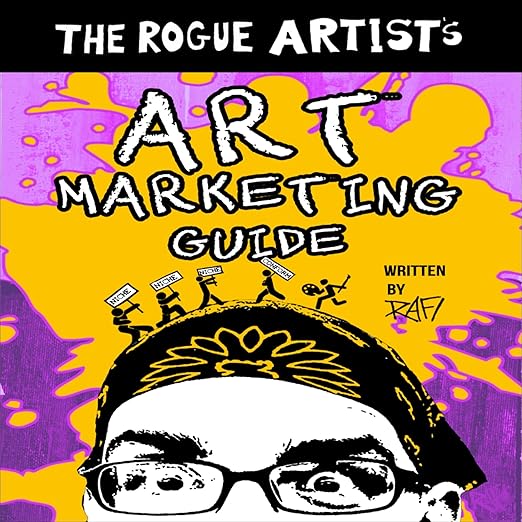
Rafi Was Here is the YouTube channel behind this audiobook's author, and that detail matters more than it might seem: Rafi Perez has spent over a decade making a living as a full-time artist and building an audience through exactly the kind of unconventional, personality-driven self-promotion this guide is trying to teach. The Rogue Artist's Art Marketing Guide isn't a conventional marketing course adapted for a creative audience; Perez positions it explicitly against that model, arguing that typical marketing advice is built for boring products and doesn't fit how artists, musicians, and writers actually need to sell themselves. I went in skeptical of the anti-establishment framing, plenty of self-help books claim to reject conventional wisdom while just repackaging it, but this one mostly earns the claim.
Perez Narrates His Own Marketing Advice
The book's actual content leans on Perez's own decade-plus career rather than borrowed theory, working through the mindsets and specific techniques he used to build a sustainable creative income without following what he calls cookie-cutter courses from professional marketing mentors. That first-person, story-centric approach is the book's real differentiator: rather than laying out a generic funnel or content calendar, Perez narrates his own trial and error, positioning the listener as someone learning alongside his actual experience rather than absorbing abstracted best practices. It's a structure that depends heavily on Perez himself being a credible, likable guide, since no separate expert voice or research layer backs up the advice independently.
Since Perez narrates his own book, and the entire premise is that marketing yourself as an artist should be fun rather than a chore, his delivery functions as a kind of live demonstration of the advice itself. A guide about injecting personality and creative energy into self-promotion loses credibility fast if the person teaching it sounds flat reading his own material aloud. That's not the case here: reviewers consistently describe the book as encouraging and down-to-earth rather than polished-corporate, which tracks with an author narrating in his own genuine voice rather than a hired professional smoothing out his specific, off-beat energy.
A Decade of Proof, Not One Viral Hit
Perez's own credibility case rests specifically on longevity rather than one viral success story, and the book leans into that distinction directly. A decade-plus of sustaining a full-time creative income is a different, arguably more instructive kind of proof than a single breakout moment would be, since it implies the marketing approach he's teaching has had to adapt and hold up across changing platforms and audience trends, rather than working once under circumstances that may not recur.
One Reviewer Ranks It Beside Artpreneur
One reviewer, a professional artist who says he'd already read nearly every artist-help book available, ranks this alongside a book called Artpreneur as one of just two titles in the genre he considers genuinely essential, a strong endorsement from someone with real comparison points rather than a first-time reader of the category. Another reviewer, Sue MacQ, describes concrete results rather than just enjoying the listen: she credits the book with pushing her to put her own art out there and reports a 'steady gain in sales' as a direct result, which is the kind of practical follow-through a marketing guide should be judged by.
The book also works as encouragement independent of its tactical content. An Amazon reviewer writes plainly that it 'makes you think about your own art and journey as an artist,' calling the experience 'very encouraging.' That emotional register, permission to see your own creative path as legitimate before you're taught how to market it, seems to be as much a part of what listeners are getting from this as any specific technique, which fits Perez's own stated goal of answering whether marketing yourself can actually be fun.
The book's positioning against generic 'boring products' marketing logic is also a genuinely useful reframe for creative listeners who've absorbed standard small-business advice and felt it not quite fit. Naming that mismatch directly, rather than leaving a listener to intuit on their own why conventional marketing tactics feel off for creative work, gives the book real diagnostic value even before it gets to specific technique.
The book's own framing of its audience is broader than 'artists' in the narrow sense too. The synopsis explicitly extends the pitch to musicians, writers, makers, teachers, and serious hobbyists, not just visual artists building a portfolio, which suggests Perez is really teaching a transferable creative-marketing mindset rather than a discipline-specific playbook. That breadth is worth knowing going in: the specific examples lean on Perez's own visual-art career, but the underlying principles are pitched as applicable well beyond it.
When Visual Platform Advice Meets an Audio Guide
Because the guide is built almost entirely around Perez's own experience and personality rather than broader market research or case studies from other artists, the advice is inherently more anecdotal than systematic. Listeners looking for a step-by-step funnel, specific platform tactics, or data-backed strategy should know this leans toward mindset and story over spreadsheet-level tactics.
The book is also part of a larger Rogue Artist Series, and the synopsis doesn't clarify whether this specific marketing guide assumes familiarity with other entries, so newcomers to Perez's work should treat it as a reasonable starting point rather than assume it's the definitive first installment without checking the series order themselves. At 8 hours and 47 minutes, it's also a longer sit than most single-topic marketing guides, which fits its story-driven structure but is worth knowing if you were expecting a tighter, more skimmable format. Because Perez built his own audience substantially through video, on his own YouTube channel, listeners should expect occasional references calibrated to that visual medium even inside an audio-only format; a marketing philosophy shaped by a creator whose biggest platform is inherently visual sometimes nods toward techniques, thumbnails, on-camera presence, that don't translate one-to-one into the listening experience, even while the underlying mindset still does.
Offering Permission as Much as Tactics
Working artists, musicians, and writers who've bounced off conventional marketing advice because it feels built for a different kind of product entirely will likely find real relief here, both practical and emotional. It's also a strong fit for anyone earlier in a creative career looking for permission as much as tactics, the encouragement reviewers describe seems to matter as much as any specific technique, and for existing fans of Perez's Rafi Was Here YouTube channel who want the longer-form version of his voice and philosophy.
Creatives who want a rigorous, data-driven marketing course with specific platform tactics and measurable frameworks should look elsewhere; this guide trades that kind of structure for personal story and mindset work, which is the point rather than a shortcoming, but it means the actionable specifics are thinner than a conventional business marketing book would offer.
- Voice: Rafi Perez self-narrates with genuine, off-beat energy that doubles as proof of his own central claim, that marketing yourself as an artist can actually be fun.
- Big ideas: art and creative-career marketing, anti-corporate self-promotion, mindset over tactics
- Atmosphere: Encouraging and story-driven, closer to a pep talk from an experienced peer than a business course
- Worth it?: A genuinely encouraging, personality-driven guide for working artists tired of generic marketing advice, thinner on measurable tactics than a data-driven course.
A Few Questions About The Rogue Artist's Art Marketing Guide
Is The Rogue Artist's Art Marketing Guide audiobook narrated by the author himself?
Yes, Rafi Perez self-narrates, and since the book's whole premise is that marketing yourself can be fun and full of personality, his own energetic delivery functions as a demonstration of the advice, not just a reading of it.
Does this audiobook give specific marketing tactics, or is it more about mindset?
It leans heavily toward mindset and personal story rather than step-by-step tactics or platform-specific strategy. Perez works through his own decade-plus experience rather than a systematic marketing framework.