At a Glance
- Narrator: Patrick Lawlor keeps dense evolutionary science moving at a steady, trustworthy pace across a long runtime, based on the genre's usual demands.
- Subjects: mammalian evolution, mass extinction and survival, deep time
- Tone: Vivid, detective-driven, and genuinely absorbing for a science book
- Bottom line: A strong pick for anyone who loved The Rise and Fall of the Dinosaurs or wants deep time made vivid rather than abstract.
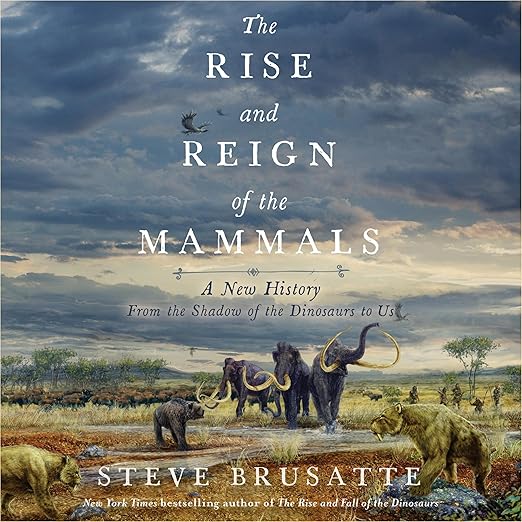
Steve Brusatte tells mammal history backward from where most popular science books would start, not from us, working forward from lions and whales and dogs, but from the ashes of the asteroid that killed the dinosaurs, working forward through sixty-six million years to arrive at the animals we recognize today. The Rise and Reign of the Mammals is his follow-up to The Rise and Fall of the Dinosaurs, and this audiobook runs thirteen hours and twenty-five minutes tracing that entire lineage, saber-toothed tigers, woolly mammoths, car-sized armadillos, cave bears three times a grizzly's weight, all the way down to us. I worked through most of it on long weekend hikes, which felt fitting for a book this interested in deep time and the ground beneath your feet.
A Closer Look at The Rise and Reign of the Mammals
The structural choice described above is the smartest thing about this book, and one reviewer specifically singled it out: rather than starting from the present and looking backward at familiar mammal lineages, Brusatte starts near the beginning and lets the reader discover how genuinely strange this evolutionary path was before arriving somewhere recognizable. That reviewer said they read the whole thing cover to cover in twenty-four hours, a striking claim for a work of scientific nonfiction, and it speaks to how much narrative momentum Brusatte builds into material that could easily read as a dry taxonomic survey in less careful hands.
Brusatte also folds real detective work into the narrative rather than presenting conclusions as settled fact from the start: fossil clues, cutting-edge dating technology, and the actual process of paleontological reasoning show up throughout, giving the book a procedural, discovery-driven quality alongside its historical sweep. That approach worked for The Rise and Fall of the Dinosaurs, which the Washington Post called 'a masterpiece of science writing,' and the same instinct, treat the reader as a partner in figuring things out rather than a recipient of finished answers, carries over intact here.
The book's late chapters, addressing other human species like Neanderthals as part of the broader mammalian family tree rather than a separate story entirely, are a particularly effective choice. Folding our own genus into the same sprawling, mostly-extinct lineage as saber-toothed cats and woolly mammoths reframes human exceptionalism as one branch among many survivors of repeated mass extinction, a humbling angle that popular science about our own history does not always commit to as directly as Brusatte does here.
Brusatte's work sits comfortably alongside other scientist-writers who have made deep time accessible to general audiences, in the tradition of specialists translating their own fieldwork into narrative nonfiction without dumbing down the underlying science. What distinguishes his specific approach across both this book and its dinosaur predecessor is a willingness to admit uncertainty and ongoing scientific debate rather than presenting paleontology as a settled catalog of facts, a choice that makes the detective-work framing mentioned above feel earned rather than performed for dramatic effect.
Patrick Lawlor narrates, and long-form popular science audio like this depends on a specific skill: keeping dense factual material, geological eras, extinction events, taxonomic relationships, moving at a pace that respects the listener's attention without either rushing past complexity or grinding to a lecture-hall crawl. I do not have prior confirmed listener commentary on Lawlor's specific performance here, but the genre's demands are clear, and thirteen-plus hours of unbroken factual density needs exactly that kind of steady, trustworthy pacing to avoid listener fatigue.
A real case exists for audio specifically with a book this vivid: Brusatte's descriptions of extinct creatures, armadillos scaled up to car size, bears outweighing modern grizzlies threefold, land with real physical presence when read aloud rather than skimmed on a page, and a good narrator turns scientific description into something closer to nature documentary narration. Worth noting the audiobook also comes with a supplemental enhancement PDF, useful for anyone who wants visual reference alongside the narration.
Brusatte's own credentials matter for how much trust a listener extends across thirteen hours of dense material: National Geographic has called him one of the stars of modern paleontology, and that active-researcher status, rather than a science writer synthesizing other people's fieldwork secondhand, gives the detective-work sections of the narrative real authority. Hearing that authority carried through a confident, unhurried narration voice reinforces rather than undercuts it.
Things to Know Before Starting The Rise and Reign of the Mammals
This title is filed under sports-outdoors and tagged 'Outdoors & Nature' in the data behind this review, which undersells what the book actually is: rigorous popular science nonfiction about evolutionary biology and paleontology, not an outdoors-adventure or sports title. Listeners browsing by that category may be looking for something else entirely; fans of Brusatte's earlier dinosaur book, or of scientific storytelling generally, are the more accurate audience regardless of how this particular listing is filed.
One reviewer, while calling the book wonderful overall, pushed back specifically on a section addressing anthropogenic climate change, characterizing Brusatte's claims there as inaccurate. That is one listener's assessment of a small portion of the book rather than a settled fact about the content, and readers with strong views on that specific topic should know the book does address it directly, whatever conclusion they personally reach about how persuasively.
Runtime is worth planning around too. At thirteen hours and twenty-five minutes, this sits solidly in the middle range for ambitious popular science nonfiction, shorter than some multi-volume evolutionary histories but long enough to reward being spread across several sessions rather than consumed in one sitting, despite what one enthusiastic reviewer managed in a single day. Listeners newer to Brusatte's writing might reasonably start here or with The Rise and Fall of the Dinosaurs; either book stands alone regardless of which one came first chronologically in his bibliography.
Who Steve Brusatte Is Writing For
This audiobook is for anyone who enjoyed The Rise and Fall of the Dinosaurs and wants the same treatment applied to the animals that inherited the planet afterward, or for popular science listeners generally who want deep time made vivid rather than abstract. It rewards patience with scientific detail and works well as a long-form listen, hikes, road trips, extended commutes, rather than something to dip in and out of quickly. Skip it if you came looking for sports or outdoor adventure content based on its current category placement; this is a science book through and through, however it happens to be filed.
Common Questions
Is this audiobook a sequel to The Rise and Fall of the Dinosaurs?
It's a follow-up covering the mammalian lineage that inherited the planet after the dinosaurs' extinction, written by the same author, Steve Brusatte.
Why is this audiobook tagged as sports-outdoors?
That category tag doesn't match the content; this is popular science nonfiction about paleontology and evolutionary biology, not an outdoors or adventure title.
How long is The Rise and Reign of the Mammals audiobook?
It runs 13 hours and 25 minutes and comes with a supplemental enhancement PDF for listeners who want visual reference alongside the narration.
Does this audiobook address climate change?
Yes, and at least one listener pushed back on that section specifically; readers with strong views on the topic should know it's addressed directly.