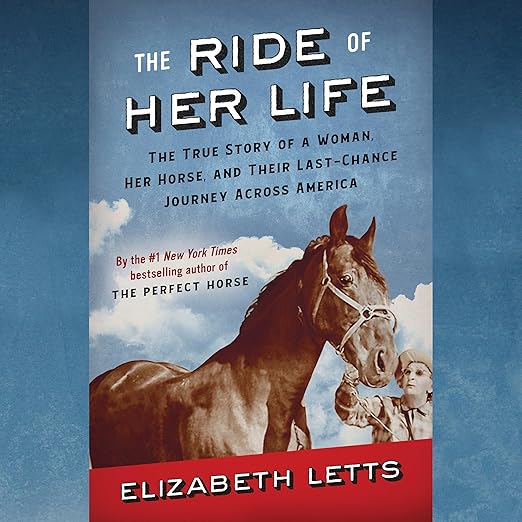
- Narrator: Elizabeth Letts narrates her own research with visible affection for Annie Wilkins, trading studio polish for authenticity.
- Subjects: postwar Americana, solo adventure late in life, the kindness of strangers
- Tone: Warm, nostalgic, quietly triumphant
- Bottom line: A gentle, well-researched ride that rewards listeners who enjoy true stories more than thrillers.
In November of 1954, Annie Wilkins pointed a secondhand horse named Tarzan south and refused to stop until she reached the Pacific. She was sixty-three, broke, recently evicted from her Maine farm, and had just been told by her doctor that she had roughly two years left to live. Rather than move into the county charity home as advised, she bought Tarzan, packed a bedroll, and rode out with her dog, Depeche Toi, beginning a journey that would cover more than four thousand miles and take nearly two years to complete. This audiobook, narrated by author Elizabeth Letts, tells that story with the same care for period detail that made her earlier books, The Perfect Horse and The Eighty-Dollar Champion, national bestsellers.
What makes The Ride of Her Life work as more than a novelty is the America Annie rides through. The mid-1950s were a period of rapid highway construction, expanding car ownership, and the early creep of television into daily life, and Letts uses Annie's slow, horse-paced journey as a lens on all of it. Annie meets everyone from Andrew Wyeth, who sketched Tarzan, to Groucho Marx, and fields job offers and even a marriage proposal along the way, all of it grounded in the kind of small-town hospitality Letts frames as already becoming rare.
Annie did reach the Pacific, completing a journey most people around her assumed would end in a hospital or a roadside grave rather than a beach. Letts doesn't treat that ending as a simple triumph, though; she's careful throughout to show how much of Annie's survival depended on strangers' generosity rather than pure grit alone, which complicates any easy read of the story as a straightforward bootstraps narrative. The America that made Annie's journey possible, Letts suggests, was also an America already starting to close itself off from that kind of casual trust in strangers.
What Elizabeth Letts Gets Right
Letts narrating her own research gives the audiobook a particular warmth. She's spent her career writing about horses and the people who love them, and that affection comes through in how she paces Annie's story, lingering on the details a professional narrator without the same research investment might rush past. Her voice isn't studio-polished in the way a career audiobook narrator's would be, but the trade-off is a sense of closeness to the material that suits a story this personal.
Reviewers respond specifically to the historical texture. One, Gerri, says she was absorbed from the first chapter and highlights the historical details of 1950s life as much as the adventure itself, and Bonnie Krim notes being drawn to books based on true events for exactly this reason. For listeners who enjoy narrative nonfiction that reads like fiction without inventing anything, Letts delivers a well-researched account that never loses its human center.
Letts has built a career finding these overlooked corners of American horse history, and The Ride of Her Life benefits from the same research instincts that shaped The Perfect Horse, her account of the rescue of European royal horses during World War Two. That consistency of interest gives her an authority on the period's relationship with horses that a more general narrative historian might lack, and it shows in the small period details, harness types, feed costs, road conditions, that ground Annie's journey in something more specific than pure sentiment.
Where Elizabeth Letts Loses Some Ground
Some retailers file this under sports and outdoors, which undersells what's actually a work of narrative history and biography. Listeners expecting an athletic or adventure-sports framing may be surprised to find a slower, more reflective book focused on postwar American culture and one woman's quiet defiance of her own circumstances rather than feats of athleticism.
Because Letts narrates her own work, the audiobook has the texture of an author reading rather than a trained performer's interpretation. That's an asset for listeners who value authenticity over polish, but anyone who prefers the smoother, more theatrical delivery of a professional narrator should know what they're getting before starting. The pacing is also unhurried throughout, matching a horse-and-rider journey rather than a thriller, so listeners wanting momentum should adjust expectations accordingly.
Listeners expecting a fast-moving adventure narrative should recalibrate further. Annie's actual pace, dictated by an aging horse and increasingly hostile roads built for cars rather than riders, was slow by necessity, and Letts doesn't artificially speed up the storytelling to compensate. The tension in this book comes from accumulation, one act of kindness and one close call with traffic at a time, rather than from a single sustained crisis, which rewards patient listening more than it rewards listeners hunting for a page-turner's momentum.
Who Should Pick Up The Ride of Her Life
Fans of Letts' earlier books, or of narrative nonfiction about ordinary people doing extraordinary things, will find this a natural fit. Readers who loved Seabiscuit or The Eighty-Dollar Champion for the way they braid animal stories into larger American history should feel right at home here, as should anyone drawn to stories about older women refusing to accept the limits placed on them.
Listeners looking for pure adventure or high-stakes tension should look elsewhere. This audiobook is about resilience measured in miles and small kindnesses rather than danger, and its rewards come from patience. For the right listener, that patience is repaid generously, and Elizabeth Letts' own voice telling Annie Wilkins' story adds a sincerity that a hired narrator, however skilled, would have had to work harder to earn.
Listeners who enjoy audiobooks for long drives or extended chore time will find the unhurried pace particularly well suited to that kind of half-attentive listening, since nothing here demands the moment-to-moment focus a thriller would. Annie's journey unfolds gradually enough that missing a few minutes here and there rarely costs a listener the thread, which makes this a forgiving choice for anyone whose listening happens in fragments across a busy week rather than in single dedicated sessions.