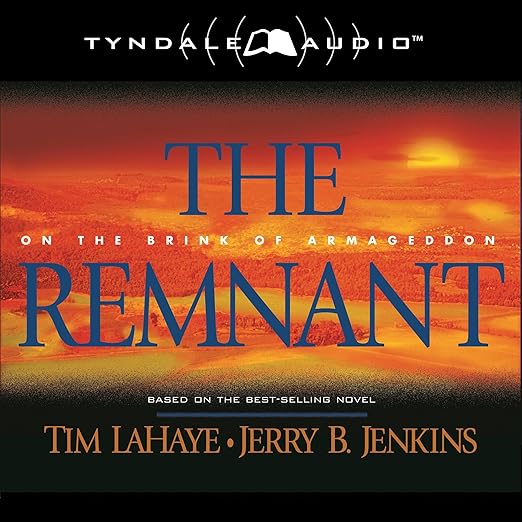
The Left Behind series has always been better suited to audio performance than its critics typically acknowledge, and The Remnant audiobook makes that case more forcefully than most entries in the sequence. This is a production in the fullest sense: dramatized with a cast of actors, layered with sound effects and musical scoring, so that what you receive is something closer to an audio drama than a conventional narrator-plus-text recording. For longtime readers of Tim LaHaye and Jerry Jenkins, that distinction matters considerably.
The Remnant covers a pivotal stretch of the Great Tribulation narrative, with the Antichrist figure Nicolae Carpathia's fury directed squarely at the millions of Christians who have survived to this point in the sequence. LaHaye's eschatological framework, drawn from a specific interpretive tradition of biblical prophecy, drives every plot decision. The book operates on two tracks simultaneously: as thriller narrative and as theological argument. For believers already aligned with that framework, The Remnant delivers on both counts. For secular listeners or those from different theological backgrounds, the doctrinal scaffolding is prominent enough to require genuine engagement rather than simple suspension of disbelief.
What distinguishes the audio experience from the print version, according to multiple reviewers who have encountered this series in both forms, is that the dramatized production strips away the pacing hesitations that can make very long Christian fiction feel static. One reviewer notes they had never been able to engage with fiction before encountering this series in audio, citing the involvement of the story and the cliffhanger structure of individual scenes. Another reports listening to the entire Left Behind audio series three times. That kind of habitual re-listening tells you something important about how this format functions for its audience.
Why The Remnant Works as an Audiobook
The production values are the primary reason to choose this audiobook over reading the novel. The sound design creates atmosphere that the prose alone cannot generate, and the cast approach distributes the emotional weight of the story across multiple voices rather than relying on a single narrator to manage the full range of characters and tones. For series listeners who have already moved through earlier installments in audio form, The Remnant maintains that immersive quality across its runtime of 3 hours and 12 minutes, a notably compressed presentation of what is a substantial narrative.
That runtime deserves a note of clarification for prospective listeners. At just over three hours, this production appears to present a condensed or abridged version of the source novel rather than an unabridged reading. Listeners who prefer complete text should confirm this before purchase. Those who prioritize the audio drama experience and the dramatic shape of the narrative over every scene and passage from the book will find the format works on its own terms. The cliffhanger structure that one reviewer highlights, where each scene ends at precisely the right moment of tension, is preserved in the dramatized version and drives the pacing forward.
Weak Spots in The Remnant
This is not a standalone entry point into the Left Behind universe. The Remnant arrives deep in a multi-book sequence, and while the broad strokes of the Tribulation scenario are established enough to provide general context, the character histories and theological stakes that give individual scenes their weight accumulate across the earlier books. Listeners who have not engaged with the series from the beginning will find the dramatic production engaging at the surface level but will likely miss the emotional payoffs that come from knowing these characters across multiple installments.
The theological position of the Left Behind series is worth naming directly. It reflects a pre-tribulation, pre-millennial dispensationalist reading of Revelation and related texts. That framework shapes every narrative choice and character arc. For readers who share that interpretive tradition, it is one of the series' core appeals. For listeners from different theological backgrounds or no religious background at all, the series functions best approached as imaginative apocalyptic fiction rather than as a representation of mainstream Christian theology. The production's dramatic elements make it more accessible to non-specialist listeners than the prose alone, but the doctrinal content remains prominent.
The series structure also rewards the audio drama format in a way that print does not fully replicate. Each episode of the Left Behind narrative is designed with escalating stakes that accumulate across the sequence, and hearing those stakes performed rather than read creates a different kind of investment in the outcome. The production choice to use a full cast rather than a single narrator means that major characters retain consistent vocal identities across the series, which matters when you are following dozens of named characters through an apocalyptic sequence spanning multiple volumes. That consistency is part of why devoted listeners return to the series multiple times.
For listeners who have completed the earlier installments, the stakes in The Remnant carry accumulated weight that makes the production's dramatic choices land with proportionate force.
Who Should Listen to The Remnant
Devoted Left Behind series listeners who have been following the sequence in this dramatized audio format will find The Remnant a satisfying continuation of the production values they already know. Listeners who enjoy sweeping end-times narratives with clear moral stakes and high dramatic intensity, and who engage positively with explicitly Christian frameworks, will find the audio drama format well-matched to the material. New listeners should start at the beginning of the series rather than here. Listeners seeking theological diversity or narrative ambiguity will find the series' binary moral structure a significant constraint on their experience of the drama.
Quick Take
- Read by: Jack Sondericker leads a dramatized production with actors, sound effects, and music. Reviewers cite it as transformative for listeners who previously found fiction dull.
- At its heart: End-times prophecy, spiritual warfare, the endurance of faith under persecution
- Vibe: Dramatic and propulsive, with genuine production sweep
- Short version: The dramatized audio format gives The Remnant a scale that the Left Behind series earns best in this form. Essential for series devotees and a legitimate gateway for listeners new to apocalyptic Christian fiction.
Before You Listen
Is The Remnant audiobook a full unabridged production or a condensed drama?
At 3 hours and 12 minutes, the production appears to be a condensed dramatized version of the source novel rather than a complete unabridged reading. It functions as an audio drama with cast, sound effects, and music rather than a traditional single-narrator audiobook.
Do I need to have listened to the earlier Left Behind audiobooks before starting The Remnant?
Yes. The Remnant is positioned deep in the Left Behind sequence, and the character relationships and escalating theological stakes only carry full emotional weight if you have followed the earlier installments. Starting here without context will leave significant gaps in your engagement with the narrative.
Is this audiobook accessible to listeners who are not evangelical Christians?
The Left Behind series operates from a specific pre-tribulation dispensationalist theological framework that shapes every narrative decision. Non-Christian or theologically diverse listeners can engage with it as apocalyptic fiction, but the doctrinal architecture is prominent rather than backgrounded throughout.